-
Michael D. Lemonick, Climate Central
Surprise Geoengineering Test Goes Forward Off Coast of Canada
›November 2, 2012 // By Wilson Center Staff
The original version of this article, by Michael D. Lemonick, appeared on Climate Central.
Harvard’s David Keith calls it the “goofy Goldfinger scenario” – a rogue nation, or even an individual, would conduct an unsupervised geoengineering experiment – and he confidently predicted in a story I wrote last month that it would never happen.
-
Michael D. Lemonick, Climate Central
Geoengineering Faces Dilemma: Experiment or Not?
›September 18, 2012 // By Wilson Center Staff
The original version of this article, by Michael D. Lemonick, appeared on Climate Central.
In May, a team of British scientists abruptly canceled an experiment they had been planning for nearly two years. The Stratospheric Particle Experiment for Climate Engineering, or SPICE, was intended to test ways of injecting tiny particles of sulfur dioxide into the upper atmosphere, with the eventual goal of filtering out sunlight to cool the Earth in the face of global warming. The main reason given for the cancellation was a potential patent dispute over some of the technology involved.
-
Georgina Mace on Planetary Stewardship in a Globalized Age: Risks, Obstacles, and Opportunities
›April 18, 2012 // By Stuart Kent“The goal, ultimately, is just to manage our world better,” to have an “integrated system for the environment that is driven by what local communities want and need,” said Professor Georgina Mace, director of the NERC Centre for Population Biology at Imperial College London. Mace spoke to ECSP on the sidelines of the 2012 Planet Under Pressure conference.
The environmental challenges of humanity are “really twofold,” she said. First, “human societies have grown up at what we now call the local scale…traditionally using the area in which they live.” Communities have always exerted pressures on their local environment but population growth “means those pressures on local landscapes are much greater than they use to be,” said Mace. “We can’t do everything all in the same place,” without the needs of different groups sometimes conflicting.
Second, “there are connections between societies that are sometimes good but quite often they’re damaging.” For example, the increasingly globalized nature of how we utilize natural resources means that “overuse by one community may affect local people in ways that they have no way of responding to.”
Taking apart the first of these challenges, Mace explained that “the population growth issue is really a population growth and demographic change [issue].” In places with mature age structures, such as North America, Europe, Russia, South Korea, and Japan, “the concern is about the number of old people dependent on a reducing number of producers in their society,” while in many poorer regions of the globe the concern is about the “many young people who still have to go through their reproductive years.”
This latter case “looks a horrible problem from the environment point of view,” said Mace, because the areas growing fastest are areas that are “already overused in many ways.” If countries “don’t worry too much about international migration [and] we’re able to accommodate that,” this “demographic divide” could actually be helpful, as countries with growing populations could provide a young, energetic workforce to those that are aging.
Mace made policy recommendations on different scales, from the local to the planetary. At the local level she encouraged making sure that climate interventions “are actually in concert with what’s going on in the environment.” “Let’s take advantage of ecological resilience, biological adaptation – all the things that nature has provided us with that give us mechanisms for coping,” she said.
On a broader scale, she recommended intervening to counteract the “damaging drivers of environmental change,” by using geoengineering and better land use planning, “which is essentially gardening the planet.”
“Both of those offer solutions that are actually incredibly efficient. They also have costs, risks, and obstacles to do with governance, to do with different people being winners and losers, and to do with the fact that we tend to organize our world around nation states and these solutions mostly transcend international boundaries.”
“That’s a major obstacle,” Mace said, but in the end we need “to have a fully integrated planning system that is not top down but has an overall strategy that seeks to optimize all the things that people want and allows a way for local communities to connect.”
“I think that’s the big challenge for us – how to get there.” -
Robert Olson for the Science and Technology Innovation Program
Geoengineering for Decision Makers
›Download Geoengineering for Decision Makers, by Robert Olson, from the Wilson Center. Excerpted below is the executive summary.
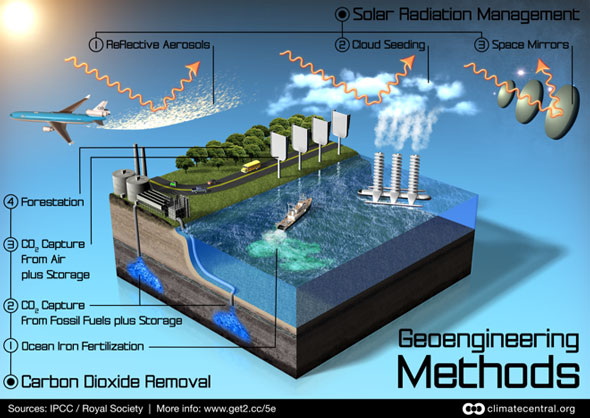
Geoengineering involves intentional, large-scale interventions in the Earth’s atmosphere, oceans, soils or living systems to influence the planet’s climate. Geoengineering is not a new idea. Speculation about it dates at least to 1908, when Swedish scientist Svente Arrhenius suggested that the carbon dioxide released from burning fossil fuels might help prevent the next ice age. Until recently, proposals for using geoengineering to counteract global warming have been viewed with extreme skepticism, but as projections concerning the impact of climate change have become more dire, a growing number of scientists have begun to argue that geoengineering deserves a second look.
Below are 10 of the major concerns about geoengineering that policymakers need to be aware of and give due consideration. These concerns apply mainly to solar radiation management (SRM), the form of geoengineering that attempts to cool the climate by reflecting a small amount of solar radiation back into space. SRM involves significantly higher risks than the other form of geoengineering, carbon dioxide removal (CDR) which involves removing carbon dioxide from the atmosphere and storing it in the ocean, plants, soil, or geological formations.- Unintended Negative Consequences: We may know too little about the Earth’s geophysical and ecological systems to be confident we can engineer the climate on a planetary scale without making an already bad situation even worse;
- Potential Ineffectiveness: Some proposed CDR methods are so weak that they would produce useful results only if sustained on a millennial timescale;
- Risk of Undermining Emissions-Mitigation Efforts: If politicians come to believe that geoengineering can provide a low-cost “tech fix” for climate change, it could provide a perfect excuse for backing off from efforts to shift away from fossil fuels;
- Risk of Sudden Catastrophic Warming: If geoengineering is used as a substitute for emissions reduction, allowing high concentrations of CO2 to build up in the atmosphere, it would create a situation where if the geoengineering ever faltered because of wars, economic depressions, terrorism or any other reasons during the millennium ahead, a catastrophic warming would occur too quickly for human society and vast numbers of plant and animal species to adapt;
- Equity Issues: Geoengineering efforts might succeed in countering the warming trend on a global scale, but at the same time cause droughts and famines in some regions;
- Difficulty of Reaching Agreement: It could be harder to reach global agreements on doing geoengineering than it is to reach agreements on reducing carbon emissions;
- Potential for Weaponization: Geoengineering research could lead to major advances in knowledge relevant for developing weather control as a military tool;
- Reduced Efficiency of Solar Energy: For every one percent reduction in solar radiation caused by the use of SRM geoengineering, the average output of concentrator solar systems that rely on direct sunlight will drop by four to five percent;
- Danger of Corporate Interests Overriding the Public Interest: Dangers include a lack of transparency in SRM technology development and the possibility that the drive for corporate profits could lead to inappropriate geoengineering deployments;
- Danger of Research Driving Inappropriate Deployment: Research programs have often created a community of researchers that functions as an interest group promoting the development of the technology that they are investigating.
Several of the best climate studies suggest that stabilizing the amount of carbon dioxide and other greenhouse gases below the level that risks dangerous climate change will require a social mobilization and technological transformation at a speed and scale that has few if any peacetime precedents. If correct, and the needed mobilization does not occur in the years immediately ahead, then decision makers later in the century could find themselves in a situation where geoengineering is the only recourse to truly dangerous climate change. The most fundamental argument for R&D; on geoengineering is that those decision makers should not be put in a position of either letting dangerous climate change occur or deploying poorly evaluated, untested technologies at scale. At the very least, we need to learn what approaches to avoid even if desperate.
Continue reading by downloading the full report from the Wilson Center.
Robert Olson is a Senior Fellow at the Institute for Alternative Futures. -
Backdraft: Minimizing Conflict in Climate Change Responses
›“What are the conflicts or risks associated with response to climate change?” asked ECSP Director Geoff Dabelko at the Wilson Center on July 18. “How we respond to climate change may or may not contribute to conflict,” he said, but “at the end of the day, we need to do no harm.”
-
Fixing the Sky: The Checkered History of Weather and Climate Control
›As geoengineering becomes a more politically and technologically appealing approach to addressing climate change, it is critical to heed the lessons of history and understand the limits of our control over nature, said James Fleming of Colby College. Speaking at the launch of his new book, Fixing the Sky: The Checkered History of Weather and Climate Control, at the Wilson Center on October 6, Fleming brought what he called a “historically informed view of the humanities” to a growing policy discussion: the possibility of using geoengineering as a “quick fix” for the problem of climate change.
Not So Ancient History
“When facing unprecedented challenges, it’s good to take a look at the precedents,” said Fleming. He pointed to recent weather management projects conducted in China, U.S. experiments in the 1940s, and older historical discussions about geoengineering as evidence of humanity’s long fascination with “fixing of the sky.”In 2008, “they had 30,000 Chinese artillerists shooting chemicals at the clouds to keep either the venues clear or get the rain down on the weekend before the Olympics started,” Fleming said. “And they’re still doing this kind of stuff. So now there’s inter-regional tensions in China, because imagine rains comes across the country, some places get hit some places get missed, there’s intermittent showers, but now every intermittent shower is seen as a managed event where ‘you took my rain away from my farmland.’ So as soon as you start managing the sky, you start fighting about it.”
In 1839, the United States’ first meteorologist, James Espy, proposed lighting regular fires along the Appalachians to induce rainfall on the eastern seaboard. “What if Espy’s idea actually worked?” asked Fleming. “It’d very much like that Chinese story today, where there’s internecine struggles between keeping and taking the rain away from others,” he said.
The Threat of Militarization
Fleming highlighted a number of fundamental ethical concerns raised by atmospheric scientist Alan Robock:
In 1947 Nobel Laureate Irving Langmuir, in conjunction with GE and the U.S. military, experimented with controlling Hurricane King by seeding it with dry ice. They expected the storm to continue its course off the coast of Florida into the Atlantic, but instead it veered west and hit Savannah, Georgia, causing considerable damage. The lesson, said Fleming, is that “you can intervene in a cloud, but you can’t point it downwind – you can’t tell it what to do.”- Who has the moral right to change the climate?
- Where would be the “global thermostat” be?
- Will it reduce incentives for mitigation?
- Could it be commercialized and/or militarized?
Other U.S. military research into geoengineering included researching the possibility of inducing west-to-east moving rain storms in Europe to help neutralize a Soviet invasion and using the magnetosphere to create selective blackouts over Moscow.
“Shall we fix the sky – is it broken?” asked Fleming. “And if it is broken should we have people with military hardware shooting at it?”
One possible institutional counter could be strengthening the UN Environmental Modification Convention (ENMOD), which Fleming said “has been revisited again twice, and could be revisited again if large-scale environmental modification were to get more serious – if there’s deployment of geoengineering techniques.” The treaty prohibits environmental modification “through the deliberate manipulation of natural processes – the dynamics, composition or structure of the Earth, including its biota, lithosphere, hydrosphere and atmosphere, or of outer space.”
The Once and Future Earth
The Greek myth of Phaeton illustrates how old, but also flawed, the human desire to control climate really is, said Fleming. In the myth, Phaeton convinces his father, Helios, to let him drive the sun’s chariot for a day. However, Phaeton falters, lacking the strength and experience to control the reins, and Zeus intervenes to save the world from immolation. “Take up Phaeton’s reins,” said Fleming, should be interpreted as “control your carbon emissions,” rather than trying to control the sky.
We should consider geoengineering to be only an “interesting hypothetical exercise,” said Fleming, until the consequences and results of such colossal tinkering can be better assessed. “Even perfect climate prediction would lead to climate chaos, because the country that could do that could trump its competitors” in various markets, he said. However, such predictions might never be possible, considering the difficulty in modeling cultural and ethical norms, as well as the geostrategic implications – in short, the human element.
Fleming cautioned against the fundamental belief that you can accurately model the impact of geoengineering projects, reminding would-be geoengineers that “you can only have one Earth to experiment on, you don’t have a lot drosophila Earths or laboratory rat-Earths – you only have one.”
Event Resources
Sources: NASA, Toronto Star, U.S. State Department.
Image Credit: Adapted from original by Craig Phillips for The Wilson Quarterly, reproduced with permission. -
Assessing Our Impact on the World’s Rivers
›In a special “Rivers in Crisis” issue of Nature, the lead article, “Global Threats to Human Water Security and River Biodiversity,” presents damning evidence that manipulation of river systems — through the construction of canals, levees, hydroelectric projects, and other infrastructure — has caused serious and lasting biological damage to watersheds throughout both the developing and developed worlds. The authors (all 11 of them!) report that key rivers have become shadows of their former selves in terms of the amount of aquatic life they can support. Without drastically improved stewardship of waterways, “we are pushing these river systems toward catastrophe,” warns Peter McIntyre, an article co-author.The human impact on the world’s river systems will be hard to reverse, says Margaret Palmer, author of a second Nature article on freshwater biodiversity loss, “Beyond Infrastructure.” Human-induced changes to watersheds affect local hydrology at a fundamental level, she contends, weakening rivers’ ability to deliver crucial “ecological goods and services” — such as clean water and nutrient-rich sediment loads — that help maintain the health of local environments and the human populations that depend on them. To fully understand the scope of the problem, Palmer says more research is needed to explore the linkages between biodiversity levels and “ecosystem services” that healthy rivers provide. -
Weather as a Weapon: The Troubling History of Geoengineering So Far
›September 27, 2010 // By Wilson Center StaffExcerpted from the original version of this article on Slate, by James Fleming.
Is there a technological fix for global warming? Where would we put a “planetary thermostat,” and who would control the settings? The long and tragicomic history of fixing the sky — of rainmakers, rain fakers, weather warriors, and climate engineers — indicates that such ideas are far-fetched. Dosing the stratosphere with sulfuric acid to turn the blue sky milky-white does not sound like a good idea. Neither does dumping an iron slurry into the oceans to fill them with algae and turn them soupy-green. A global forest of artificial trees? Storing massive amounts of carbon dioxide under our feet forever? A flotilla of ships pumping seawater into the clouds? Unlikely, unlikely, unlikely.
Global climate engineering is untested and untestable, and dangerous beyond belief. The famous mathematician and computer pioneer John von Neumann warned against it in 1955. Responding to U.S. fantasies about weaponizing the weather and Soviet proposals to modify the Arctic and rehydrate Siberia, he expressed concern over “rather fantastic effects” on a scale difficult to imagine and impossible to predict. Tinkering with the Earth’s heat budget or the atmosphere’s general circulation, he claimed, “will merge each nation’s affairs with those of every other more thoroughly than the threat of a nuclear or any other war may already have done.” In his opinion, attempts at weather and climate control could disrupt natural and social relations and produce forms of warfare as yet unimagined. It could alter the entire globe and shatter the existing political order.
Continue reading on Slate.
James Fleming is an environmental historian and Professor of Science, Technology, and Society at Colby College. ECSP and the Wilson Center will be hosting the launch of his new book, Fixing the Sky: The Checkered History of Weather and Climate Control, on October 6, 2010.
Photo Credit: Adapted from “Lever du jour,” courtesy of flickr user Solea20.
Showing posts from category climate engineering.