-
Christina Larson, Yale Environment 360
Gauging the Impact of Warming On Asia’s Life-Giving Monsoons
›August 21, 2012 // By Wilson Center Staff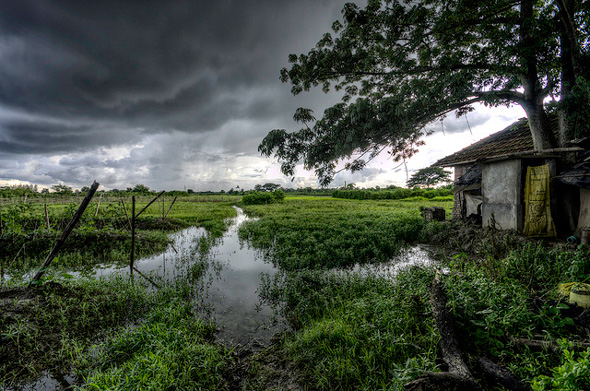
The original version of this article, by Christina Larson, appeared on Yale Environment 360.
Bouncing along bad roads in a jeep through central Mongolia, with bright blue skies and high clouds overhead, we drive for miles through a treeless landscape, passing only dry grasslands dotted with cattle and white yurts. But as we head north – myself, two U.S. scientists, and one Mongolian forestry expert – we begin to notice Siberian pine and larch growing on the northern slopes of rolling hills, but not the southern slopes, and at some elevations, but not others. In water-scarce Mongolia, as my travel companion Neil Pederson of Columbia University’s Lamont-Doherty Earth Observatory explained, the precarious growth of trees is limited by temperature and moisture availability; small variations – northern slopes are slightly cooler and wetter – can make all the difference.
-
Inside U.S. Climate Security Policy: Geoff Dabelko Interviewed by ISN
›August 20, 2012 // By Kate Diamond
Climate change “has been thought of in many quarters as something that affects folks ‘over there,’ and not as much domestically, and I think that’s a mistake,” said ECSP’s Geoff Dabelko in a recent podcast with the Zurich-based International Relations and Security Network. “I think folks are coming to a realization that there are very high economic, political, and ultimately security stakes for the United States.”
-
U.S. Drought, Climate Change Could Lead to Global Food Riots, Political Instability
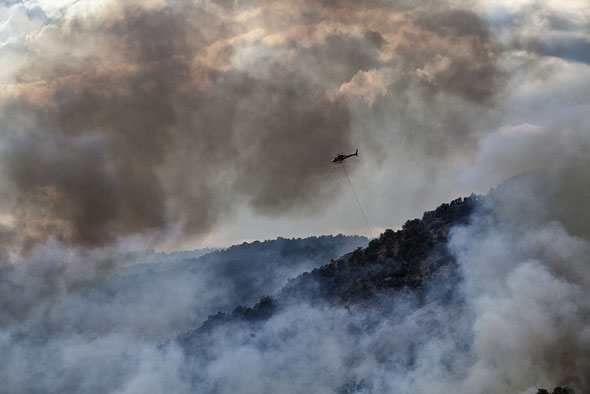
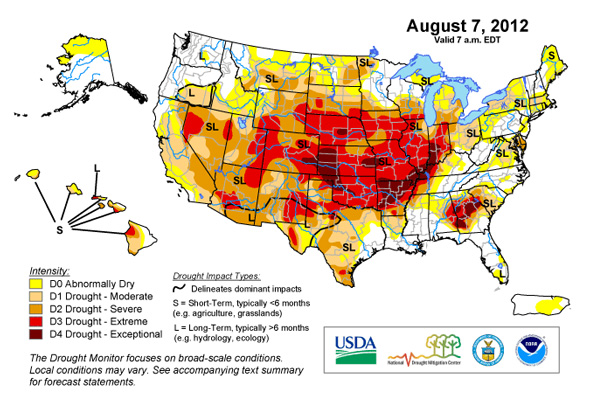
›August 15, 2012 // By Graham NorwoodIt’s been a difficult year for U.S. agriculture. Record high temperatures and the country’s worst drought since 1956 have combined to decimate crops across the nation, and some forecasters are predicting more heat and dryness in the months ahead. Things have been so bad that many experts fear a recurrence of the food riots and instability that shook the world in 2007-8, and again in 2010-11. Others point to this year’s unusual weather in the United States and elsewhere as a harbinger of how climate change might impact humanity in the 21st century.
Things started out well enough earlier this year, as America’s farmers took advantage of the warmest March weather on record by planting the largest corn crop in 75 years. As late as May 10, the USDA was projecting that previous corn production and yield records would be shattered. “We’re looking at the potential for just a true bin-buster of a crop [this year],” grain expert and Iowa State University economics professor Chad Hart told The Huffington Post at the time. “There’s going to be a lot of corn flying around here.”
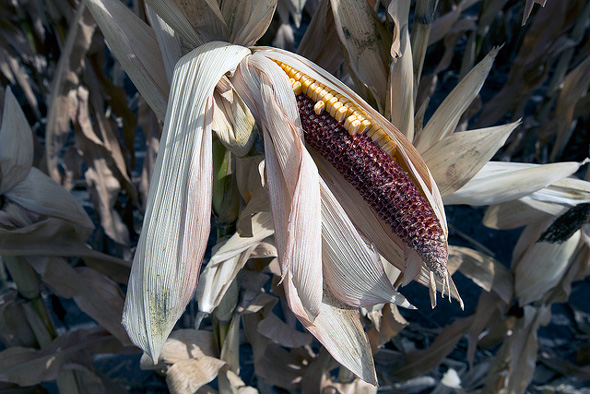
But those predictions came before a historic drought descended upon the country’s heartland, accompanied by soaring summer temperatures. In July, the USDA slashed its estimate for corn production by 12 percent, the largest such adjustment in a quarter century. The organization released an even bleaker update last Friday. Meanwhile, many commodity traders, believing the worst may still be yet to come, have reduced their own projections even further. Soybeans, which are frequently intercropped with corn, have also struggled with this summer’s conditions.
As optimism for the corn and soybean harvests has faded, commodity prices have surged. Corn futures have reached record highs, and soybeans have also seen dramatic price increases. Both commodities have now surpassed their peaks from the 2007-8 crisis that led to riots in more than two dozen countries across the world.
Even wheat, which is primarily a winter crop, has experienced a price increase of about 50 percent over the past two months. “If the price of corn rises high enough, it also pulls up the price of wheat,” Robert Thompson, a food security expert at the Chicago Council on Global Affairs, told The Guardian. Wheat has not yet outpaced its high from the 2007-8 crisis, but it is trading higher than after the Russian wheat export ban that helped lead to another crisis in 2010-11 (and ultimately, some analysts say, to the Arab Spring).
Crisis Catalysts Beyond the U.S. Drought
The United States is vital to the global food market, being the world’s largest exporter of corn, soybeans, and wheat. However, several other key grain-producing regions have been affected by abnormal weather this year as well.
Summer heat waves in southern Europe have adversely impacted corn crops from Italy to Ukraine – a region that produces 16 percent of the world’s exports, according to Bloomberg. Below average rainfalls in parts of South America and Australia threaten other strategically important production areas.
And that’s not all. Spain suffered its worst drought in 70 years this past winter, leading analysts to reduce projections for Europe’s wheat crop. Flooding in Japan, India and Bangladesh has jeopardized rice crops. And an unusually cold winter in the Himalayas has dramatically slowed glacial melting, leaving farmers to cope with a greatly reduced Indus River and as much as an 80 percent reduction in available water for irrigation.
Add to all this the fact that world grain stocks are reportedly headed for a five-year low, and it isn’t difficult to see why there is such concern about the global food market.
Causes for Concern
Rising grain prices are expected to lift overall food costs throughout the world over the next six months. That spike is unlikely to have much of an impact in the United States, where consumers spend on average just 13 percent of their household budgets on food. However, in less developed countries – where the portion of household income used for purchasing food is often 50 percent or higher – there is cause for concern that a new round of food riots may be in the offing.
Kaitlin Shilling on climate conflict and export crops in sub-Saharan Africa “Large numbers of people live very close to the edge,” Save the Children’s Justin Forsyth recently told The Financial Times. “Failed rains and high food prices have tipped lots of people over the edge from being able to cope to not being able to cope.”
“Based on my research on the natural disasters-food prices-social unrest nexus, I think we will observe increased social unrest in the next 6 to 12 months,” warned Duke University professor and agricultural economist Marc Bellemare in an email exchange, stressing the distinction between social unrest (i.e., food riots) and civil war or intra-state conflict.
“The similarity between now, 2007-8, and 2010-11 is that they are all episodes of high food prices caused by a series of natural disasters,” he continued. “The difference is that this time around, the natural disasters in question – episodes of extreme temperature and drought – are taking place in our backyard instead of halfway around the world, which makes this all the more salient in American minds.”
Some Reasons for Optimism
Still, there are a number of reasons to believe the present situation will not lead to the kind of instability and conflict that characterized the last two food crises. One key difference between 2007-8 and today’s situation is the price of oil.
In July of 2008, oil rushed to an all-time high of $147 per barrel; today, it’s around $90 a barrel. This means that consumers can buy relatively more food now than in 2008, making food riots less likely.
Moreover, any reduction in the possibility of riots and other political instability has a multiplying effect, according to a recent Chatham House article:
And because riots are less likely, governments are less inclined to impose export controls, reducing the chance of a collapse in confidence, as one country after another bans exports, pushing up international prices further and encouraging others to do the same. This dynamic was a major factor in both the 2007-8 crisis and the 2010-11 spike.
Perhaps most important of all is the fact that the crops in the worst shape this year – chiefly corn and soybeans – are less fundamental to the diets of many in the less developed world than rice or wheat. “[Rice] is very important for [the] food security of millions of people around the world,” Abdolreza Abbassian, senior economist and grain expert at the FAO, recently told Reuters. “We do not see any production or supply problems with rice.”
Meanwhile, USDA Chief Economist Joseph Glauber has downplayed fears of an imminent food crisis because of a relative abundance of wheat. “Prices are higher [right now], and there’s no question about that, but we really had an extreme shortage of wheat in 2007-2008 and I don’t see that at this point,” he recently told The Financial Times.
Unlike rice and wheat, corn is seldom consumed directly. Rather, it is far more commonly used for ethanol production (roughly 40 percent of the U.S. corn crop is used to produce biofuels), food processing, and especially animal feed. This means that a rise in corn prices won’t have as direct and deleterious effect on people in the developing world as did the acute rice and wheat shortages that triggered previous crises. Higher corn prices will certainly increase the costs of meat and dairy products, processed foods, and other comestibles, but these price increases are unlikely to have much of an effect in less developed countries, where such products are seldom prominent in the daily diet.
“[This] is a serious situation which has to be monitored closely, but it is too early to refer to it as a food crisis situation,” said Abbassian.
The Role of Climate Change
Whether or not this summer’s troubles blossom into the kinds of food riots and political instability seen in previous food crises remains an open question, but there is another unresolved issue with even greater potential long-term impact. With so many extreme weather events playing a role in this year’s high prices, many are wondering: To what extent is climate change a factor? And what might continued warming and increased CO2 mean for the long-term prospects of global food security? Are this summer’s stifling conditions “the new normal,” as the blog G-FEED has asked here and here?
One of the most significant recent developments in climate research is that scientists have begun linking individual extreme weather events to anthropogenic climate change. A groundbreaking 2011 study by the National Oceanic and Atmospheric Association, the UK Met Office, and others explained:
In the past it was often stated that it simply was not possible to make an attribution statement about an individual weather or climate event. However, scientific thinking on this issue has moved on and now it is widely accepted that attribution statements about individual weather or climate events are possible, provided proper account is taken of the probabilistic nature of attribution.
The report goes on to apply this principal to several extreme weather events from last year, including a devastating drought in Texas it claims was made 20 times more likely to occur by man-made climate change.
While no such study has yet examined the 2012 U.S. drought or other recent extreme weather events, most scientists believe that climate change is playing at least some role in this year’s freak weather episodes. “I think what we’re seeing is largely a naturally occurring event [influenced by La Niña weather patterns], but it’s occurring against the background of a warming environment,” Richard Seager, a professor and drought specialist at Columbia University’s Lamont-Doherty Earth Observatory, told Climate Central.
The idea of naturally occurring droughts playing out across a backdrop of global warming is a sobering one, because of the unique interactions between precipitation and hot weather. One timely study published last month describes how dry conditions increase the likelihood of abnormally hot weather: During droughts, less of the sun’s heat energy is used to evaporate moisture in vegetation and the soil, meaning that more energy can go into heating the air directly. Thus, “the occurrence probability of an above-average number of hot days is high after dry conditions and low after wet conditions.”
The study suggested that this phenomenon played an important role in exacerbating the 2011 Texas drought. Moreover, lead author Brigitte Mueller noted in an email conversation with Climate Central that precipitation in the 2012 U.S. drought was within the range where the drought/heat feedback would be expected to occur, “which implies an even higher likelihood for an above-average [number of hot days] to occur.”
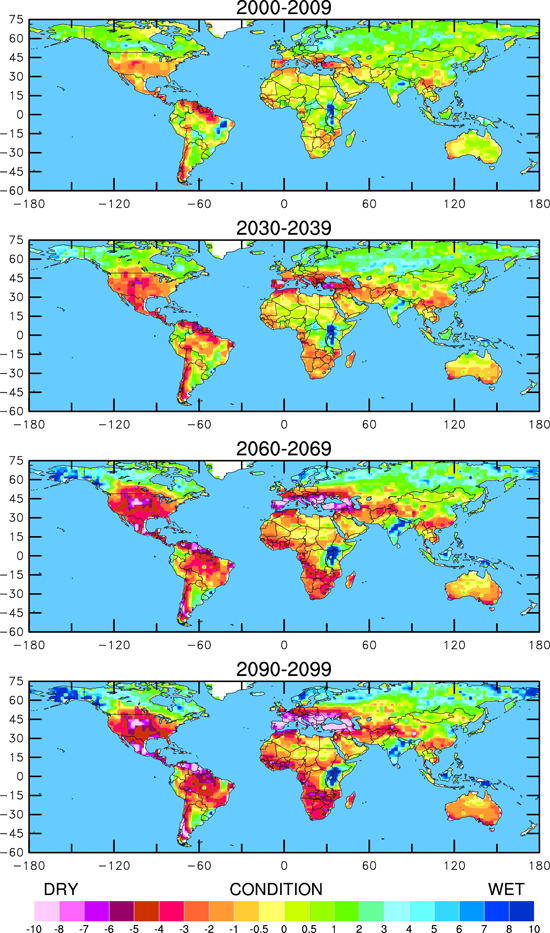
With the planet expected to continue warming due to increasing levels of greenhouse gases in the atmosphere, and with reports from IPCC and National Center for Atmospheric Research predicting increasingly frequent droughts in the decades ahead, the heat/drought feedback loop is still more bad news for a global agricultural sector already tasked with the formidable job of feeding a world population expected to reach nine billion by mid-century.
Research on the effects that heat and drought have on crop yields and food production is beginning to emerge. One recent paper conservatively estimated that U.S. farm production could drop 4 to 13 percent over the next two decades or so. Another study, which considered “worst-case scenarios,” projected that average U.S. crop yields could plummet 63 to 82 percent by the end of the century if global warming is particularly rapid.
Such an outcome would necessitate fundamental changes in how the world is fed, and would obviously make global food security an issue of paramount importance. Even in the present, however, it seems clear that climate change is already an integral part of the food security issue. This summer’s freakish weather, in the United States and elsewhere around the globe, has brought the world closer to another round of food riots and political instability.
Although there are reasons to be optimistic that such a crisis may yet be averted in the short term, it appears that maintaining and improving global food security will remain a major challenge into the foreseeable future.
Sources: Bloomberg, Chatham House, Climate Central, The Financial Times, The Guardian, The Huffington Post, National Oceanic & Atmospheric Association, Proceedings of the National Academy of Sciences, Resources for the Future, Reuters, USDA.
Map Credit: U.S. Drought Monitor, courtesy of Mark Svoboda/National Drought Mitigation Center. Drought stricken corn on a farm in Iowa, which President Barack Obama and Agriculture Secretary Tom Vilsack visited on Monday, courtesy of the USDA. Future drought conditions, courtesy of Aiguo Dai/Wiley Interdisciplinary Reviews.
-
Family Planning Saves Lives, Can Help Mitigate Effects of Climate Change
›Contraceptives prevented an estimated 272,040 maternal deaths in 2008, reducing worldwide maternal mortality by 44 percent, according to a recent paper by Saifuddin Ahmed, Qingfeng Li, Li Liu, and Amy O. Tsui, published in The Lancet. But the prevention of maternal deaths could have been even higher. The study, “Maternal Deaths Averted by Contraceptive Use: An Analysis of 172 Countries,” estimates that an additional 104,000 maternal deaths – many occurring in developing parts of Africa and South Asia – could have been averted simply by satisfying existing unmet need for contraception. In sub-Saharan Africa, for example, only 22 percent of women who are married or sexually active use contraception – a far cry from the 65 percent which the study suggests is the point at which maternal deaths avoided by contraceptive use begin to plateau. Not surprisingly, this has also yielded some of the highest regional fertility rates in the world.
Such high fertility rates are driving growing concerns about scarcity and capacity in the region, and how climate change might exacerbate already-difficult development hurdles. This nexus of issues was the subject of a recent policy brief by Population Action International and the African Institute for Development Policy, titled Population, Climate Change, and Sustainable Development in Africa. The brief points out that “a large share of Africa’s population lives in areas susceptible to climate variation and extreme weather events,” and that there is an inherent tension the continent faces as it seeks to balance high population growth with climate change-induced reductions in the availability of natural resources, like water and arable land. The authors urge policymakers, rather than focusing on environment, population, and health individually, to “connect population dynamics and climate change” to address their interlinked challenges together.
-
Population and Sustainability in an Unequal World
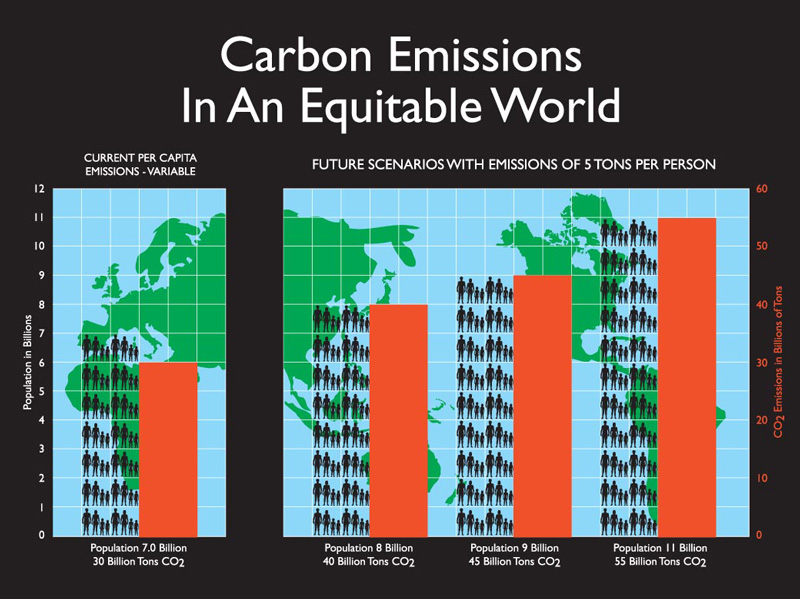
›August 13, 2012 // By Laurie MazurJune’s Rio + 20 Conference on Sustainable Development left environmentalists little to cheer about. Kumi Naidoo, executive director of Greenpeace International, called the meeting “a failure of epic proportions.” And Washington Post reporter Juliet Eilperin said the conference “may produce one lasting legacy: convincing people it’s not worth holding global summits.”
-
Three UN Millennium Development Targets Reached and a Review of the Human Drivers of Climate Change
›“It is plausible that key transitions in human evolutionary history have been driven in large part by climate change,” write Eugene A. Rosa and Thomas Dietz in “Human Drivers of National Greenhouse-Gas Emissions,” a literature review published by Nature Climate Change. “Changes in climate will doubtless be a key force in the future evolution of social systems, including all aspects of social, economic, and political life, while impinging on the health and well-being of the individuals who populate them.” Rosa and Dietz cite numerous studies to argue that nearly every facet of society will be affected by climate change. “The critical point,” they write, “is that population, affluence, technology, and all other drivers act not alone or additively but in a multiplicative fashion.” For example, rapid population growth can lead to an increase in urbanization, which generates “substantial demand for goods and services that can induce emissions in distant places.” They conclude that huge changes must be made in technology and consumption in order to combat the effects of climate change that are being caused by a growing population and an increasingly affluent world.The United Nations’ 2012 Millennium Development Goals Report, released last month in New York City, announces that three of the eight major human development goals have been reached ahead of their 2015 targets. The Millennium Development Goals, set at a conference in 2000, were established to “uphold the principles of human dignity, equality, and equity at a global level.” The 2012 report indicates that the number of people living in extreme poverty has been halved since 1990; the proportion of people in the world without sustainable access to safe drinking water has also been halved; and more than 200 million slum dwellers have “gained access to either improved water sources, improved sanitation facilities, or durable or less crowded housing.” At the report launch, UN Secretary-General Ban Ki-moon noted that “these results represent a tremendous reduction in human suffering and are a clear validation of the approach embodied in the MDGs, but they are not a reason to relax.” Goals that have yet to be achieved include universal primary education; gender equality; reduced child mortality and improved maternal health; reducing rates of diseases such as HIV and malaria; and creating a global partnership for development.
Keenan Dillard is a cadet at the United States Military Academy at West Point and an intern with the Woodrow Wilson Center’s Environmental Change and Security Program. -
Is This What Climate Change Feels Like? Geoff Dabelko on ‘CONTEXT’
›“I think that the conditions that we’re experience now are ones that track with what we expect to see more of; so dry places getting drier, wet places getting wetter, and more extremes in terms of variability of the weather,” said ECSP Director Geoff Dabelko in the latest installment of CONTEXT, a weekly Wilson Center interview series. While it’s difficult to link the current drought – or any one weather or climate event – directly to man-made climate change, Dabelko said that “the warming trends that we’re seeing and anticipating with climate change suggests that this is a preview of what may be to come.”
-
From Youth Bulge to Food and Family Planning, Los Angeles Times’ ‘Beyond 7 Billion’ Series Synthesizes Population Challenges
›Over the next 40 years, the world is set to add 2.3 billion people. Millions more will join the middle class, pushing consumption upwards and further straining the world’s natural resources. Variables like climate change and political instability will exacerbate that strain and complicate efforts to bolster peaceful and stable development. Los Angeles Times correspondent Kenneth Weiss and photographer Rick Loomis examine these numerous and interconnected challenges in a five-part series on population growth and consumption dynamics.
Speaking to demographic and health experts (including a number of New Security Beat regulars, like Richard Cincotta, Jon Foley, and Dr. Joan Castro), Weiss provides a thorough, astute, and compelling assessment of population dynamics in a rapidly changing world. The series starts with a basic introduction to population, climate, and consumption dynamics and progresses through to discuss political demography, global food security, and detailed looks at two important case studies, China and the Philippines.
Part One: A Population Primer
Population growth alone poses a number of challenges as cities become more crowded and demand for basic resources like water and food outpaces supply. Climate change and the unpredictable and sometimes extreme weather that is its hallmark “will make all of these challenges more daunting,” writes Weiss. And “population will rise most rapidly in places least able to handle it.” Africa, the Middle East, and South Asia, already expected to bear the brunt of climate change with rising sea levels, shorter growing seasons, and increasingly variable weather patterns, will also have to support the bulk of the world’s population growth by mid-century. Populations in Europe, North America, and East Asia are expected to stay stable or decline in numbers.
The magnitude of growth in Africa, the Middle East, and South Asia, however, is uncertain. What happens from here “hinges on the cumulative decisions of hundreds of millions of young people around the globe,” Weiss writes. And yet, “population growth has all but vanished from public discourse.” Family planning in particular remains hamstrung by “erratic funding and unpredictable crosscurrents.” The result, he writes, is that even “under the best conditions, it’s hard to get contraceptives into the hands of impoverished women who want them.”
Part Two: The Arc of Instability
Drawing on work from demographer Richard Cincotta, George Mason University’s Jack Goldstone, Population Action International, and others, part two of Weiss’ series examines youth bulges and the so-called “arc of instability,” stretching across the disproportionately youthful countries of Africa, the Middle East, and South Asia.
When a large youth population is mixed with other societal conditions, like “religious and ethnic friction, political rivalries, economic disparities, or food shortages,” youth can be “the kindling” for a spark that ignites simmering tensions, writes Weiss. Afghanistan is a case in point, where unemployed young men are often turning to the Taliban not out of extremist fervor, but out of a desperate need to support themselves and their families. “It’s too hard to employ this many people and too easy to recruit them into violence,” Cincotta told Weiss.
And Afghanistan is just the beginning, according to Goldstone. “We are literally going to see one billion young people come into the populations in the arc of instability over the next two decades,” he said. “We can’t fight them. We have to figure a better way to help them.”
Part Three: Feeding a Growing Population
As the world’s population continues to grow, and as more families join the middle class, world food production will have to double by mid-century in order to meet future demand. “What that actually means,” says World Wildlife Fund’s Jason Clay, an agriculture specialist, “is that in the next 40 years we need to produce as much food as we have in the last 8,000.”Jon Foley on how to feed nine billion and keep the planet
Weiss presents the Horn of Africa and Punjab as microcosms of the problems facing global food production in the 21st century. Desertification and urbanization are eating away at potential cropland, while harmful farming techniques leech essential nutrients from soil, rendering it useless for future use. Insufficient infrastructure means that food spoils as it’s shipped from where it’s produced to where it’s needed, while extreme and widespread poverty means that those most in need can’t afford enough to feed their families.
Stuck between growing demand and restricted supply, the University of Minnesota’s Jonathan Foley said the challenge of the century is straightforward: “How will we feed nine billion people without destroying the planet?”
Part Four: Population and Consumption in China
China has “a greater collective appetite – and a greater ecological impact – than any other country,” writes Weiss, making it a prime example of “how rising consumption and even modest rates of population growth magnify each other’s impact on the planet.”
The country’s one-child policy slowed population growth rapidly, cutting fertility almost in half in less than a decade. Over time, a large working-age cohort with few dependents emerged, and helped China reap a demographic dividend. The resulting economic prosperity has come at a cost, however, as rising incomes and increasing consumption, spread across 1.3 billion people, have wreaked havoc on the country’s environment on a scale not seen anywhere else in the world.
Because of that scale, what happens in China will have global repercussions. Climate scientists “say that in order to avoid a potentially catastrophic rise in global temperatures, worldwide carbon dioxide emissions must be cut in half by 2050,” Weiss writes. “For that to happen, China’s emissions would have to peak by 2020” – 15 years earlier than official government projections. The government remains opposed to further limits on emissions, arguing that such limits would “cripple” economic growth – an unfair impediment considering that developed countries were able to “pollute their way to prosperity, their argument goes.”
Part Five: Family Planning in the Philippines
Weiss ends the series with an in-depth look at family planning in the Philippines – a country at the forefront of the global debate over access to contraception. Lawmakers in the 80-percent-Catholic country have steadfastly refused to fund family planning services, while support from the international community all but vanished when USAID, “the major donor of contraceptives to the Philippines,” said in 2008 that it would end its contraceptive program.
Today, half of all pregnancies in the Philippines are unintended. Lawmakers are considering a “reproductive health bill…call[ing] for public education about contraceptives and government subsidies to make them available to everyone,” but a powerful opposition, including Church leadership, has stalled the bill for 14 years, Weiss writes.Joan Castro on population-environment programing in the Philippines
Public officials, including the former Manila mayor who ended the city’s contraceptive program 12 years ago, portray unbridled population growth as an economic asset, saying that “when you have more people, you have a bigger labor force.” For the millions of Filipinos who live in poverty, however, the lack of affordable family planning services leaves them with little control over family size and puts the Philippines on track to grow from 96.4 million people today to 154.9 million by mid-century. At that rate, the Philippines would be Asia’s third fastest growing country, behind Timor Leste and Afghanistan.
Not everything in the series is dire – there are side columns highlighting population, health, and environment programming in Uganda, Iran’s successful family planning program, and Dr. Joan Castro’s family planning and marine conservation work in the Philippines. But Weiss is not naïve about the challenges ahead. Under any of the United Nation’s population projections, “living conditions are likely to be bleak for much of humanity,” he writes. “Water, food, and arable land will be more scarce, cities more crowded, and hunger more widespread.”
“Even under optimistic assumptions, the toll on people and the planet will be severe.”
But while the population challenges facing the world are many, Weiss, like many before him, makes one argument clear: providing family planning services to the 222 million women who want to control the number of children they have but cannot would go a long way towards minimizing future strain.
Be sure to check out the photo and video features accompanying the “Beyond 7 Billion” series on the feature site.
Note: The sentence beginning with “When a large youth population…” was corrected.
Sources: Los Angeles Times, UN Population Division.
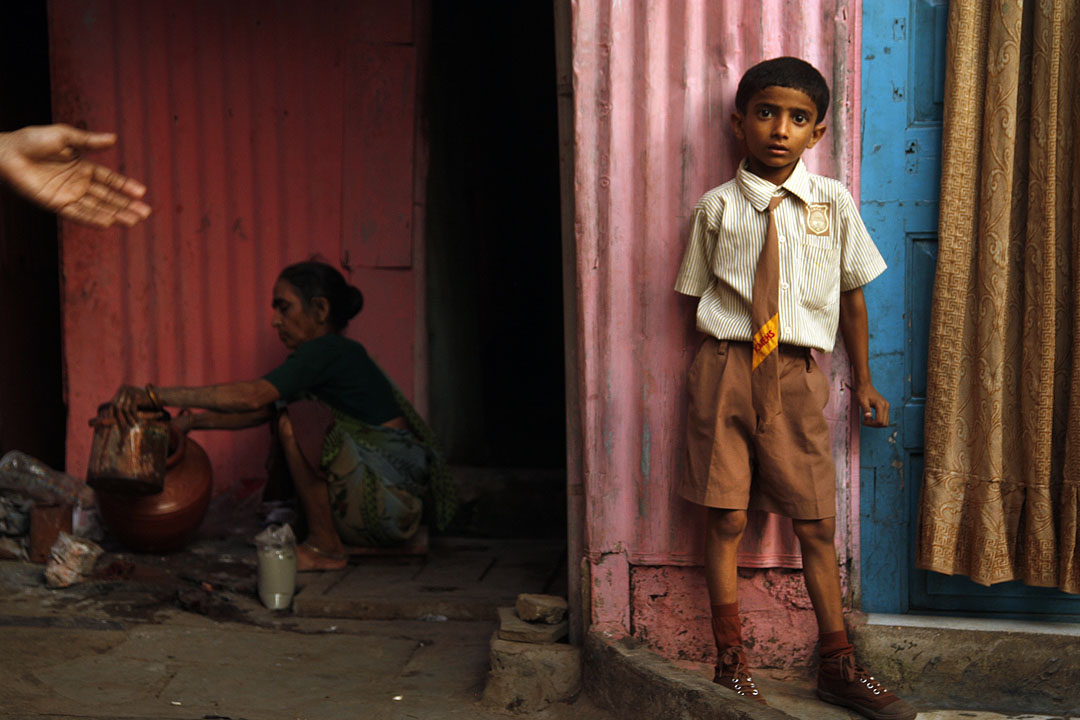
Video Credit: “The Challenge Ahead,” used with permission courtesy of the Los Angeles Times; Photo: “Dharavi,” used with permission courtesy of Rick Loomis/Los Angeles Times; Jon Foley video: TEDx.
Showing posts from category climate change.