-
ECSP Weekly Watch | September 16 – 20
›
A window into what we’re reading at the Wilson Center’s Environmental Change and Security Program
COP29-Host Azerbaijan Accused of Hypocrisy (The Guardian)
Azerbaijan holds the presidency for the upcoming COP29 in November 2024, and it is using that platform to call for all member states to cease any ongoing conflict they are involved in during the two-week conference. The Central Asian country will also host a “peace day” on November 15, and is putting forth a COP29 Climate and Peace Initiative to support vulnerable countries and advance action in the climate and peace nexus.
-
War and Climate Change Intensify Global Water-related Conflicts
›
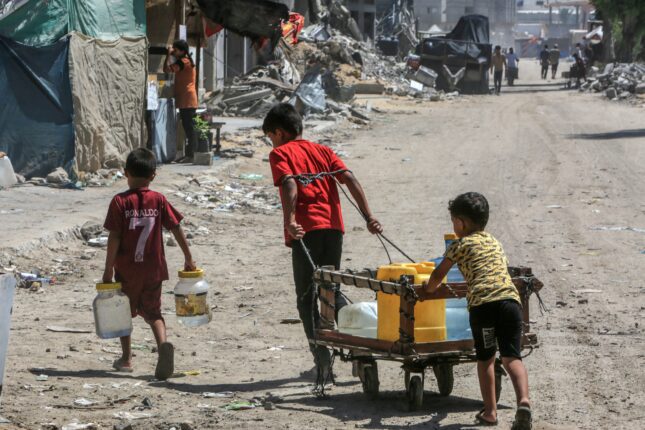
The Pacific Institute recently updated its Water Conflict Chronology—a database of water-conflict events that began to take form in the 1980s. The recent updates include the addition of 300 new entries to the database, highlighting the alarming rise of water-related conflicts in the last few years. Despite this overwhelming evidence of a growing trend in water-related conflicts, global attention toward addressing them remains negligible.
-
ECSP Weekly Watch | September 9 – 13
›A window into what we’re reading at the Wilson Center’s Environmental Change and Security Program
Fukushima Nuclear Clean-up Begins (The Diplomat)
It has been over 13 years since a massive 9.0 earthquake near the coastline of Japan in 2011 triggered a tsunami that irreversibly damaged the Fukushima Daiichi nuclear plant. Failing cooling systems within the plant led to the melting of its radioactive core reactor, which dripped toxic fallout across the plant and in the larger ecosystem. Since that catastrophe, Japan has been devising ways to responsibly clean the waste in Fukushima—and it might be getting closer to a final answer.
-
The Arc | Climate Justice in the Arctic: Part 2
›In today’s episode of The Arc, ECSP’s Claire Doyle and Angus Soderberg interview Dr. Benno Fladvad, Junior Professor for Natural Science Peace Research with a focus on Climate and Security at the University of Hamburg. Dr. Fladvad unpacks the potential environmental justice issues that arise as renewable energy deployment across the globe accelerates. Additionally, he also describes the challenges of balancing the demand for rapid decarbonization with equity and justice considerations, drawing on examples from the Saami communities’ experience with green hydrogen and wind development. We also glean Dr. Fladvad’s insights into how energy projects can move beyond ineffective consultation processes toward peacebuilding and justice for marginalized communities. Select quotes from the interview are featured below. -
ECSP Weekly Watch | September 3 – 6
›A window into what we’re reading at the Wilson Center’s Environmental Change and Security Program
Proliferation of Icebreakers in the Arctic (Foreign Policy)
As climate change-induced melting of ice sheets clears new pathways, the fast-melting Arctic now has a new strategic race: icebreakers. Russia covers over half of what is defined as “Arctic” territory, and it has the largest number of icebreakers in the region. Russia’s attempt to consolidate and expand has led the US and its NATO allies to redefine their own Arctic security strategy.
-
Climate Security in South Sudan: A Conversation with Ratia Tekenet
›In today’s episode of New Security Broadcast, ECSP Director Lauren Risi interviews Ratia Tekenet, a Climate Security Expert with the UN Mission in South Sudan (UNMISS) and a former ECSP staff member. In their conversation, Ratia explores how climate change is intensifying South Sudan’s security challenges, creating an immense humanitarian crisis. She also discusses the efforts of UN agencies, the South Sudanese government, and local communities to build resilience and respond to ongoing climate disasters, as well as the need for greater integration of the humanitarian-development-peace (HDP) nexus. Select quotes from the interview are featured below. -
ECSP Weekly Watch | August 26 – 30
›A window into what we are reading at the Wilson Center’s Environmental Change and Security ProgramWorld Food Program Faces Scrutiny Over Fraud in Sudan (Reuters)
As Sudan suffers an immense humanitarian crisis due to an ongoing internal conflict between the Army Forces and the paramilitary Rapid Support Forces (RSF), the U.N. World Food Program (WFP) has provided crucial aid to people displaced by the conflict. Yet its ability to continue this crucial work is now under threat because of allegations of illicit activities made against its top officials in that country. These developments have drawn the attention of humanitarian practitioners and diplomats—who also have concerns regarding WFP’s mismanagement and how it might have contributed to the failure to deliver enough aid in Sudan.
-
ECSP Weekly Watch | August 19 – 23
›A window into what we are reading at the Wilson Center’s Environmental Change and Security Program
What’s Next for the Teesta Water Disputes? (The Hindu)
The recent political upheaval in Bangladesh which led to the resignation of Prime Minister Sheikh Hasina and the return of Nobel Peace Prize laureate Muhammed Yunus as leader of an interim government is not the only tumult in this nation. A worsening trend in weather events there has heightened Bangladesh’s exposure to climate shocks and allowed a dispute over the Teesta River to reemerge.
Showing posts from category climate change.
 In today’s episode of
  In today’s episode of New Security Broadcast, ECSP Director Lauren Risi interviews Ratia Tekenet, a Climate Security Expert with the UN Mission in South Sudan (UNMISS) and a former ECSP staff member. In their conversation, Ratia explores how climate change is intensifying South Sudan’s security challenges, creating an immense humanitarian crisis. She also discusses the efforts of UN agencies, the South Sudanese government, and local communities to build resilience and respond to ongoing climate disasters, as well as the need for greater integration of the humanitarian-development-peace (HDP) nexus. Select quotes from the interview are featured below.