Showing posts from category *Blog Columns.
-
PHE and Community-Based Adaptation to Climate Change: Stronger Together
›
Over the past several years, community-based adaptation has emerged alongside national and regional climate change initiatives as a strategic, localized approach to building resilience and adaptive capacity in areas vulnerable to climate change.
-
Re-Thinking Price Shocks and Conflict?
›“Conflict, Food Price Shocks, and Food Insecurity: The Experience of Afghan Households,” a paper prepared for presentation at the Agricultural and Applied Economics Association’s annual meeting, examines the relationship between conflict and food prices, using Afghanistan during the 2008 global food crisis as a case study. By examining per capita food intake, numbers of fatalities and injuries, and the number of violent incidents in a given area, authors Anna D’Souza and Dean Jolliffe, of the U.S. Department of Agriculture and World Bank, respectively, determine that “at least in the case of Afghanistan, conflict does not seem to be the predominant driver of food insecurity.” Instead, inhabitants of conflict-prone regions, namely southern Afghanistan, consume more food, on the whole, than their northern compatriots. Residents of conflict areas do seem to be more affected by major food price increases, however these are fairly uncommon. D’Souza and Jolliffe speculate that this may be due to “interruptions in market access, inability to trade and barter, and worse food production and distribution systems.” These findings may be somewhat counterintuitive, but are an important resource for those seeking to reduce food insecurity in both conflict-prone and peaceful regions.In a working paper for the Center of Global Development, Samuel Bazzi and Christopher Blattman upend much of the established thinking on the relationship between commodity prices and conflict onset. Past researchers have found that lower prices of agricultural commodities lead to conflict as civilians have less to lose by rebelling against the government, and higher prices of resources like oil and minerals can lead to conflict as rebel groups have greater incentive to seize control. Contrary to these explanations, however, Bazzi and Blattman find “no evidence of a consistent, robust relationship between commodity price shocks and political instability.” Even when examining states with higher risks of conflict, like those which are particularly fragile, ethnically polarized, economically unequal, especially poor, and/or located in sub-Saharan Africa, they find no correlation between price shocks and conflict. The only evidence of a relationship they find is that rising prices lead to rising incomes, which can hasten the end of a conflict, but even this correlation is weak and varies from state to state. Though currently only a working paper, Bazzi and Blattman’s research provides an intriguing counter-narrative: “We argue that errors and publication bias have likely distorted the theoretical and empirical literature on political instability,” they write. -
Family Planning and Results-Based Financing Initiatives
›“Family planning means healthier moms and kids – and it’s good for development too,” said Lindsay Morgan, a senior health analyst at Broad Branch Associates, a healthcare advocacy group. But any number of hurdles can keep women from accessing family planning services. Morgan spoke at a May 21 discussion about results-based financing (RBF) programs, which aim to address hurdles on both the supply and demand sides of the equation in developing countries by incentivizing the provision of a variety of quality services while removing barriers to access for women in need of those services.
Removing Barriers to Providing and Using Family Planning Services
Incentives in RBF programs can come in a variety of forms – like subsidies or fees paid to clinics or vouchers sold to women, said Morgan. In Burundi, for example, under a pilot program rolled out across three provinces in 2006, health facilities receive payments for each patient that uses a modern method of contraception. In 2009, the government and international partners began scaling up the program to a nationwide level. In addition to expanding the program’s geographic reach, the scale-up incorporated new payment criteria to better incentivize quality of care (as opposed to just quantity) and longer-lasting methods of contraception.
Since the RBF pilot began, maternal and child health indicators have improved. The number of children being fully immunized is up, as is contraceptive prevalence, said Morgan. Additionally, those immediate results can lead to a slew of additional benefits down the line. For instance, improving modern contraceptive prevalence is one of the most cost-effective interventions available for reducing maternal death, she said.
In nearby Kenya, the health ministry leads a voucher system across four districts and two Nairobi slums to help some of the country’s poorest women afford maternal healthcare, family planning, and gender-based violence services.
The program is “written into large policy documents [and] strategic pieces,” including Vision 2030, a long-term government-wide strategy document “unveiled in 2008 as a way to reach middle-income country status by 2030,” said Ben Bellows, a reproductive health associate at Population Council Kenya. The government’s emphasis on the voucher program as more than just a health initiative is an acknowledgment of the downstream impact that improved maternal and reproductive health can have on the country’s development, he said.
“An Equity Gap in Family Planning”
However, the fact that the voucher program is needed at all is evidence of “an equity gap in family planning,” Bellows said. Access to family planning services can be significantly skewed depending on a woman’s income level, he said, pointing to a recent article in The Lancet assessing health inequalities in 12 different maternal and child health services across 54 priority Millennium Development Goal countries.
The equity gap reflects “an interesting problem with development,” said Bellows: Though low-income countries are converging with higher income countries, in terms of economic growth rates and income levels “the benefits of growth aren’t being evenly distributed.” The Africa Progress Panel’s annual report, released last month, echoes that point, he said.
“Governments are failing to convert the rising tide of wealth into opportunities for their most marginalized citizens,” the report concludes, and “unequal access to health, education, water and sanitation is reinforcing wider inequalities.”
Kenya’s voucher system is designed to help shrink that gap. Among the poorest of the poor – those benefitting from the system – inequalities are dropping, even if on a broader scale, inequity still exists between poor and wealthy Kenyans. “We’re seeing lower inequalities of service in areas exposed to the voucher,” said Bellows.
“RBF supports progress on a path towards universal health coverage,” said Beverly Johnston, the senior policy advisor at USAID’s Office of Population and Reproductive Health. And within the context of family planning “the whole idea is to level the playing field” so that all contraceptive methods are equally readily available to the women seeking them.
“A Catalyst for Change” in Family Planning
In addition to addressing equal access concerns, RBF programs can serve as “a catalyst for change…to stimulate quality of care and quality of family planning counseling in particular,” said Johnston.
A commonly cited hurdle to better family planning access is social norms that support large family sizes or otherwise limit a woman’s ability to space or limit her pregnancies. Given community health workers’ unique roles within their communities – “often on the front lines…where many of these social taboos and barriers exist,” as Morgan described – simply strengthening their training, and in turn improving the quality of care that women receive, can help counter norms that might otherwise prohibit access to family planning.
As more women receive higher quality care, norms dissipate even further, said Morgan. “There is evidence that [quality of care] is strongly associated with a woman’s decision to choose a method to use, to continue to use it, and to recommend it to others.”
“Rights Are Tantamount”
One trap RBF programs need to be aware of is over-incentivizing expansion of coverage to the detriment of quality or individual women’s concerns about what makes sense for them, said Johnston.
“Rights are tantamount,” she said. In order to ensure that rights are upheld, programs must reflect and be sensitive to local histories and local needs – particularly given the fact that some countries have had “a history of coercive programs and policies.”
Ultimately, “we really look at RBF as just one tool,” said Johnston. “RBF is not for every place and every context,” and neither is family planning’s place in RBF programming.
As one tool of many, RBF programs are gaining prominence as a way to meet MDGs related to maternal and child health. Bellows sees RBF’s importance lasting long past that 2015 deadline, though.
“The high inequity that we witness across many low-income countries, and the ability of targeted mechanisms [like Kenya’s voucher program] to address that, suggest that this may be a kind of generalized solution,” he said. “Obviously it will be context specific in the way in which it is rolled out, but the strategy of incentivizing clients and providers suggests that there’s some sort of globalized solution that could be considered for this widespread challenge.”
Event Resources
Photo Credit: Sean Peoples/Wilson Center. -
Top 10 Posts for May 2012
›Laurie Mazur, Elizabeth Leahy Madsen, Tim Hanstad, and Musimbi Kanyoro topped the list last month. Integrated looks at development and security issues were popular in general, with looks at hotspots like Nigeria, Uganda, Yemen, Pakistan, Ethiopia, and India, and topics like land and water security all represented in the top 10.
1. Taming Hunger in Ethiopia: The Role of Population Dynamics
2. India’s Maoists: South Asia’s “Other” Insurgency
3. Yemen: Revisiting Demography After the Arab Spring
4. Guest Contributor Tim Hanstad: Poor Land Tenure: A Key Component to Why Nations Fail
5. Guest Contributor Musimbi Kanyoro: Women’s Rights and Voices Belong at Rio+20
6. The Global Water Security Assessment and U.S. National Security Implications
7. Uganda’s Demographic and Health Challenges Put Into Perspective With Newfound Oil Discoveries
8. Nabeela Ali on How PAIMAN Is Improving Maternal Health in Pakistan
9. In Search of a New Security Narrative: The National Conversation Series Launches at the Wilson Center
10. Nigeria Beyond the Headlines: Demography and Health [Part One] -
USAID’s New Global Health Framework and Delivering Equity in Health Interventions
›USAID’s new Global Health Strategic Framework, Better Health for Development, lays out the agency’s major health priorities for the next five years. “Core global health priorities” include reducing maternal mortality, ensuring child survival and nutrition, fostering an “AIDS free generation,” and fighting infectious diseases. Family planning and reproductive health is listed as a key area for bilateral engagement. In particular, the strategy hopes to continue to “graduate” countries from the agency’s family planning program, which since the 1980s has transitioned 21 countries into local ownership of family planning support. The strategy also takes stock of the shifting global health environment, noting the rise of the “BRICS” countries as new donors and the need to strengthen public health systems in developing countries. “Already, private payments account for 50-80 percent of total health spending in Africa and Asia, leading to system inefficiencies, inequitable access, and health costs that prove catastrophic to individuals and families,” the report reads. In order to achieve its priorities within this context, the document sets out a number of strategies, including a focus on program sustainability, the empowerment of women, and integrated approaches to development. Health, it says, “cannot be isolated from other development challenges.”Speaking of health interventions, a team of researchers led by Aluisio Barros of the Federal University of Pelotas, Brazil, recently compared coverage data from more than 50 countries against an index of household wealth to estimate the most and least equitable interventions. The study, “Equity in Maternal, Newborn, and Child Health Interventions in Countdown to 2015: A Retrospective Review of Survey Data From 54 Countries,” published in The Lancet, found that “interventions with similar levels of overall coverage often have very different degrees of inequality.” According to the data, “the most inequitable indicator was skilled birth attendant, followed by four or more antenatal care visits, whereas the most equitable was early initiation of breastfeeding.” For example, though the average for attendance by a skilled birth attendant was 53.6 percent across the entire sample, the wealthiest fifth had an 84.4 percent coverage rate and the poorest stood at 32.3 percent. “Interventions that are usually delivered in fixed health facilities…tend to be the most inequitably distributed,” write the authors, with geographical access, financial barriers, and discrimination appearing as likely obstacles for the poor. The authors conclude that, although “concern about inequalities in maternal and child health in poor countries was conspicuously absent from the global agenda in the past,” the availability of new, intervention-specific data provides a means of targeting equity issues in health delivery more successfully. -
Comparing Urban Governance and Citizen Rights in China and India
›Today, according to Xuefei Ren, 129 cities in China and 45 in India have populations of over a million people. Such large-scale urbanization has created major governance challenges. Speaking at a May 23 Asia Program event co-sponsored with the Kissinger Institute on China, United States Studies, and the Comparative Urban Studies Project, Ren, a Wilson Center Fellow, examined two case studies of urbanization-driven governance in China and India and their effect on citizen rights.
Her first case study involved housing demolitions and urban re-development in Shanghai and Mumbai. In Shanghai, nearly a million households were relocated between 1995 and 2008 to make way for hotels, airports, and luxury apartments. City regulations in 1991 and 2001 legalized forced demolitions, and no prior consent from residents was needed.
However, Ren noted that displaced residents “are not quite powerless.” She highlighted the case of a woman who sued the city government after being relocated and was eventually granted the compensation she had requested. In 2003, China’s central government ordered a freeze on large-scale demolitions. Several years later, it passed a “landmark” property rights law.
Meanwhile, in Mumbai, local officials in the early 2000s had their own re-development plans. The Indian city is rife with overcrowded, low-income housing; slums are populated by seven million citizens (40 percent of the city’s total population), and comprise up to 10 percent of Mumbai’s total land area.
In 2004, aware that most of the slums were located in desirable areas – near airports or in central business districts – city planners recognized a major development opportunity. Over the next two years, officials launched a demolition campaign that left 400,000 people homeless. According to Ren, certain categories of residents were theoretically entitled to compensation, but with “legal protections carrying little weight,” most of them received nothing.
Yet, as in Shanghai, Mumbai’s city dwellers successfully fought back. Housing activists staged acts of “direct agitation,” including a series of street protests and road blockages. Such tactics, said Ren, were “disruptive but effective.” The Mumbai courts sided against the activists in 2006, but India’s Supreme Court later issued a ruling in their favor.
Fighting Land Acquisitions: A Comparison
Ren’s second case study compared land acquisition efforts outside the slums.
Last year, residents in Wukan, a village along China’s southeast coast in the province of Guangdong, launched a protest movement against land seizures. They alleged that government officials had sold their land to developers and failed to provide residents with appropriate compensation. The protestors made two demands: the return of their land and the holding of local elections.
Notably, Ren said, protestors in Wukan affirmed their support for the Communist Party, and never framed their movement as an anti-government effort. In March 2012, local elections were in fact held, with two leaders of the protest movement voted into office (one as village chief, the other as his deputy).
Ren also discussed an attempt by India’s Tata Motors corporation to acquire land in Singur, a village about 100 miles from Calcutta in the state of West Bengal. The company wanted to use this land to construct a factory for the Nano, a small, cheap car marketed to India’s urban middle class. In 2005, the West Bengal government, which had been controlled by the Communist Party of India-Marxist (CPI-M) for nearly 30 years, actively wooed the firm. State authorities “went overboard” in offering Tata Motors subsidies and highly fertile land, said Ren. Small landowners were obliged to surrender their plots at low prices, and in 2006 the corporation formally took over the land (nearly 1,000 acres altogether), despite heavy opposition from peasants.
However, violent protests continued and after several months, Tata Motors was forced to pull out of West Bengal. Then, in a state election in May 2011, the Trinomool Congress Party, led by the populist leader Mamata Banerjee, swept the CPI-M from power. Banerjee had run her campaign on a promise to restore the land to Singur’s farmers.
Just weeks after the new government assumed power, West Bengal passed a law that would allow for about 400 acres from the Tata Motors project to be returned to farmers who had refused government compensation for their land.
Ren acknowledged that in both countries, citizenship rights are not enjoyed by all and tend to be unevenly distributed across social groups. Still, she concluded, Chinese and Indian cities “have become strategic sites for reassembling citizen rights.” By asserting their land and housing rights, city denizens “are becoming active citizens.”
Michael Kugelman is a program associate with the Wilson Center’s Asia Program. He can be reached at michael.kugelman@wilsoncenter.org and on Twitter @michaelkugelman.
Photo Credit: Mumbai pipes, courtesy of flickr user lenskap. -
Full Extent of Africa’s Groundwater Resources Visualized for the First Time
›“In Africa, groundwater is the major source of drinking water and its use for irrigation is forecast to increase substantially to combat growing food insecurity,” yet, a lack of quantitative data has meant that “groundwater storage is consequently omitted from assessments of freshwater availability,” according Alan Macdonald, Helen Bonsor, and Brighid Dochartaigh of the British Geological Survey, and Richard Taylor of University College London, writing in Environmental Research Letters.
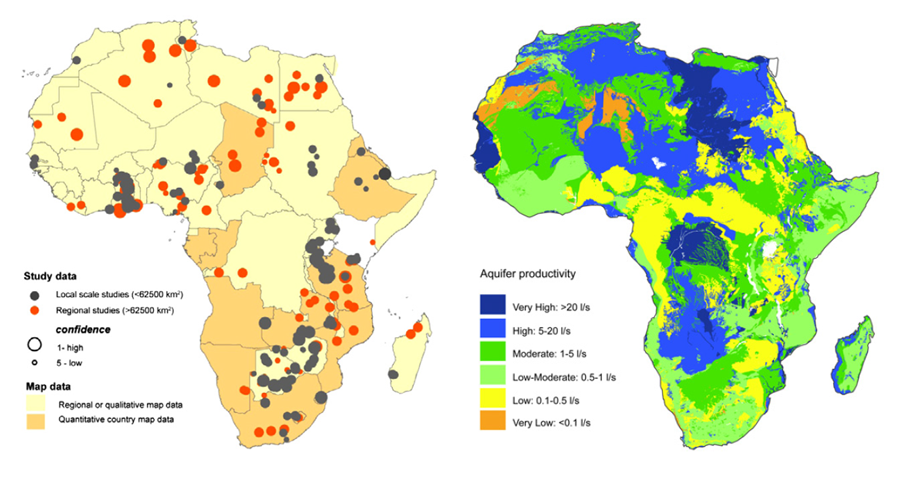
The authors hope to remedy this with new research presented in “Quantitative Maps of Groundwater Resources in Africa.” They used estimates compiled from geologic data and 283 aquifer summaries from 152 different publications to quantitatively visualize, for the first time, the full extent of Africa’s groundwater resources.
Tapping a Hidden Resource
The study estimates the scale of the continent’s groundwater resources at around 0.66 million km3. This volume, the authors explain, is “more than 100 times the annual renewable freshwater resources, and 20 times the freshwater stored in African lakes.”
Tapping into this massive resource is not always straightforward, however. The largest aquifers, and those most able to support high yielding bores, are concentrated in the arid regions of North Africa. The depth of these aquifers and their distance from major populations creates substantial economic challenges for extraction.
The geographic distribution of aquifers across sub-Saharan Africa is also quite variable, and local geology can determine not just the availability and accessibility of water but also its quality. For instance, geologic specificities can result in elevated levels of arsenic and other undesirable chemicals. Furthermore, “contamination…is common in urban areas from widespread and dispersed faecal effluent from on-site sanitation and leaking sewers.”
Tempering Expectations
Throughout Africa, “groundwater provides an important buffer to climate variability and change,” say the authors. But these buffers are not a singular solution to the threat of future water scarcity.
As the analysis shows, most aquifers, especially south of the Sahara, are unlikely to sustain boreholes of a higher capacity than that required by community-level hand pumps (one liter per second of flow at minimum). Yet, commercial irrigations schemes and urban towns typically demand boreholes greater than five liters per second, according to the study.
So, groundwater extraction may help communities and some small-scale farmers maintain access to water, particularly because many aquifers are found to possess the storage capacity required “to sustain abstraction through inter-annual variations in recharge,” however, “strategies for increasing irrigation or supplying water to rapidly urbanizing cities that are predicted on the widespread drilling of high yielding boreholes are likely to be unsuccessful.” Especially, the authors assert, where drilling precedes detailed local scale mapping of the available resources.
Sources: Environmental Research Letters.
Image Credit: Figures 1 and 3, courtesy of Environmental Research Letters. -
Imelda Abano on Environmental Reporting in the Philippines
›“What we are trying to do is to explore more strategies on how to improve environmental reporting in the Philippines – and on how to reach the government and communities as well,” said Imelda Abano, president of the Philippine Network of Environmental Journalists, Inc. (PNEJ) and senior correspondent at Business Mirror, in an interview with ECSP.
With an overwhelmingly coastal population of around 95 million, the 7,150 island archipelago of the Philippines is seen as highly vulnerable to environmental and climate-related threats. One of Albano’s major aims as president of the PNEJ is therefore to “empower local journalists to report more on environmental issues like biodiversity, climate change, disaster, and other environmental challenges in the Philippines,” she said.
Compelling reporting, she said, comes from “try[ing] to understand what the government is trying to say or what researchers or other organizations are trying to say,” and then relating that information back to the people “in the layman’s terms.”
Environmental issues require a lot of context, she said. One of the most important related issues in the Philippines is population growth.
“When you talk about environment issues, it really resonates or links to population issues,” Abano said. Current UN projections estimate that by 2050, the population could balloon to nearly 155 million. “This really affects our jobs, women, culture, and of course the population around the coastal areas.”