Showing posts from category *Blog Columns.
-
USAID Turns to Crowdsourcing to Map Loan Data
›
The original version of this article, by Aaron Lovell, appeared on the Wilson Center’s Science and Technology Innovation Program Commons Lab blog.
On June 28, officials from USAID met at the Wilson Center to discuss a recent experiment in using crowdsourcing to help clean up and map data on development loans. The agency had 117,000 records on private loans made possible by their Development Credit Authority, which theoretically could be mapped and made available to the public. The problem? Location data for the loans was not standard and was difficult to parse. USAID decided to turn to “the crowd” and recruit interested volunteers from the Standby Task Force and GISCorps – two online volunteer communities – to help clean the data, making it available for additional analysis.
Shadrock Roberts, Stephanie Grosser, and D. Ben Swartley – all with USAID – discussed the results of the project. They were able to clean up the information at virtually no cost to the government, noting that they hope it will be an example for further collaboration between government and engaged volunteers.
“Our hope is that the case study will provide others in government with information and guidance to move forward with their own crowdsourcing projects. Whether the intent is opening data, increased engagement, or improved services, agencies must embrace new technologies that can bring citizens closer to their government,” the officials wrote in a recently released case study focused on the exercise. While the exercise resulted in high-quality output, Roberts et al. did provide advice for other agencies considering similar work. Grosser stressed the need to “crawl, walk, [then] run” – that is, start small with a few hundred records and then expand on that, as the system is refined.
But USAID sees crowdsourcing becoming a key part of improving government data. “We need to be working as hard to release relevant data we already have as we are to create it,” Roberts concluded, when discussing how the experience could apply more generally. “The crowd is willing to do research, data mining, and data cleanup.”
Sources: USAID. -
Guttmacher Updates Unmet Need Estimates, and West Africa’s Demographic Dividend Examined
›The Guttmacher Institute has updated their estimates for global contraceptive services, putting the number of women around the world who have an unmet need for modern family planning at 222 million (up from 215 million). Authors Susheela Singh and Jacqueline E. Darroch, in Adding It Up: Costs and Benefits of Contraceptive Services Estimates for 2012, also examine the estimated current costs of contraception, cost of meeting the current unmet need, and the money saved from having fewer unintended pregnancies. An estimated four billion dollars is currently spent on contraception in the developing world, and “the total cost of fully meeting the contraceptive needs of all women in the developing world with appropriate services would…be $8.1 billion per year.” Singh and Darroch note that there are substantial benefits to increasing access to contraception, including reduced infant and maternal mortality and lower education and health costs as smaller populations put less strain on existing systems. They conclude that “the gains that derive from meeting the contraceptive needs of all women in the developing world more than outweigh the financial costs.”How Can We Capitalize on the Demographic Dividend?, by Jean-Pierre Guengant of the Institute of Development Research, explores the connection between population age structure and economic growth in 12 West African countries (the West African Economic and Monetary Union plus Ghana, Guinea, Mauritania, and Nigeria). While much of Africa has recently experienced economic growth between four and six percent, Guengant notes it has been “too low to allow for any substantial increase in per capita income levels” due to continued population growth. And he suggests that projections of declining fertility in much of Africa are overly optimistic. “Contrary to popular belief,” he writes, “the demographic future of sub-Saharan Africa has not been written.” Guengant extrapolates his own fertility projection using data beginning in 1960. If fertility declines rapidly, he writes, the larger proportion of people in the labor force could increase the GDP per capita and drive up the standard of living. -
Hania Zlotnik Discusses Changes to Latest UN Population Projections
›Former UN Population Division Director Hania Zlotnik spoke recently at the Wilson Center discussing last year’s highly-publicized UN world population projections and explaining the methodology behind the figures. “The latest projections are very special,” she said, adding that “we think that this methodology is a lot better than what we had before.”
What accounts for such improvement? Zlotnik said it has a lot to do with greater availability of data. “The UN has been…mandated by governments to produce population estimates since the 1950s,” she stated, and they have refined their projections process over the years based on an increasing record of data and identification of some “patterns that can inform the future.”Former UN Population Division Director Hania Zlotnik spoke recently at the Wilson Center discussing last year’s highly-publicized UN world population projections and explaining the methodology behind the figures. “The latest projections are very special,” she said, adding that “we think that this methodology is a lot better than what we had before.”
What accounts for such improvement? Zlotnik said it has a lot to do with greater availability of data. “The UN has been…mandated by governments to produce population estimates since the 1950s,” she stated, and they have refined their projections process over the years based on an increasing record of data and identification of some “patterns that can inform the future.”
The increasingly large dataset accumulated during this process is particularly important because of what Zlotnik called “inertia” in population change. “There’s something called ‘population momentum,’ where the population changes on the basis of how many people have already been accumulated on the planet,” she explained, pointing out that many of the people included in the UN’s population projections for 2050 have already been born.
This inertia helps make population projections fairly accurate, but last year’s projections differed from previous efforts in two significant ways.
First, the UN Population Division provided projections not just to 2050 but also to 2100. These more long-term projections estimated an end-of-century population of more than 10 billion – notably higher than previous reports, which had predicted that population would stabilize mid-century at around nine billion.
Second, the underlying methodology used shifted from a deterministic to a probabilistic approach that, according to Zlotnik, does a better job capturing variability in each country’s fertility rate over the next century. “Essentially,” she explained, “a model was developed for every country that takes into account the past path of fertility change [and] also takes into account changes that have happened in other countries…Then [it] does a simulation for the future for every country, in which 100,000 paths are projected, essentially by throwing dice, and then the central path of those 100,000 is used to project the future.”
Zlotnik cautioned that projecting so far into the future is an inexact – albeit necessary – science: “Of course, as we go further into the future, the numbers are more subject to uncertainty. But [the long-term projections] help us give people a better feeling of how important it is to change trends from here to 2050, so that we ensure that, at the end of the century, the number of people on the planet is sustainable.”
“In order to make sure that the population projections made by the United Nations [are realized],” Zlotnik said, “it’s very important that fertility continues to decline, and especially that fertility decline happens in the countries that still have very high fertility.”
“Fertility decline happens in many ways,” she continued, “but the immediate reason why fertility can be reduced is that more people use modern methods of contraception.” -
An Update on PRB’s Population, Health, and Environment Project Map
›As reproductive rights advocates reflect on their disappointment with the outcome of last week’s Rio+20 summit, it is encouraging to see that population, health, and environment (PHE) projects – which fundamentally connect women’s health with sustainable development – continue to sprout up around the world. The Population Reference Bureau (PRB) launched their community-supported PHE Project Map in March 2010, and since then, the map has grown to include 76 projects across three continents, and has been viewed more than 82,000 times.
The goal of the map is to show which organizations are doing what PHE work where and when. While the map highlights expected hotspots like Ethiopia, Madagascar, and the Philippines, it also brings into focus countries that may not necessarily come to mind when thinking about PHE – South Africa, Venezuela, and Vietnam being among them. The map is updated on a rolling basis, and has grown substantially during its first two years.
These numbers should offer encouragement to reproductive rights and sustainable development advocates. Even if world leaders are still struggling to integrate these issues into a global development framework, NGOs, local nonprofits, and development agencies across the world are moving full-speed ahead to improve healthcare, strengthen ecosystems, and empower women and men across Latin America, sub-Saharan Africa, and South Asia.
To add a project to the map, contact PRB’s Rachel Yavinksy at ryavinsky@prb.org. -
Top 10 Posts for June 2012
›With the focus on sustainable development last month, Rio+20 coverage and related-population, health, and environment stories crept into the top posts (measured by unique pageviews). Carl Haub of Population Reference Bureau made a surprise appearance too with his update on the Democratic Republic of Congo’s latest demographic and health survey coming in at number three. To read ECSP’s full coverage of the 20th anniversary of the UN Earth Summit, see a full line-up of posts from Sandeep Bathala and our partners here.
1. India’s Maoists: South Asia’s “Other” Insurgency
2. The Year Ahead in Political Demography: Top Issues to Watch
3. Republic of Congo Demographic and Health Survey Shows High Maternal Health, But No Fertility Decline
4. In Search of a New Security Narrative: The National Conversation Series Launches at the Wilson Center
5. Reading Radar: USAID’s New Global Health Framework and Delivering Equity in Health Interventions
6. Guest Contributor Tim Hanstad: Poor Land Tenure: A Key Component to Why Nations Fail
7. Pop at Rio+20: Getting Women’s Rights on the Agenda
8. Bringing Environment and Climate to the 2012 Population Association of America Annual Meeting
9. On the Beat: Sex and Sustainability on the Road to Rio+20
10. PHE and Community-Based Adaptation to Climate Change: Stronger Together -
Gwen Hopkins, Aspen Institute Global Health and Development
Aspen Ideas Festival Takes on “The Population Challenge”
›The original version of this article, by Gwen Hopkins, appeared on the Aspen Ideas Festival blog.
The pictures flash quickly: lush sea vegetation replaced by empty grey-blue seabed as carbon bubbles out of undersea vents. Reservoirs depleted too quickly, never to refill. Forests and mountains leveled for coal, deep sea oil rigs ablaze, the arctic ice cap visibly retreating. Dennis Dimick is answering the question posed to him with a litany of evidence collected by National Geographic: Does population matter?
Yes, he says – a lot.
Kicking off the Our Planet: The World at Seven Billion track, on a panel called “The Population Challenge,” Washington Post staff writer Joel Achenbach moderated a conversation between Dimick and Helene Gayle, president and CEO of CARE USA, following Dimick’s presentation about how the earth’s human population has made its presence known.
Dimick explains that this new geologic era has been dubbed Anthropocene, the age of man, as we “transform the planet to perpetuate our lifestyle.” That’s a lifestyle powered first and foremost by what he calls “the new sun” – coal, oil, and gas, or in Dimick’s words, “ancient plant goo.” These transformations are deep and widespread – and according to Dimick, growing worrisome in their magnitude. While there is searing inequity – “few have a lot, and a lot have few” – those that lead the consumption have, for example, caught 90 percent of the big fish in the sea already, and burn in one year a quantity of fuel that took a million years to coalesce underground. “If everyone in the world lived like Americans do, we’d need four planets.”
Continue reading on the Aspen Ideas Festival blog.
Photo Credit: Aspen Institute. -
What Are the Most Important Factors in the Failed States Index?
›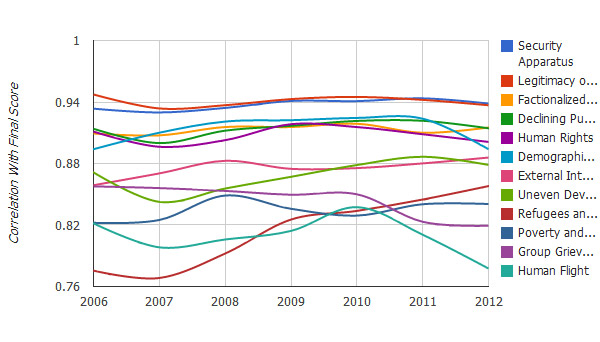
Last week, the Fund for Peace issued its eighth annual Failed States Index (FSI). The index gives 177 countries a score between 1.0 and 10.0 for 12 indicators, ranging from the legitimacy of the state and the security apparatus to demographic pressure and uneven development (high being bad, low being good – see full descriptions of the indicators here). But which of these indicators has the biggest impact? We did a quick analysis of the Failed States Indexes published from 2006 to 2012 to show which of the indicators correlate most with a high score. (We skipped 2005 since the roster of analyzed countries was significantly smaller.)
-
IPPF and Partners Connect Reproductive Rights With the Environment and Development
›A new framework for sexual and reproductive health is needed, argued panelists in a recent event at the Wilson Center, and the Rio+20 conference on sustainable development would have been the place to start. An international consensus around women’s human rights was developed at the International Conference on Population and Development in Cairo in 1994, but Carmen Barroso, director of the International Planned Parenthood Federation’s Western Hemisphere Region, said there has been slow implementation, little funding, and furthermore the world has changed significantly since then.
Barroso was joined by Latanya Mapp Frett, vice president of Planned Parenthood Global, as well as two representatives of Planned Parenthood partner organizations, Marco Cerezo of FUNDAECO and Ben Haggai of Carolina for Kibera.
New challenges to the reproduce rights landscape include the rapid spread of HIV/AIDS and decreased funding for international programs. But new opportunities include rapid dissemination provided by the internet and globalization and a subsequent mobilization of youth. “Young people are the largest cohort in history,” Barroso said in an interview with ECSP, both in absolute numbers and in percent of the population. “We have a historical opportunity [to incorporate] them in these decision-making processes.” Additionally, gender and health issues are incresaingly seen by many as linked with the environment and development.
Intersection of Health and the Environment
Marco Cerezo’s FUNDAECO (Foundation for Ecodevelopment and Conservation) is an example of Planned Parenthood’s partnership with other organizations. Based, in rural Guatemala, they shifted from primarily focusing on conservation and sustainable development to incorporating women’s health after finding a vicious cycle of poverty, high fertility, and environmental degradation in the places they worked.
Women’s health was so dire it was holding development back, Cerezo said. “Sustainable community development will not be possible without the education, empowerment, and support to rural women,” they write in their mission statement.
FUNDAECO now acts as a model for the intersection between reproductive health and the environment. Cerezo reported that once women are healthy and empowered through clinics established by FUNDAECO, they become more active in all aspects of the community, including ecological preservation.
Building Healthy Communities
Ben Haggai, who works in Nairobi’s biggest slum, Kibera, further reiterated the need for integrated programs. Carolina for Kibera has a number of programs to improve the quality of life for residents, he said, and has a particular focus on youth with sports associations and education programs.
Youth are the best reproductive health educators, Haggai said, as they are able to talk frankly with their peers. The NGO trains peer youth educators to reach out to community members about reproductive health and other issues like substance abuse. Since the young people work as volunteers, Haggai said, they are motivated only by a desire to improve their communities.
A Natural Intersection
Latanya Mapp Frett agreed that sexual and reproductive health aligns quite naturally with issues of sustainability. “We try to work in the countries overseas in Latin America and Africa where we focus particularly on non-traditional health sectors,” she said in an interview with ECSP following the panel. “One of those sectors is the environment.”
While emphasizing that contraceptive use is a cost-effective way to ensure sustainable development, Mapp Frett cautioned against framing sexual and reproductive health only in the context of reducing fertility. While this may have been common in the past, she noted, it’s important to ensure that women have the right to make childbearing choices for themselves.
Mapp Frett also urged policymakers in the United States to look to developing countries for intersections between development, the environment, and reproductive health. She said that Planned Parenthood’s partner organizations, including FUNDAECO and Carolina for Kibera, have found these connections and successfully partnered with already existing networks like churches to more effectively reach the community.
Translating Into Effective Action
Each member of the panel spoke about the challenge of articulating the need for sexual and reproductive health programs to people outside the field. Barroso mentioned research conducted by Brian O’Neill which found that meeting the current unmet need for contraception would slow population growth enough to reduce emissions by 17 percent.
Cerezo emphasized the importance of consensus among the staff of a given organization, saying it is difficult to make a case to agronomists and farmers if a culture clash exists within the institution. Haggai agreed, adding that focusing on reproductive issues is an important measure of prevention which helps protect both the environment and the health of women in a community.
For Mapp Frett, women’s reproductive and sexual health is indivisible from other aspects of development. “As you talk about sustainable development, you talk about ensuring that women are empowered to make sure that our earth is sustainable,” she said.
Assessing Rio+20
The panel took place before the UN Conference on Sustainable Development got underway in Rio. Participants had high hopes for a renewed focus on gender and reproductive rights at the conference. Unfortunately, language on reproductive rights was first weakened and then omitted entirely from the final outcome document (see the account written by ECSP’s Sandeep Bathala at Rio for more on the conference).
While pressure from the Vatican and the G-77 kept reproductive health out of the outcome document, it was not entirely forgotten at the conference. A number of side events highlighted the importance of reproductive rights, especially in the context of the environment and development.
Hillary Clinton also re-affirmed U.S. commitment to access to contraception and reproductive health care. “Women must be empowered to make decisions about whether and when to have children,” she said at the conference on Friday. “And the United States will continue to work to ensure that those rights are respected in international agreements.”
Clinton shared the urgency expressed by the panelists at the Wilson Center. “There is just too much at stake, too much still to be done,” she said. “We simply cannot afford to fail.”
Event Resources:Sources: FUNDAECO, UN Conference on Sustainable Development, U.S. Department of State.
Photo Credit: Sean Peoples/Wilson Center.