-
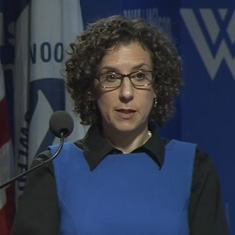
Mark Montgomery: More Data on Urban-to-Urban Migration Needed
›
“If I ask you to consider the image in your mind of a migrant girl, probably you – like me – have a vision of a girl embarking from a rural village on a trek to the city,” says Mark Montgomery of the Population Council in this week’s podcast. But, “Is that what the empirical realities show?”
Perhaps not: “It is far more common for urban and migrant girls to come from other cities and towns than it is for them to come from rural villages,” he explains.
-
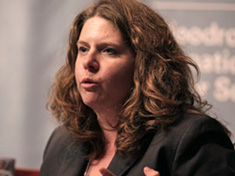
Miriam Temin: Migrant Girls, Forced or Not, Need Safety Nets
›
“There’s a common myth that migrant girls are forced to move against their will, but in fact what we’ve found through our research is that most migrant girls are involved in the decision to move,” said the Population Council’s Miriam Temin in this week’s podcast.
Temin spoke at the launch of her and her colleagues’ new report, Girls on the Move: Adolescent Girls and Migration in the Developing World, about the economic incentives for girls to migrate and the risks involved for them.
-
Lisa Friedman: Bangladesh Shows Importance of Expanding Coverage of Climate-Induced Migration
›“What I found in Bangladesh was that [climate migration] wasn’t a straight line,” says Lisa Friedman in this week’s podcast. It’s “a far more complicated story.”
Friedman is the deputy director of ClimateWire, a news service that brings readers daily information related to climate change and its effects on business and society. At the launch of ECSP’s new report, Backdraft: The Conflict Potential of Climate Mitigation and Adaptation, Friedman discussed her experiences reporting on climate-induced migration in Bangladesh – one of the most vulnerable countries to climate change in the world, due to its low-lying geography, dense population, and high poverty levels.
-
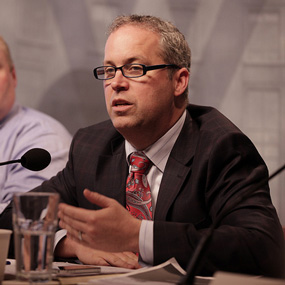
Stacy VanDeveer: “Green Economy” May Bring More of the Resource Curse
›“We can’t talk about a ‘green economy,’ ‘green technologies,’ or ‘green energies’ only by talking about technologies that are stamped out at one end of a large global process and deployed for cleaner energy,” says Stacy VanDeveer in this week’s podcast.
“The green economy, or green energy transition, requires a lot of metals, and a whole lot of things that are mined,” he says. “Because of the scale of the industry now, the scale of the environmental and social change being driven by mining globally is actually quite stunning.”
-
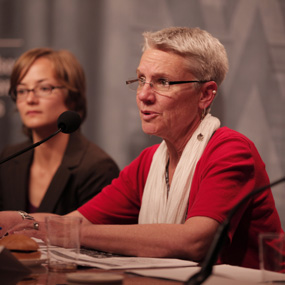
Susan Bradley on Feed the Future: Solving Hunger Requires Cross-Cutting Development Initiatives
›“Sustainable food security means that food production has to be climate smart,” says Susan Bradley in this week’s podcast. “In order to achieve climate smart food security, we are going to have to build resilience and adaptive capacity into agriculture.”
Bradley, division director for the USAID’s Bureau for Food Security, is working to implement the U.S. government’s Feed the Future Initiative. Unveiled by the Obama Administration in 2009, the $3.5 billion “whole of government” initiative aims to alleviate hunger and increase food security around the world.
-
Lisa Dabek on How Papua New Guinea’s Tree Kangaroo Conservation Project Does More Than Conserve
›“All through Papua New Guinea, in every province, there is logging and mining, but we are the first conservation area,” says Lisa Dabek in this week’s podcast.
Dabek is the director of the Tree Kangaroo Conservation Project (TKCP), an effort of the Seattle Woodland Park Zoo that works to protect tree kangaroos while empowering communities in Papua New Guinea’s YUS Conservation Area to manage their natural resources, health care, and food security.
-
Joan Castro on Engaging Youth to Create Change in the Philippines
›“Exposing young people to information about PHE [population, health, and environment] and food security dynamics can be a powerful tool to steer their interests and commitment to care for the environment and become sexually responsible individuals,” says PATH Foundation Philippines, Inc. (PFPI)’s Joan Castro in this week’s podcast.
PFPI’s Youth EMPOWER project has trained close to 300 “youth peer educators” in the southern Philippines to promote environmentally sustainable livelihoods, clean up the environment, raise awareness of reproductive health, and encourage participation in local government.
-
Leslie Mwinnyaa: Young People Drive Integrated Development in Ghana’s Ellembelle District
›“I have been amazed and inspired by the youth that I’ve worked with, with their dedication and motivation to help their countrymen and to try to make their communities better places,” says Leslie Mwinnyaa in this week’s podcast.
When Mwinnyaa arrived in the Ellembelle district of coastal Ghana as a Peace Corps volunteer she found a multitude of development challenges. Fishermen routinely use illegal techniques like chemicals, lights, and dynamite that decimate fish stocks; “sand winning” and mangrove clearing increases erosion, leaving communities vulnerable to flooding and reducing breeding grounds for local fish; poor waste and refuse management contributes to disease and poor health; and teenage girls have twice the national rate of pregnancy.
Showing posts from category Friday Podcasts.