-
Point of View: Investing in Maternal Health
›
Every minute, a woman dies in pregnancy or childbirth. But the overwhelming majority of these more than 500,000 deaths a year are avoidable.
“We know how to save women’s lives, we don’t need a cure…this is a political problem and political will is essential,” said Theresa Shaver, the director of White Ribbon Alliance.
Addressing longstanding issues like political will could jumpstart progress toward Millennium Development Goal 5, which seeks to reduce maternal deaths by 75 percent by 2015. We face daunting challenges, but there are some clear steps we can take to meet this critical goal. We must strengthen health systems in the developing world.Increasing women’s access to quality health services during pregnancy, and ensuring they are attended by skilled providers during childbirth, can help to reduce preventable causes of death, such as hemorrhage, pre-eclampsia, and obstructed labor—which together account for 80 percent of maternal deaths.
Scaling-up family planning services are a cost-effective way of preventing unwanted pregnancies, delaying the age of first pregnancy, increasing the time between pregnancies, and facilitating important relationships between women and health care providers. However, many societal and cultural factors dissuade women and girls from seeking contraception. Culturally sensitive education programs can help overcome this barrier, especially if they include men and local leaders, in addition to women and girls.
We should recognize that improving the well-being of mothers is inseparable from the health of newborns. Efforts to reach Millennium Development Goal 4, reducing under-5 mortality by two-thirds, are integral to improving maternal health. Skilled birth attendants could decrease both maternal and child mortality.
In the United States and abroad, momentum is growing to make the investment necessary to scale up these interventions. In January, Secretary of State Hillary Clinton renewed a commitment of $63 billion for the Obama Administration’s Global Health Initiative, which will include significant resources for maternal and child health.
According to the U.S. Agency for International Development, maternal and newborn deaths cost the world $15 billion a year in lost productivity. Researchers conclude that maternal health services would cost only a $1 per day per woman. That’s a small price to pay for such a high return—saving not only dollars, but also women’s lives.
For more information about maternal health and the Global Health Initiative’s Advancing Policy Dialogue on Maternal Health Series please see this month’s issue of Centerpoint. -
Watch: Harriet Birungi: Challenges Facing HIV-Positive Adolescents in Kenya
›“Services are not necessarily very adolescent-friendly, so when you get children who are HIV-positive they are likely to face discrimination,” says Harriet Birungi, an associate in the Reproductive Health Program with the Population Council in Kenya, in this interview with ECSP’s Gib Clarke following the Global Health Initiative’s Integrating HIV/AIDS and Maternal Health Services panel.
According to Birungi, medical service censoring and targeted exclusion from schools are among the top challenges facing Kenyan adolescents living with HIV/AIDS. She hopes better support systems and intervention strategies, especially for pregnant individuals, will help medical personnel more quickly identify HIV-positive young adults needing critical medical services. -
Human Resources for Maternal Health
›
“Pregnancy is not a disease, a woman should not die of pregnancy…it doesn’t need a new drug…it doesn’t need research – we just need skilled workforce at different levels,” argued Seble Frehywot, assistant research professor of Health Policy and Global Health at George Washington University, at the Global Health Initiative’s second event of the Advancing Policy Dialogue on Maternal Health Series.
Research shows that increased access to skilled health workers during pregnancy and delivery, including midwives and other practitioners, can significantly reduce maternal mortality in developing countries. One solution to the current human resource crisis is to expand, and in many cases, acknowledge, the skills and responsibilities of non-physician health workers.
Task-Sharing: Who, What, and How
“There are too many preventable deaths…if we look at the data, quality maternal health services are not available,” argued Frehywot, as she presented the following evidence:
There are four common types, or levels, of task-shifting:- Countries that have the highest maternal mortality rates are those that also have the greatest worker shortage
- In Africa, for every 10,000 births, only 2 physicians and 11 nurses or midwives are present at delivery.
- According to the World Health Organization, there needs to be at least 53 skilled health care workers (nurses, doctors, midwives) per 10,000 births to meet Millennium Goal 5 which seeks to reduce maternal deaths by 75 percent by 2015.
1. Doctors to non-physician health clinicians
“All [task-shifting] needs to be done through a sound regulatory framework…it is very important to match tasks that are needed at the ground level with the competency needed to back it up,” maintained Frehywot. Regulatory issues such as the scope of practice, standard of care, training, licensure, and supervision must be addressed to ensure safe and high-quality treatment. Additionally, political buy-in and commitment from the Ministry of Health, medical universities, and professional councils and associations are necessary for long-term development, argued Frehywot.
2. Health clinicians to registered nurses and midwives
3. Nurses/midwives to community health care workers
4. Community health care workers to expert patients
Policies for scaling-up human resources should start at the district level, as these localized hospitals are geographically closest to the need, argued Frehywot. “If one really wants to decrease the maternal mortality ratios, especially by 2015, this is where most of the people live.”
Applying Task-Shifting in Afghanistan
“Maternal mortality ratios in Afghanistan are the second highest in the world,” declared Jeffrey Smith, regional technical director for Asia at Jhpiego. In 2002, when Smith arrived in Afghanistan, there were limited health workers, most with out-of-date skills, and no functional schools for training. “The most important decision made early in the reconstruction [of] Afghanistan was that midwives would be the backbone of the reproductive health workforce and they would be empowered with the skills to perform the tasks necessary for provision of basic emergency obstetric care,” shared Smith.
Making the case for task-shifting, Smith discussed the importance of empowering health workers on the front line so that they may provide services in the most peripheral areas. “Task shifting should not be a temporary fix until we have more doctors,” argued Smith, as this framework disenfranchises a cadre of health workers and fails to build long-term solutions for human resources. Instead, Smith advocated for the “Health Center Intrapartum Care Strategy” that makes midwives the foundation of care and includes strategies for training, staffing, and linkages to the overall health system.
In this post-conflict setting, task-shifting began as an emergency approach. However, it rapidly became a development strategy for professionalizing the workforce and rebuilding the health system. Afghanistan’s Ministry of Public Health was imperative to the success of scaling up midwives as they clearly defined from the beginning what was needed and who would provide care, taking steps to ensure that the midwifery schools maintained legitimacy and received formal accreditation.
“Keep it clinical and keep it local,” shared Smith. The midwifery schools made efforts to recruit individuals from the provincial level, teaching specific life-saving skills applicable in the field. This framework has successfully retained 86% of its graduates, and many of the women report that the program has provided them with a sense of community and ownership.
Building a Sustainable Health Workforce
“We invite the maternal health community to take advantage of the incredible momentum that human resources for health is having right now,” shared Pape Gaye, president and CEO of IntraHealth. While there are many issues within the health system that need to be strengthened, Gaye maintained that “we must pick our battles” and advocated for an emphasis on scaling-up the training and availability of midwives.
In order to scale-up midwives for maternal health we must avoid the same old traps, particularly the lack of donor coordination shared Gaye. “If we do a better job of improving coordination we will start solving the problem.” Additionally, Gaye discussed the implications for training generation “Y,” emphasizing the importance of including new technologies available for training, including PDA’s and e-learning courses.
Performance outcomes and training are the two key pillars of effective scale-up, shared Gaye. Task-shifting also requires legal support and the endorsement from medical associations to help legitimize this new health system framework. “This is not simple work; you really need to have a systems approach. What we seek in the end is good integration. Integration across systems, integration across roles, courses, learning processes, and training for maximum adaptability,” shared Gaye. -
Integrating HIV/AIDS and Maternal Health Services
›
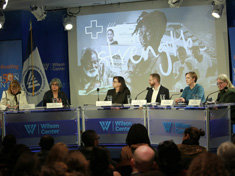
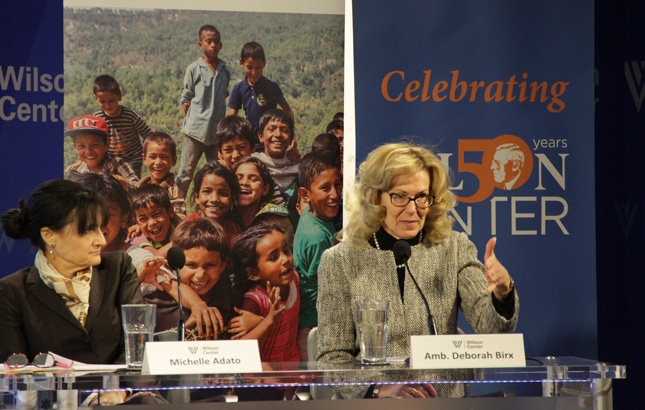
Integrating maternal health and HIV/AIDS services “includes organizing and providing services that meet several needs simultaneously…focusing not only on the condition, but also the individual,” argued Dr. Claudes Kamenga, Senior Director of Technical Support and Research Utilization at Family Health International, during the first event of the Advancing Policy Dialogue on Maternal Health series co-convened by the Wilson Center’s Global Health Initiative, Maternal Health Task Force (MHTF), United Nations Population Fund (UNFPA), and technical support from U.S. Agency for International Development (USAID). Joined by Michele Moloney-Kitts, assistant coordinator at the Office of the U.S. Global AIDS Coordinator, and Harriet Birungi, a program associate with the Population Council in Kenya, the panelists discussed how integration of HIV/AIDS and maternal health services not only improves health outcomes, but also increases program efficiencies, strengthens health systems, and saves money.
-
Tackling the Biggest Maternal Killer: How the Prevention of Postpartum Hemorrhage Initiative Strengthened Efforts Around the World
›On Friday, November 20th, 120 representatives from the maternal health community, the U.S. and around the world, gathered for an all day meeting at the Woodrow Wilson International Center for Scholars to discuss the report, Tackling the Biggest Maternal Killer: How the Prevention of Postpartum Hemorrhage Initiative Strengthened Efforts Around the World. This report describes the challenges and successes of the U.S. Agency for International Development (USAID) funded Prevention of Postpartum Hemorrhage Initiative (POPPHI).
The five-year POPPHI project was executed through the support of many partners whose main goal was to catalyze the expansion of active management of the third stage of labor (AMTSL) worldwide. The conference convened experts and advocates in the field of maternal health, to share best practices, new innovations, and future challenges for tackling maternal health’s leading killer: postpartum hemorrhage (PPH). Panelists included POPPHI field partners such as International Federation of Gynecology and Obstetrics, The International Confederation of Midwives, the World Health Organization, and international researchers.
Preventing Postpartum Hemorrhage: AMTSL
“We need to work on women postpartum–after birth we leave them,” argued Deborah Armbruster, POPPHI Project Director. Due to the fact that many women in the developing world give birth at home or in local clinics that lack the sufficient resources to prevent postpartum hemorrhaging, approximately 132,000 women die annually. Fortunately, effective and feasible interventions such as those established by POPPHI have been proven to save lives.
Active management of the third stage of labor (AMTSL) includes three factors that, when used together, can avert postpartum hemorrhage, including:1. Administration of uterotonic drugs (including oxytocin – the most preferred drug)
POPPHI’s “BOLD” Approach
2. Controlled cord contraction
3. Uterine massage after the delivery of the placenta
In collaboration with its partners, POPPHI implemented country-level and global programs to scale up AMTSL. Driven by the “BOLD” approach, Armbruster described how the initiative provided overall frameworks and approaches for strengthening PPH interventions by Building on evidence, Obtaining consensus, Linking partners, and Demonstrating to policymakers AMTSL’s feasibility.
Additionally, POPPHI provided learning materials such as toolkits, fact sheets, posters, and guides that were used to train providers and increase their use of AMTSL. A pilot project on Uniject (a single use needle pre-prepared with oxytocin) was also executed in Mali. Uniject was shown to be acceptable and successful with birth attendants there, and the study is now being replicated in Honduras.
Voices from the Field
Representatives from Argentina, Bangladesh, Ghana, Guatemala, Peru, and Mali presented their country results with the POPPHI project–concluding that the initiative served as a catalyst for upscaling AMTSL. Dr. Abu Jamil Faisel, Project Director and Country Representative of EngenderHealth in Bangladesh, discussed how the project helped to break through misperceptions that often prevented women from wanting to use misoprostol. In Ghana, policymakers worked with program managers and drug suppliers to register misoprostol in the country’s essential medicine list and updated guidelines to reflect best practices. While each country’s experiences were unique, the importance of partnerships was common to successfully upscaling AMTSL in all locations.
Partnerships: Critical to Success
Integrating maternal health indicators directly into program design is imperative to upscaling AMTSL, argued Niamh Darcy, Director of POPPHI Monitor and Evaluation. Additionally, Darcy argued that the success of POPPHI is due to the project’s emphasis in working with all levels of partners, particularly facility providers. Working with the supportive supervisors at facilities is necessary according to Darcy because this group is ultimately responsible for executing active management and recording project outcomes.
Identifying African experts who have taken leadership and ownership of the project has been instrumental in POPPHI successfully disseminating results at the regional, national and international levels argued Doyin Oluwole, Director, Africa’s Health in 2010. Partnering with local champions as well as policymakers has enabled many of the country projects to build capacity and upscale AMTSL.
Building on Lessons Learned
“A key lesson we have learned is that, when there is political commitment, AMTSL is rapidly scalable,” stated Lily Kak, Senior Maternal and Newborn Health Advisor, USAID. Changing behaviors and practices takes significant amount of resources and time commitment, however, POPPHI demonstrates that partnerships and research can be used to upscale AMTSL and change policies more efficiently.
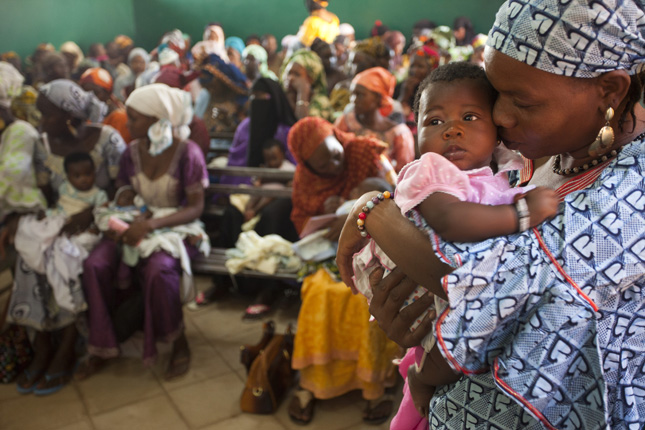
Photo: Women wait outside a maternity ward in Chad. Courtesy of Flickr user mknobil. -
Watch: Nicholas Kristof on Maternal Mortality
›“Although a half million women die each year, that doesn’t get attention, because the victims invariably have three strikes against them: They are poor, they are rural, and they are female,” journalist Nicholas Kristof says in a video interview about his new book, Half the Sky: Turning Oppression into Opportunity for Women Worldwide.
“If men had uteruses and were dying at this rate, every country would have a minister of paternal mortality, the security council would be meeting, this would be a real international priority,” he says.
Recently launched at the Wilson Center, Half the Sky tells the transformational stories of women and girls who are the “face of statistics” on four appalling realities: maternal mortality, sexual violence, and lack of education and economic opportunities.
“So many Americans want to help, but are skeptical,” so Half the Sky offers a “do-it-yourself toolkit,” says Kristof. People “can truly save individual women’s lives out there, and their babies’ lives, that would otherwise die.” -
Is the White Ribbon the New Black? Making Maternal Health Fashionable
›
Celebrity philanthropists such as Bono, Angelina Jolie, and George Clooney have shined their star power on global issues like AIDS, genocide, and refugees. In last month’s Vogue, supermodel Christy Turlington turned the light on one of the most overlooked problems: maternal mortality.
-
Half the Sky, All the Promise: The Personal is Political in NYT Special Issue
›“The world is awakening to a powerful truth: Women and girls aren’t the problem; they’re the solution,” write Nicholas Kristof and Sheryl WuDunn in the lead article of this Sunday’s The New York Times Magazine.
In this special issue devoted to “Saving the World’s Women,” five articles document global failures and personal horrors, but also offer forward-looking solutions from the individual to the institutional. As the subtitle says—“changing the lives of women and girls in the developing world can change everything”— this vital effort can help us not only improve the lives of women, but meet larger goals including international security, global health, and economic development.
In “The Women’s Crusade,” Pulitzer Prize-winners Kristof and WuDunn, whose new book Half the Sky will be published on September 8, outline the ways in which the world’s women and girls are abused, neglected, and overlooked. They use devastating data to detail how women around the world suffer from lack of education, maternal mortality, sexual violence, trafficking, and economic and political oppression, and then bring these figures to life with women’s personal stories.
They argue that elevating women is not a “soft” issue, but rather has the power to transform economies and address security threats—a point echoed in an interview with Hillary Clinton, in which she calls women and girls “a core factor in our foreign policy.”
“I happen to believe that the transformation of women’s roles is the last great impediment to universal progress,” says Clinton, long an informed and passionate advocate for global women’s issues. She encouraged President Obama to create a new ambassadorship for global women’s issues, and filled the opening with Melanne Verveer, a respected activist and former head of the Vital Voices Global Partnership.
Clinton most strongly emphasizes the connection between women’s issues and national security, calling it “an absolute link”: “If you look at where we are fighting terrorism, there is a connection to groups that are making a stand against modernity, and that is most evident in their treatment of women.” She goes so far as to agree that spending taxpayer money on education and healthcare for girls and women in Pakistan would be more effective than military aid to the country.
“A woman who is safe enough in her own life to invest in her children and see them go to school is not going to have as many children. The resource battles over water and land will be diminished,” she says. “And it’s an issue of how we take hard power and soft power, so called, and use it to advance not just American ends but, in advancing global progress, we are making the world safer for our own children.”
Also in the magazine:
The New York Times’ website adds a slide show of Katy Grannan’s portraits of women in South Asia and Africa, and launches a contest soliciting personal stories from the field. Submit your photos and blog posts to Kristof’s blog by September 19.- Dexter Filkins investigates the acid attacks on girl students in Afghanistan in the horrifyingly vivid storytelling he displayed in his best-seller, The Forever War.
- Lisa Belkin takes note of an emerging generation of female philanthropists using their money to “deliberately and systematically to aid women in need,” spurred by the Hunt sisters’ “Women Moving Millions” campaign.
- Tina Rosenberg describes how sex-selective abortion and inadequate health care for young girls has led to a “daughter deficit” in China and India, where, somewhat paradoxically, “development can worsen, not improve, traditional discrimination.”
- Africa’s first female President, Liberia’s Ellen Johnson-Sirleaf, tells NYT that if women ran the world, it would be “better, safer and more productive.”
To me, such vital voices are the most powerful, proving that the personal is political. The quotes in the lead article from academic studies, local NGO personnel, and women themselves map the way forward:- “When women command greater power, child health and nutrition improves” – Esther Duflo of MIT, on micro-finance.
- “Girls are just as good as boys” – An unidentified man who once beat his wife for not having sons, but changed his mind when a micro-loan turned her into the family breadwinner.
- “Gender inequality hurts economic growth” – Goldman Sachs, Global Economics Paper, 2008
- “I can’t talk about my children’s education when I’m not educated myself … If I educate myself, then I can educate my children” – Terarai Trent, a Zimbabwean woman now completing a PhD in the United States.
Showing posts from category Dot-Mom.