Showing posts from category aging.
-
Consumption and Global Growth: How Much Does Population Contribute to Carbon Emissions?
›July 6, 2011 // By Schuyler Null When discussing long-term population trends on this blog, we’ve mainly focused on demography’s interaction with social and economic development, the environment, conflict, and general state stability. In the context of climate change, population also plays a major role, but as Brian O’Neill of the National Center for Atmospheric Research put it at last year’s Society of Environmental Journalists conference, population is neither a silver bullet nor a red herring in the climate problem. Though it plays a major role, population is not the largest driver of global greenhouse gases emissions – consumption is.
In Prosperity Without Growth, first published by the UK government’s Sustainable Development Commission and later by EarthScan as a book, economist Tim Jackson writes that it is “delusional” to rely on capitalism to transition to a “sustainable economy.” Because a capitalist economy is so reliant on consumption and constant growth, he concludes that it is not possible for it to limit greenhouse gas emissions to only 450 parts per million by 2050.
It’s worth noting that the UN has updated its population projections since Jackson’s original article. The medium variant projection for average annual population growth between now and 2050 is now about 0.75 percent (up from 0.70). The high variant projection bumps that growth rate up to 1.08 percent and the low down to 0.40 percent.
Either way, though population may play a major role in the development of certain regions, it plays a much smaller role in global CO2 emissions. In a fairly exhaustive post, Andrew Pendleton from Political Climate breaks down the math of Jackson’s most interesting conclusions and questions, including the role of population. He writes that the larger question is what will happen with consumption levels and technological advances:The argument goes like this. Growth (or decline) in emissions depend by definition on the product of three things: population growth (numbers of people), growth in income per person ($/person), and on the carbon intensity of economic activity (kgCO2/$). This last measure depends crucially on technology, and shows how far growth has been “decoupled” from carbon emissions. If population growth and economic growth are both positive, then carbon intensity must shrink at a faster rate than the other two if we are to slash emissions sufficiently.
Pendleton also brings up the prickly question of global inequity and how that impacts Jackson’s long-term assumptions:
Jackson calculates that to reach the 450 ppm stabilization target, carbon emissions would have to fall from today’s levels at an average rate of 4.9 percent a year every year to 2050. So overall, carbon intensity has to fall enough to get emissions down by that amount and offset population and income growth. Between now and 2050, population is expected to grow at an average of 0.7 percent and Jackson first considers an extrapolation of the rate of global economic growth since 1990 – 1.4 percent a year – into the future. Thus, to reach the target, carbon intensity will have to fall at an average rate of 4.9 + 0.7 + 1.4 = 7.0 percent a year every year between now and 2050. This is about 10 times the historic rate since 1990.
Pause at this stage, and take note that if there were no further economic growth, carbon intensity would still have to fall at a rate of 4.9 + 0.7 = 5.6 percent, or about eight times the rate over the last 20 years. To his credit, Jackson acknowledges this – as he puts it, decoupling is vital, with or without growth. Decoupling will require both huge innovation and investment in energy efficiency and low-carbon energy technologies. One question, to which we’ll return later, is whether and how you can get this if there is no economic growth.But Jackson doesn’t stop there. He goes on to point out that taking historical economic growth as a basis for the future means you accept a very unequal world. If we are serious about fairness, and poor countries catching up with rich countries, then the challenge is much, much bigger. In a scenario where all countries enjoy an income comparable with the European Union average by 2050 (taking into account 2.0 percent annual growth in that average between now and 2050 as well), then the numbers for the required rate of decoupling look like this: 4.9 percent a year cut in carbon emissions + 0.7 percent a year to offset population growth + 5.6 percent a year to offset economic growth = 11.2 percent per year, or about 15 times the historical rate.
To further complicate how population figures into all this, Brian O’Neill’s Proceedings of the National Academy of Sciences article, “Global Demographic Trends and Future Carbon Emissions,” shows that urbanization and aging trends will have differential – and potentially offsetting – impacts on carbon emissions. Aging, particularly in industrialized countries, will reduce carbon emissions by up to 20 percent in the long term. On the other hand, urbanization, particularly in developing countries, could increase emissions by 25 percent.
What do you think? Is infinite growth possible? If so, how do you reconcile that with its effects on “spaceship Earth?” Do you rely on technology to improve efficiency? Do you call it a loss and hope the benefits of growth are worth it?
Sources: Political Climate, Proceedings of the National Academy of Sciences, Prosperity Without Growth (Jackson). -
Dividend or Deficit? The Economic Effects of Population Age Structure
›According to the latest projections, the global population will hit the seven billion mark later this year and perhaps nine billion by 2050. Yet, while the global population is growing, it is also aging, due to falling fertility rates and longer life expectancies. By 2050 the number of people aged 60 and over will reach two billion. At an event at the Wilson Center on April 1, Andrew Mason of the University of Hawaii at Manoa and the East-West Center and Ronald Lee of the University of California, Berkeley, discussed their research on the economic effects of an aging world with discussant Dalmer Hoskins of the Social Security Administration. [Video Below]
Changing Age Structures and Economic LifecyclesThere are three phases of age transition, Mason explained: during the first phase, high fertility rates and declining infant and child mortality rates increase the share of children in the population. In the second phase, the proportion of the working age population (those aged 15-64) increases, potentially providing a boost to production and consumption, and in the third phase, the elderly proportion increases due to lower fertility rates, decreasing production and increasing the burden on state support systems.
From 2010-2015, 85 countries are projected to witness the largest absolute increase in history of their populations aged 60 and over. This increase in elder populations is significant, Mason said, because it may mean slower economic growth.
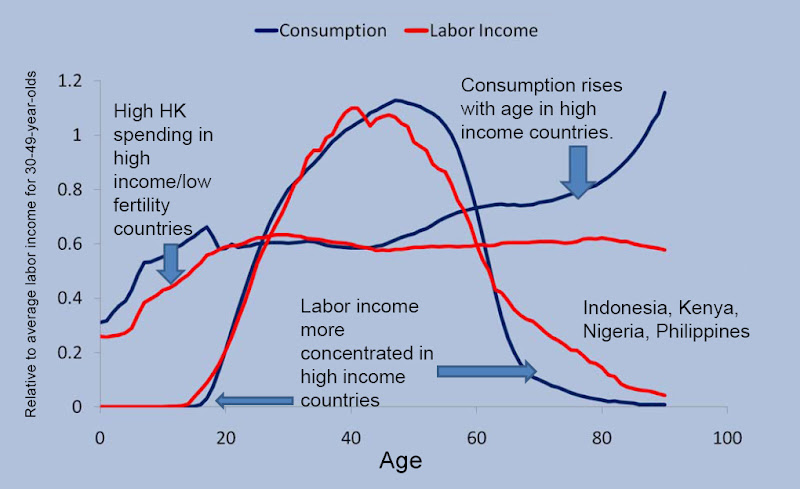
Based on data collected through National Transfer Accounts, Mason and Lee’s economic lifecycle tracks the labor income and consumption rates of a population at a given age. In high income countries, consumption increases around the teen years as a result of investments in education, then dips slightly, and, finally, sharply rises around the age of 80 due to high health care expenditures. The consumption rate remains relatively flat in low income countries, with consumption differing the most in the older ages.
The support ratio measures the number of workers relative to the number of consumers, while taking into account age-specific variances in number of hours worked and level of consumption. Mason explained that China, after four decades of rapid growth, has reached the peak of its support ratio, with many workers relative to the number of consumers. However, China is rapidly aging, like much of Northeast Asia, and also because of its one-child policy. The resulting decline in its support ratio will likely limit its economic growth; however, Mason cautioned that it would be “rash” to say that its growth will bottom out completely.
The United States has an age structure that is “quite a bit more favorable” than other industrial countries, Mason said. Higher fertility, lower life expectancy, and a higher rate of immigration mean that aging is coming more slowly to the United States than other developed countries.
The Second Demographic Dividend: An Investment OpportunityDuring the first demographic dividend, the labor force grows more rapidly than the dependent population, thus allowing more resources to be spent on economic growth. But what happens after that? As populations age, there is a “semi-automatic” increase in investment in human, physical, or financial capital, Lee explained; for example, as fertility falls, the amount invested per child increases. This second demographic dividend, said Lee, can help somewhat offset the decline in support ratio that comes in the third phase of the age transition – aging.
One response to the increased costs of an aging population, said Lee, is to reduce consumption in proportion to the decline in the support ratio. Another option would be adding more hours to the work day or pushing the retirement age back. In the United States, Lee said that to offset the declining support ratio entirely by postponing retirement would require postponement by eight years up to 2050, and 10 years by 2085.
Brazil, Lee said, is the “world champion” of pension generosity, where pensions make up 12 percent of the GDP. The United States, by contrast, relies on asset income from physical or financial investments for about two-thirds of its retirement income. Brazil’s challenge, when it begins to feel the effects of aging (it is still relatively young), will therefore be much greater than in the United States.
A “New Lens” on Aging
Aging, Hoskins said, is not the “catastrophe” that it has been portrayed to be in the media. Supporting an aging population is “something we can plan for and handle,” he said. It is possible “to do the right thing to make sure citizens have a decent life.” The problems come when a country waits too long or does not plan at all, such as in Nigeria and the Philippines where, Hoskins said, they have very underdeveloped social protection systems and the elderly have little to no income. Mason and Lee’s analysis of the work/consumption ratio, said Hoskins, offers a “new lens” into how the world will deal with aging.
Sources: Los Angeles Times, National Transfer Accounts, UNFPA, World Bank.
Image Credits: “Elderly couple – Meiji-jingu,” courtesy of flickr user Tom Spender. Chart courtesy of Ronald Lee and Andrew Mason, National Transfer Accounts. -
Book Launch: ‘The Future Faces of War: Population and National Security,’ by Jennifer Dabbs Sciubba
›“Demographic trends by themselves are neither inherently good nor bad. It’s really a state’s ability to address these issues that can determine the outcome,” said Jennifer Dabbs Sciubba, the Mellon Environmental Fellow with the Department of International Studies at Rhodes College. At a book launch event at the Wilson Center on March 14 for The Future Faces of War: Population and National Security, Sciubba, along with Deputy Under Secretary Kathleen Hicks of the Department of Defense, discussed the national security implications of demography and its important role in understanding and managing conflicts around the world. [Video Below]
Demography as an Indicator, Multiplier, and Resource
Demography can be thought of in three ways, explained Sciubba: as “an indicator of challenge and opportunity; a multiplier of conflict and progress; and a resource for power and prosperity.”
A country’s age structure can pose a challenge, said Sciubba, because countries with a large percentage of their population under the age of 30 “are about two and a half times more likely to experience civil conflict than states with more mature age structures.” Tunisia’s recent revolution, she said, could be understood as a “story about demography.”
The 26-year-old fruit vendor Mohammed Bouazizi, who set himself on fire on December 17 after being hassled by police, was part of one of the largest age cohorts in Tunisia, those aged 25-29. There are some 64 million young men across the Middle East-North Africa region between the ages of 15 and 30, according to UN estimates. “If his death was the spark” for the unrest in the region, Sciubba said, “it’s the underlying demographic trends that were the fodder.”
Yet, Sciubba sees opportunity within this challenge. Citing the work of Richard Cincotta, she said that “states have half a chance – literally 50 percent – of becoming a democracy once their proportion of youth declines to less than 40 percent.” Tunisia has the best chance in the region of becoming a free democracy based on its demography, followed by Libya, where youth aged 15-29 are 43 percent of the adult population.
At the other end of the age structure, some of the world’s most powerful countries, such as Japan, Germany, Italy, France, Russia, and China, are rapidly aging. This aging will “somewhat decrease the ability of these states to project political, economic, and military power” due to a shortage of labor and a smaller pool of funding, said Sciubba.
Countries with transitional age structures, such as India, Brazil, and South Africa, face different security challenges. With a majority of their populations between 15 and 60 years old, there are more people contributing to the economy than are taking away, which could bolster these countries economically and politically (the “demographic dividend”). Global institutions will have to reform and include these countries, she advised, “or else become irrelevant.”
But the defining trend of the 21st century, said Sciubba, is urbanization. While great sources of economic growth, cities are also quite vulnerable to natural disasters and terrorism because of their concentrations of people, wealth, infrastructure, and bureaucracy.
In looking to the future, Sciubba called for continued support for family planning initiatives. “At least 90 percent of future world population growth will take place in less developed countries,” which are least equipped to handle the demands of that growth, she said. In addition, Sciubba recommended that the United States seek out partnerships with countries that have transitional age structures, particularly India, which could be a stabilizing force in a tumultuous region. She also called on the United States to partner with states in the Western Hemisphere and remain open to migration.
Defense and Demography
“Understanding population is critical to our success in being able to prevent conflict, and also managing conflict and crises once we’re involved,” said Hicks, describing the Department of Defense’s (DOD) interest in demography. However, the DOD does not “treat demographics as destiny,” she said, but instead as “one of several key trends, the complex interplay of which may spark or exacerbate future conflicts.”
Recent world events, such as those in the Middle East and North Africa, “have demonstrated how critical our understanding of population is for security practitioners,” said Hicks. Similarly, the recent earthquake and tsunami in Japan dramatically illustrate the vulnerability of large urban areas. Echoing Sciubba’s comments on population aging, she cited “incredible divestments in defense” in Europe, which, she said, “puts us, as a key partner in NATO, at a thinking stage.”
Under Secretary of Defense for Policy Michèle Flournoy is “deeply interested” in demographic issues, said Hicks. She identified other demographic areas of great interest for her office: the youth bulge in Pakistan, urbanization in Afghanistan, the role of highly educated women in Saudi Arabia, the Chinese diaspora in the Americas, Russia’s shrinking population, and various trends in China, including aging, gender imbalance, urbanization, and migration.
Image credit: “Iraq,” courtesy of flickr user The U.S. Army.
Sources: ECSP Report 12, Financial Times, The New York Times, Population Reference Bureau, UN Population Division. -
Demographic Trends and Policy Implications in Northeast Asia
›Japan, the People’s Republic of China, Taiwan, and Korea are all aging societies. On February 26, the Wilson Center’s Asia Program hosted an event to consider issues related to demographic change in Northeast Asia. What will be the effect of aging on economic output in these countries? Can welfare states established for much younger populations in developed economies survive the stress of demographic change, or will governments in Northeast Asia need to radically rethink the provision of care to the elderly? Can immigration reform alleviate many of the problems associated with more elderly populations in Northeast Asia? And will current demographic shifts foster more benign or more belligerent interstate relations in the region?
At the event, Harvard University School of Public Health research associate Jocelyn Finlay noted that demographic trends are often overlooked in explaining economic growth in Japan, South Korea, and Taiwan between 1960 and 2000. Demographers estimate that decreases in infant mortality and adult fertility levels, which resulted in an increase of workers relative to dependents, accounted for up to a third of economic growth in these countries during this period. As the age cohort born after 1945 enters into retirement, however, the increase in dependents relative to new workers will be a contributing factor to sluggish growth. Finlay mentioned that pro-natalism and pro-immigration policies, and policies that encourage women and the elderly to participate in the workplace, could help to mitigate the effects of an aging society on economic growth but noted that such policies were all difficult to implement.
These difficulties were examined in further detail by Ito Peng, professor of sociology at the University of Toronto. Peng noted that East Asian democracies have traditionally maintained very lean welfare states, relying instead on private institutions such as extended families to carry much of the burden of, for example, care for the elderly. However, public provision of care for the aged is increasing in these countries, where the nuclear family has become the norm. Governments must actively pursue strategies to increase the number of workers and therefore income tax revenues to pay for the resulting increases in public spending.
However, policies intended to expand the tax base often have unintended consequences. For example, encouraging people to have larger families often has the effect of forcing mothers to stay at home to care for their children, depriving the labor force of a productive worker in the short term. To address this problem, Japan and South Korea have increased the level of public childcare provision. However Peng believes that there needs to be greater integration between the private and public spheres to make Northeast Asian workplaces, still a sphere of male dominance, friendlier to working mothers. Companies that insist on significant overtime duties could, for example, find ways to let working parents maintain a work-life balance that allows them to personally care for their children. Northeast Asian countries can also institute pro-immigration policies to bring more young workers from abroad. However, sustained immigration policies are also difficult in nations, like Japan and South Korea, without a history of accepting newcomers.
For Richard Cincotta, demographer-in-residence at the Stimson Center and consultant for the Wilson Center’s Environmental Change and Security Program, demographic change will be a major factor in determining the way states in Northeast Asia approach security. To illustrate the relationship between demography and security, Cincotta noted that Japan’s militarist period in the 1930s and 1940s occurred when its population was younger, more ambitious, and more energetic. With older societies, countries in Northeast Asia will be able to recruit fewer males for the military, meaning their foreign policies may shift more towards caution.
The exception, however, is China, where the number of potential male recruits far outnumbers those of its neighbors. This means that Japan, South Korea, and Taiwan will come under more pressure to intensify the use of human capital by promoting more professionalized and better equipped militaries. They will also have incentives to resolve any differences with their key ally, the United States, as well as among each other. Cincotta suggested that we may be seeing the start of a new type of Cold War, where Pacific Northeast Asian states cooperate to check a potential Chinese regional hegemon.
Bryce Wakefield is a program associate with the Asia Program at the Woodrow Wilson Center.
Photo Credit: “Mouth wide open,” courtesy of flickr user Azzazello. -
Book Preview: ‘The Future Faces of War: Population and National Security’
›February 3, 2011 // By Christina DaggettThe word “population” doesn’t come up too often in national security debates, yet, a shift may be coming, as global population reaches the seven billion mark this year, youth-led unrest rocks the Middle East, and questions of aging enter the lexicon of policymakers from Japan and South Korea to Europe and the United States. What does a population of nine billion (the UN medium-variant projection for 2050) mean for global security? How will shrinking populations in Europe affect Western military alliances and operations? Is demography destiny?The latter question has plagued demographers, policymakers, and academics for centuries, resulting in heated debate and dire warnings. Jennifer Dabbs Sciubba continues this debate in her new book, The Future Faces of War: Population and National Security, but with a decidedly more measured and optimistic tone (full disclosure: Sciubba was one of my professors). The book is targeted at policymakers but is accessible to anyone with an interest in the field of demography and national security. She will launch her book at an event hosted by the Wilson Center on March 14.
Turning Challenge Into Opportunity
The main themes of The Future Faces of War are challenge and opportunity. Yes, national security will be tested by a series of evolving demographic trends in the decades ahead, but with proper insight and preparation, states can turn these challenges into opportunities for growth and betterment. Sciubba writes, “How a state deals with its demographic situation – or any other situation for that matter – is more important than the trends themselves” (p.125).
Part of turning these population challenges into opportunity is understanding long-term trends – a daunting task given the range and number of trends to consider. Drawing on her own experiences in the defense community, Sciubba writes how policymakers were “receptive” to the idea of population influencing national security, but that the “overwhelming number of ways demography seemed to matter” made them hesitant to act (p.3). With the publication of this book, which clearly and concisely outlines the basics of each population trend with demonstrative examples, hopefully that hesitation will be turned into action.
Youth and Conflict
The first population trend Sciubba highlights is perhaps the one of most immediate concern to national security policymakers given recent world events. In the chapter “Youth and Youthful Age Structures,” Sciubba discusses the security implications of those countries (in particular those in Africa, the Middle East, and Central Asia) with a majority of their population under the age of 29. She writes, “Most important for national security, countries with youthful age structures are generally the least developed and least democratic in the world, and tend to have the highest risk of civil conflict” (p. 18). In fact, between 1970 and 1999 countries with very young and youthful age structures were two to four times more likely to experience civil conflict than countries with more mature age structures.
The risks of very young and youthful populations are well documented (Sciubba cites the examples of Somali piracy, religious extremism, and child soldiers in Africa), but what has not been as widely discussed are the opportunities. Youthful states have a large pool of potential recruits for their armies, plenty of workers to drive economic development, and even an opportunity to grow democratically through social protest. Sciubba writes, “Youth can also be a force for positive political change as they demand representation and inclusion in the political process… social protest is not always a bad thing, even if it does threaten a country’s stability, because it may lead to more representative governance or other benefits” (p. 23). (For more on youth and the transition to democracy, see “Half a Chance: Youth Bulges and Transition to Democracy,” by Richard Cincotta, and his recent blog post about the Jasmine Revolution in Tunisia).
Graying of the Great Powers
At the other end of the demographic transition is population aging. Sciubba points out that the countries with the highest proportions of people aged 60 and older are also “some of the world’s most powerful and economically or politically strategic states” (p. 42). Europe, Japan, and the United States are all getting older (though the United States to a slightly lesser extent), and Sciubba states that the “graying” of these countries has the potential to greatly limit military preparedness, size, and funding. She points out that the number of recruits available will be much smaller and more money will have to be spent on pensions and health care for the growing number of elderly persons.
To counteract these challenges, Sciubba recommends that aging states seek out alliances with each other and countries with younger populations. She writes, “As part of strong alliances, states have strength in numbers, even if they are individually weakened by aging” (p. 47). Another alternative would be to improve military technology and efficiency to compensate for the drop in personnel.
Migration and Security: A “Unique” Relationship
Migration, the third pillar of demographic change after fertility and mortality, has what Sciubba calls a “unique relationship to national security” (p.83). Migration “is the only population driver that can change the composition of a state or a community within months, weeks, or even days” (p. 83). Mass migrations (such as those caused by a natural disaster or violent conflict) are the best examples of this trend. Some of the security challenges Sciubba highlights about migration are refugee militarization, competition for resources, and identity struggles among the native and migrant populations.
However, Sciubba also argues that both migrants and receiving countries can benefit. Origin states release pressure on their crowded labor markets and earn income from remittances, while receiving countries increase their labor market and mitigate population decline (a key component of U.S. growth).
Much of this has been studied before, but two new developments in migration trends that Sciubba calls to our attention are what she calls the “feminization of migration” (the increasing number of women who are likely to move for economic reasons) and migration as a result of climate change. Both are intriguing new areas of inquiry that deserve further study, but only get a passing mention in the book.
Making Her Case
The basic trends outlined above are only a small sampling of the wealth of information to be found in The Future Faces of War. Other noteworthy topics include a discussion on transitional age structures, urbanization, gender imbalances, HIV/AIDS, differential growth among ethnic groups, and many more. The topics are varied and wide-ranging and yet, Sciubba manages to connect them and makes her case convincingly for their inclusion in the broader national security dialogue. Sciubba has briefly written about many of these topics before, but this is the first time she (or anyone else, for that matter) has brought them together in one comprehensive book with such a focus on national security.
Christina Daggett is an intern with ECSP and a former student of Jennifer Dabbs Sciubba’s at Rhodes College.
Sources: Population Action International.
Photo Credits: “Children at IDP Camp Playful During UNAMID Patrol,” courtesy of flickr user United Nations Photo. Book cover image provided by, and used with the permission of, Jennifer Dabbs Sciubba and ABC-CLIO. -
Carl Haub, Behind the Numbers
Taiwan’s Birth Rate Lowest Recorded in History
›January 27, 2011 // By Wilson Center StaffExcerpted from the original article, by Carl Haub, on the Population Reference Bureau’s Behind the Numbers blog:
Taiwan’s government has just announced that the country’s total fertility rate (or TFR, the average number of children a woman would bear in her lifetime if the birth rate of a particular year were to remain unchanged) in 2010 was the lowest in its history at 0.91 children per woman. It’s the lowest rate any country has ever reported in history. The announcement itself is a bit of a projection since births have been officially reported only through November 2010. The country’s TFR had declined to 1.1 in 2005 and had remained there through 2009.
The rather spectacular drop in 2010 was due to an additional reason: 2010 is the Year of the Tiger on the Chinese calendar, beginning on February 14. The Tiger year is particularly inauspicious for births since Tigers, while seen as brave, are also seen as headstrong and possibly difficult to work with. It is quite common for employers to consider the zodiac of job applicants and Tigers may be avoided so that parents have some concrete reasons to avoid having a child in Tiger years. While there has been a lot of concern over the demographic situation for some time, Taiwan’s President Ma Ying-jeou has now called for measures to increase the birth rate to be raised to the “national security level.”
Continue reading on Behind the Numbers.
Sources: Asia Times, USA Today.
Photo Credit: Adapted from “070923 sleeping baby,” courtesy of flickr user Wowo and her families. -
Too Few or Too Many? Joel E. Cohen on How Education Can Address Both
›December 17, 2010 // By Wilson Center Staff“So which is it: Is it too many people or is it too few people?” asks Joel E. Cohen of the Rockefeller University in this interview with ECSP. “The truth is, both are real problems, and the fortunate thing is that we have enough information to do much better in addressing both of those problems than we are doing – we may not have silver bullets, but we’re not using the knowledge we have.”
Cohen has studied the population-resources equation, trying to determine how best to support global demographics in a sustainable, equitable way. He points to the cross-cutting power of education to both curb rapid population growth in the developing world and ease the cost of aging populations in the developed.
“On continuing rapid population growth, we know that more education is associated with reductions in fertility,” said Cohen. And when combined with voluntary family planning, it’s also cheap “compared to the costs of having children that are not well cared for – the opportunity costs,” he said.
On aging, “we know that people who are educated well in their youth – both at primary, secondary, and especially tertiary levels – have better health in old age,” said Cohen. “So the costs of an aging population are diminished when people are educated. They take better care of themselves and they have options – they can use their minds as their bodies mature.”
Education is a long-term solution, but shorter-term policy options, like France’s bump of the retirement age to 62 that prompted rioting this fall, will also be necessary. “Sixty-two is only a way station,” Cohen said. “The retirement age has to move up, because people are living longer, they’re more productive, they’re in better health, and they’re going to have to keep working to take care of themselves.” -
John Bongaarts on the Impacts of Demographic Change in the Developing World
›“The UN projects about 9.1 billion people by 2050, and then population growth will likely level off around 9.5 billion later in the century. Can the planet handle 9 billion? The answer is probably yes. Is it a desirable trajectory? The answer is no,” said John Bongaarts, vice president of the Policy Research Division at the Population Council, in this interview with ECSP.
Although family planning was largely brushed aside by international policymakers following the 1994 UN International Conference on Population and Development in Cairo, Bongaarts said he is hopeful because it is now enjoying a higher profile globally – and receiving greater funding.
“I am optimistic about the understanding now, both in developing and developed world, and in the donor community, that [family planning] is an important issue that should be getting more attention,” Bongaarts said. “And therefore I think the chances of ending up with a positive demographic outlook are now larger than they were a few years ago.”
The “Pop Audio” series is also available as podcasts on iTunes.