Showing posts from category adaptation.
-
Full Extent of Africa’s Groundwater Resources Visualized for the First Time
›“In Africa, groundwater is the major source of drinking water and its use for irrigation is forecast to increase substantially to combat growing food insecurity,” yet, a lack of quantitative data has meant that “groundwater storage is consequently omitted from assessments of freshwater availability,” according Alan Macdonald, Helen Bonsor, and Brighid Dochartaigh of the British Geological Survey, and Richard Taylor of University College London, writing in Environmental Research Letters.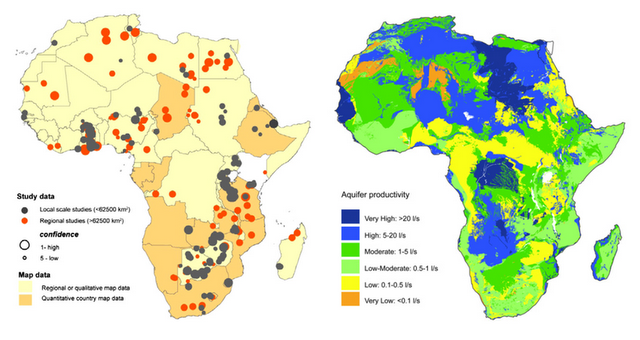
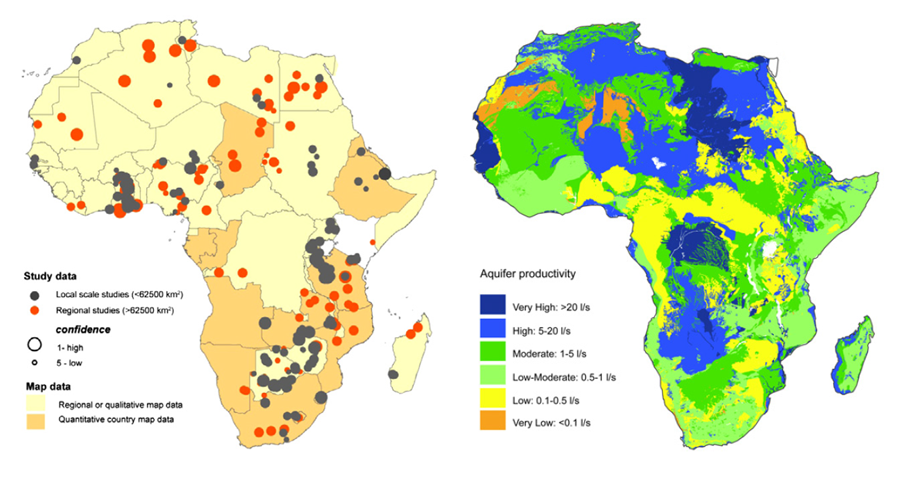
The authors hope to remedy this with new research presented in “Quantitative Maps of Groundwater Resources in Africa.” They used estimates compiled from geologic data and 283 aquifer summaries from 152 different publications to quantitatively visualize, for the first time, the full extent of Africa’s groundwater resources.
Tapping a Hidden Resource
The study estimates the scale of the continent’s groundwater resources at around 0.66 million km3. This volume, the authors explain, is “more than 100 times the annual renewable freshwater resources, and 20 times the freshwater stored in African lakes.”
Tapping into this massive resource is not always straightforward, however. The largest aquifers, and those most able to support high yielding bores, are concentrated in the arid regions of North Africa. The depth of these aquifers and their distance from major populations creates substantial economic challenges for extraction.
The geographic distribution of aquifers across sub-Saharan Africa is also quite variable, and local geology can determine not just the availability and accessibility of water but also its quality. For instance, geologic specificities can result in elevated levels of arsenic and other undesirable chemicals. Furthermore, “contamination…is common in urban areas from widespread and dispersed faecal effluent from on-site sanitation and leaking sewers.”
Tempering Expectations
Throughout Africa, “groundwater provides an important buffer to climate variability and change,” say the authors. But these buffers are not a singular solution to the threat of future water scarcity.
As the analysis shows, most aquifers, especially south of the Sahara, are unlikely to sustain boreholes of a higher capacity than that required by community-level hand pumps (one liter per second of flow at minimum). Yet, commercial irrigations schemes and urban towns typically demand boreholes greater than five liters per second, according to the study.
So, groundwater extraction may help communities and some small-scale farmers maintain access to water, particularly because many aquifers are found to possess the storage capacity required “to sustain abstraction through inter-annual variations in recharge,” however, “strategies for increasing irrigation or supplying water to rapidly urbanizing cities that are predicted on the widespread drilling of high yielding boreholes are likely to be unsuccessful.” Especially, the authors assert, where drilling precedes detailed local scale mapping of the available resources.
Sources: Environmental Research Letters.
Image Credit: Figures 1 and 3, courtesy of Environmental Research Letters. -
A Northern View: Canada’s Climate Claims and Obligations
›Reneging on Kyoto, Keystone pipeline drama, pain at the pump, re-aligned Arctic sovereignty, melting outdoor hockey rinks – all these aspects of climate change are being discussed in Canada.
However, Canadians, as potential citizens of the next energy superpower, need a more comprehensive and enriching debate. Climate change adaptation measures, at home and abroad, are inevitable, but the issue has largely been ignored by the federal government thus far.
To many Americans, it may seem that Canada has equated energy production with national prosperity, but Canadians are increasingly concerned about the human security and eco-justice implications of ongoing climate change as well. Lack of leadership at the federal level on Kyoto-related energy efficiency and emissions mitigation has been partially offset by actions at the provincial and municipal levels, but climate change is occurring now and it demands a coordinated response from the federal government, the only political apparatus capable of channeling the resources necessary for making a solid contribution to global climate change adaptation.
A moderate predictive scenario suggests that the regional impacts of climate change will be very expensive: the UN projects the global Green Climate Fund will require up to $100 billion a year by 2020. Water stress – too little, too much, or the perception of either – may be the most common theme. Coastal flooding, shoreline erosion, glacier retreat, chronic water shortages, loss of biodiversity and habitat, increased spread of invasive species, extreme weather events; taking preventive action against these (beyond the obvious call for reduced emissions) will be prohibitively expensive for most communities around the globe, including the coastal and northern regions of Canada.
The UN Convention to Combat Desertification has become a conduit for the argument that drought and land degradation related to climate change justifies southern demands for northern investment in initiatives in Africa and elsewhere. As a high emissions per capita nation, Canada has an obligation to contribute to such international efforts.
But I also don’t see why the indigenous peoples of the circumpolar north should be denied claims as permafrost thaws and ice-cover vital for subsistence hunting disappears. Citizens of small island states, to whom adaptation may well mean the abandonment of their homeland, have charged willful ignorance or purposeful negligence of their plight; so too might riparian communities along Canada’s many ocean shorelines, lakes, and rivers. Farmers, fishers, First Nations communities: all will need to adapt. We need to start seriously planning ahead to meet climate change scenarios, instead of burying the issue under the tar sands.
Of course, people will adapt to shifting conditions; such is the imperative of survival. And there are many ingenious ways this will materialize. Indeed many mitigation and adaptation strategies blend together as hybrids today. Building more effective alternative energy systems can be seen as much as responses to climate change as preventive measures and involve both public and private sector funding, for example.
However, paying for adaptation is another matter, and here it is vital in my view to stress the potential role of infrastructure spending by the federal government. Much of Canada’s current fiscal restraint is indeed a welcome development if the government cuts back on waste and redundancy, but not if it serves as a veil for sacrificing principles of eco-justice – the idea that those who made the least contributions to and benefit the least from environmental problems should not bear disproportionately higher risks.
Of course there will be nasty disputes ahead about the accounting, accountability, legitimacy, and purpose of climate change adaptation funding for Canada, in or out of the UNFCCC process, but let me draw just a few general conclusions at this stage:- There is an ethical imperative to contribute to international adaptation funding, perhaps just as great an imperative as traditional efforts to help former colonized countries. It’s not just about money, at least not directly: Canadian technical, policy, and financial expertise should be harnessed for this purpose as well.
- Unlike in other policy areas, there is no way to unload or pass the buck on climate change adaptation efforts: they demand the utilization of centralized resources redistributed throughout the country and through multilateral funding mechanisms.
- Adaptation funding should not, however, supplant more traditional emergency, humanitarian, or environmental funding. It should be seen as a supplement, albeit one with increasing importance, but not as a new form of dependency or gold-rush of aid-with-obligations opportunities. The current government is right to worry about accountability issues.
- But accountability goes both ways: we need at least to get the accounting and communications right on this, thus the need for open dialogue and ongoing consultation. Killing the well-respected National Roundtable on the Environment and the Economy, which consulted various Canadian stakeholders on key environmental questions, was not a good start.
Peter Stoett is the Fulbright Research Chair in Canada-U.S. Relations at the Wilson Center’s Canada Institute and professor in the Department of Political Science at Concordia University, Montreal.
Sources: CBC, The Catholic Register, The Huffington Post, International Institute for Sustainable Development, UNFCCC.
Photo Credit: “City, Suburb, Ocean, Mountain,” courtesy of flickr user ecstaticist (Evan Leeson). -
Avoiding Adding Insult to Injury in Climate Adaptation Efforts
›Climate change is expected to produce winners and losers – for example, melting ice-caps may open up new economic opportunities for Greenland at the same time as sea-level rise threatens Asia’s bourgeoning coastal mega-cities. The same can be said about plans to address climate change, from both the mitigation and adaptation perspectives. A special issue of Global Environmental Change, “Adding Insult to Injury: Climate Change, Social Stratification, and the Inequalities of Intervention,” takes on this topic, with two case studies providing particularly compelling evidence.Betsy Beymer-Farris and Thomas Bassett argue in their contribution, “The REDD Menace: Resurgent Protectionism in Tanzania’s Mangrove Forests,” that efforts to ensure REDD readiness in Tanzania have placed local communities at risk of forced evictions, shattered livelihoods, and persecution by both the state and conservation community. Contrary to dominant narratives that “portray local resources users, the Warufiji, in negative terms as recent migrants who are destroying the mangrove forests,” the authors say that they in fact depend upon “allow[ing] the mangroves to regenerate naturally while preparing new rice fields.” “To carbon traders, however, an uninhabited forest greatly simplifies the logistical tasks of monitoring and paying for ecosystem services,” assert the authors. This has resulted in declaration of local communities as squatters, illegally invading the forest. Government officials have repeatedly voiced threats of eviction. As well as increasing the potential for social tension, the study concludes that, “it is difficult to reconcile Tanzania REDD’s participatory and benefit sharing goals with the rhetoric, practices, and plans of the Tanzanian state.”In “Accessing Adaptation: Multiple Stressors on Livelihoods in the Bolivian Highlands Under a Changing Climate,” Julia McDowell and Jeremy Hess present evidence about how specifically-tailored adaptations to climate change risk increasing vulnerability to a complex web of other, less obvious stressors. The study draws evidence from the livelihoods of historically marginalized indigenous farmers in highland Bolivia. The authors, who see “adaptation as part of ongoing livelihoods strategies,” use the case to “explore the tradeoffs that households make when adjustments to one stressor compromise the ability to adjust to another.” For instance, socio-economic stressors have forced many farmers to more closely couple their livelihoods with the market economy by growing more cash crops, intensifying land use, participating in off-farm laboring, and relying on irrigated agriculture. However, the shift to more market-orientated livelihoods has also increased their sensitivity to climatic stress. “As stressors compounded, the ability to mobilize assets became constrained, making adaptation choices highly interdependent, and sometimes contradictory,” the authors write. Avoiding these sorts of lose-lose situations, requires “ensuring sustained access to assets, rather than designing interventions solely to protect against a specific stressor.” -
‘Earth Focus’ Talks to PAI About Bringing Out Women’s Voices on Climate Change
›“We have got to build an increased desire for [and] interest in what happens outside of the United States,” said Suzanne Ehlers, CEO of Population Action International (PAI). She was joined by Vice President of Research, Roger-Mark De Souza, in an episode of Link TV’s Earth Focus, “Women and the Changing Environment,” to discuss the interconnections between women’s reproductive health and climate change.
The episode, built around PAI’s Weathering Change documentary, draws together footage from Ethiopia, Peru, and Nepal to construct messages about the role that reproductive health services can play in responding to the burden that climate change places upon women in the developing world.
“Women are at the forefront of climate change impacts [and] they are disproportionately affected by the negative impacts,” said De Souza. Empowering women by increasing access to voluntary family planning services that allow them to make choices about the timing and the spacing of their births is a way to help ensure that women have the resilience required to react to climate impacts, he continued.
“I want the American people to get out of their borders more often,” said Ehlers. “The U.S. is an unbelievable global leader on reproductive health,” but fluctuations in funding due to domestic politics have sometimes “forced closures of clinics throughout the world.” By listening to those voices that are too often marginalized in international decision making, especially women, we can build a desire for international engagement, she suggests.
“It’s got to be something that the American people see as development…how it links to diplomacy and it absolutely supports defense – that those three D’s are interchangeable,” she said. -
Neil Adger: Embrace Community Identities To Improve Climate Adaptation
›April 16, 2012 // By Stuart Kent“On an individual basis, people care about things in their back garden and they also care about global icons of climate change…cultural heritage and natural heritage are two really important things that tie people to place and where the impacts of climate change are really going to be felt,” said Neil Adger, professor of environmental economics at the University of East Anglia and the Tyndall Centre for Climate Change Research.
Speaking at the Wilson Center, Adger explained that if policymakers don’t think seriously about the cultural dimensions of climate change adaptation they risk implementing measures that significantly, and negatively, impact people’s sense of community and identity.
“For more than a decade we have been looking at the economic costs, and the infrastructure, and the things that policymakers really focus on whenever they think about the impacts of climate change,” said Adger. In doing so “we realized that that doesn’t necessary motivate people in terms of what they believe the impacts of climate change are.”
Drawing from work on adaption in Australian agriculture, Adger explained that culture can be a barrier to effective adaptation where governments and policymakers fail to engage communities on a cultural basis.
More detailed information is needed to identify what people care about, how people construct perceptions of climate risk, and the best ways to engage people locally.
This is not easy, however. “I think the difficulty of looking at the cultural impacts of climate change is that they are very place specific,” Adger said.
But there is a significant payoff from the investment. “The cultural embedded-ness of our relationship with climate is also potentially a huge motivation for action and for change,” he said. This motivation can extend beyond adaptation to actually encourage people to decarbonize the economy, to mitigate the potential for negative climate change impacts in the first place, and to act as “citizens rather than as consumers.” -
Reproductive Health an Essential Part of Climate Compatible Development
›April 11, 2012 // By Sandeep BathalaECSP was at London’s 2012 Planet Under Pressure conference following all of the most pertinent population, health, and security events.
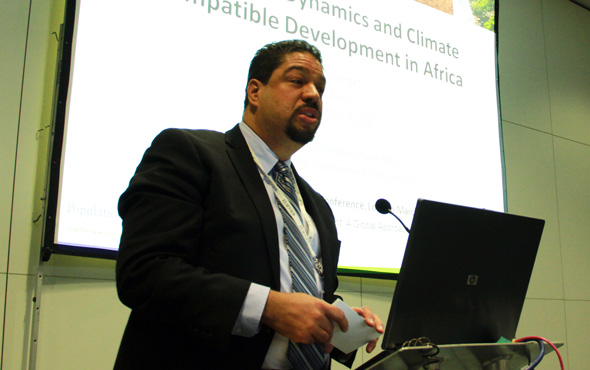
At a panel on “climate compatible development” at this year’s Planet Under Pressure global change conference, Population Action International’s Roger-Mark De Souza was the lone voice to speak about demographics. He presented a detailed analysis of population trends, based on collaboration with the Kenya-based African Institute for Development Policy.
“The link between population dynamics and sustainable development is strong and inseparable – as is the link between population dynamics, reproductive health, and gender equality,” said De Souza. These linkages were emphasized by the UN at the International Conference on Population and Development, held in Cairo in 1994, as well as during the original Rio Conference on Environment and Development in 1992.
“Climate compatible development” is a novel development paradigm being developed by the Climate and Development Knowledge Network and defined as “development that minimizes the harm caused by climate impacts, while maximizing the many human development opportunities presented by a low emissions more resilient future.”The key tenet of this development framework is an emphasis on climate strategies that embrace development goals and integrate opportunities alongside the threats of a changing climate. In this respect, climate compatible development is seen as moving beyond the traditional separation of adaptation, mitigation, and development strategies. It challenges policymakers to consider “triple win” strategies that result in lower emissions, better resilience, and development – simultaneously.
Although developed nations are historically the major contributors of greenhouse gases due to comparatively high levels of consumption, developing countries are the most vulnerable to consequences of climate change. Emerging evidence shows that rapid population growth in developing countries exacerbates this vulnerability and undermines resilience to the effects of climate change, said De Souza. Socioeconomic improvement will also increase the levels of consumption and emissions from developing countries.
“Meeting women and their partners’ needs for family planning can yield the ‘triple win’ strategy envisaged in the climate development framework,” De Souza said. “Meeting unmet family planning needs would help build resilience and strengthen household and community resilience to climate change; slow the growth of greenhouse gases; and enhance development outcomes by improving and expanding health, schooling, and economic opportunities.”
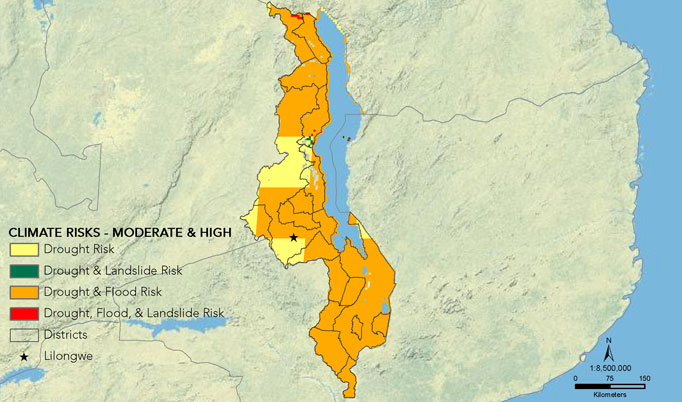
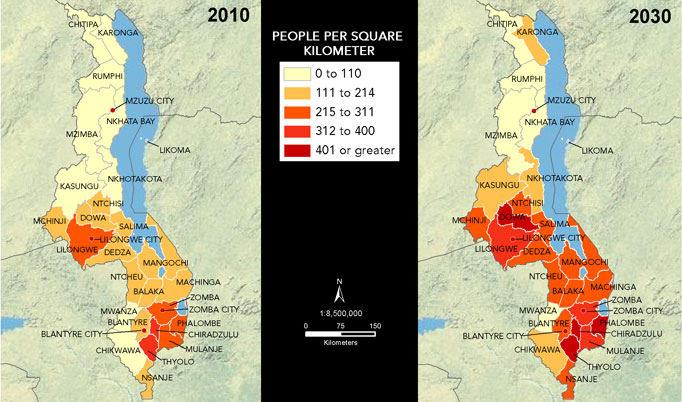
Decision makers engaged in climate change policy planning and implementation at local, national, and international levels should have access to evidence on population trends and their implications on efforts to adapt to climate change as well as the overall development process, De Souza said.He presented new maps and analysis for Africa, particularly Malawi and Kenya, developed by PAI, building on earlier mapping work which identified 26 global population and climate change hotspots – countries that are experiencing rapid population growth, low resilience to climate change, and high projected declines in agricultural production.
“PAI’s work is a clear demonstration of how better decision making can be informed by the right analysis, in the right format, at the right time,” said Natasha Grist, head of research at the Climate Knowledge and Development Network.
“Most of the hotspot countries have high levels of fertility partly because of the inability of women and their partners to access and use contraception,” said De Souza. He continued:Investing in voluntary health programs that meet family planning needs could, therefore, slow population growth and reduce vulnerability to climate change impacts. This is especially important because women, especially those who live in poverty, are likely to be most affected by the negative effects of climate change and also bear the disproportionate burden of having unplanned children due to lack of contraception.
In conclusion, said De Souza, “global institutions and frameworks that support and promote climate compatible development can enhance the impact of their work by recognizing and incorporating population dynamics and reproductive health in their adaptation and development strategies.”
For full population-related coverage from the conference, see our “Planet 2012 tag.” Pictures from the event are available on our Facebook and Flickr pages, and you can join the conversation on Twitter (#Planet2012).
Sources: Climate and Development Knowledge Network, IPCC, Population Action International.
Photo Credit: Sean Peoples/Wilson Center; Maps: Population Action International. -
Responses to JPR Climate and Conflict Special Issue: François Gemenne (Sciences Po)
›If you want a government to address something, make it a defense issue. No need to hold a PhD in political science to know that governments tend to give the highest priority to issues that involve national security interests – one can complain and whine about it, but that’s the way it is.
-
Responses to JPR Climate and Conflict Special Issue: Solomon Hsiang (Princeton University) and Todd G. Smith (University of Texas, Austin)
›A January special issue of the Journal of Peace Research brings together a new collection of evidence on a subject that has been a mainstay of the environmental security agenda: the links between climate and conflict.