-
One in Three People Will Live in Sub-Saharan Africa in 2100, Says UN
›June 8, 2011 // By Schuyler Null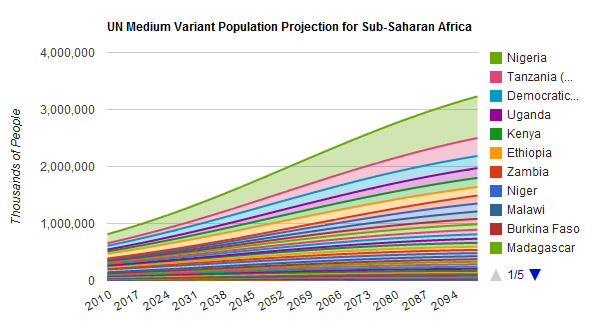
Between now and 2100, three out of every four people added to world population will live in sub-Saharan Africa. That’s what the medium variant of the UN’s world population projections estimates.* As we noted in our previous post on the latest UN numbers, Nigeria leads sub-Saharan growth, but other countries will also grow by major multiples: Tanzania and Somalia will be 7 times larger; Malawi more than 8 times; and Niger, to grow to more than 10 times its current population.
-
Health Development: Providing Free Care and Overcoming Gender-Based Violence
›In The Lancet’s “How Did Sierra Leone Provide Free Health Care?,” author John Donnelly of the Ministerial Leadership Initiative attributes the unanticipated success of a free health care program for women and children in Sierra Leone to good organization, transparency, and a high degree of cooperation between the government, donors, and development partners. One distinctive factor that has contributed to the health system’s turnaround is the unusually high level of political will on the part of President Ernest Bai Koroma, writes Donnelly. Similar to Egypt’s health and population initiatives, Sierra Leone’s marked commitment, accountability, and investment as a host country has contributed highly to the success of its program and triggered further investment from donors. In “Systematic Violence: A Barrier to Achieving the Millennium Development Goals for Women,” from the Journal of Women’s Health, authors Joia S. Mukherjee, Donna J. Barry, Hind Satti, Maxi Raymonville, Sarah Marsh, and Mary Kay Smith-Fawzi assert that the elevation of women is integral to the achievement of the Millennium Development Goals, to which structural violence serves as a significant barrier. Murkherjee et al. recommend community-based programs to combat structural violence and prevent disease, such as the Partners in Health (PIH) program in Haiti. PIH trains community health workers, expands health care as a public good, and bolsters social determinants, which include increasing access to family planning and education, providing compensation for medical workers, and improving health infrastructure.
 -
Mapping Population and Climate Change
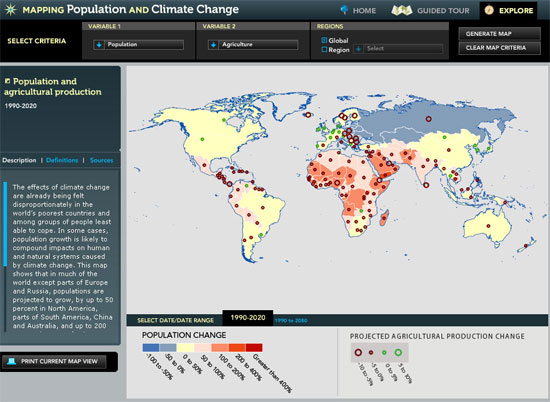
›Climate change, population growth, unmet family planning needs, water scarcity, and changes in agricultural production are among the global challenges confronting governments and ordinary citizens in the 21st century. With the interactive feature “Mapping Population and Climate Change” from Population Action International, users can generate maps using a variety of variables to see how these challenges relate over time.
Users can choose between variables such as water scarcity or stress, temperature change, soil moisture, population, agriculture, need for family planning, and resilience. Global or regional views are available, as well as different data ranges: contemporary, short-term projections (to the year 2035), and long-term projections (2090).In the example featured above, the variables of population change and agricultural production change were chosen for the time period 1990-2020. Unfortunately, no country-specific data is given, though descriptions in the side-bar offer some helpful explanations of the selected trends.
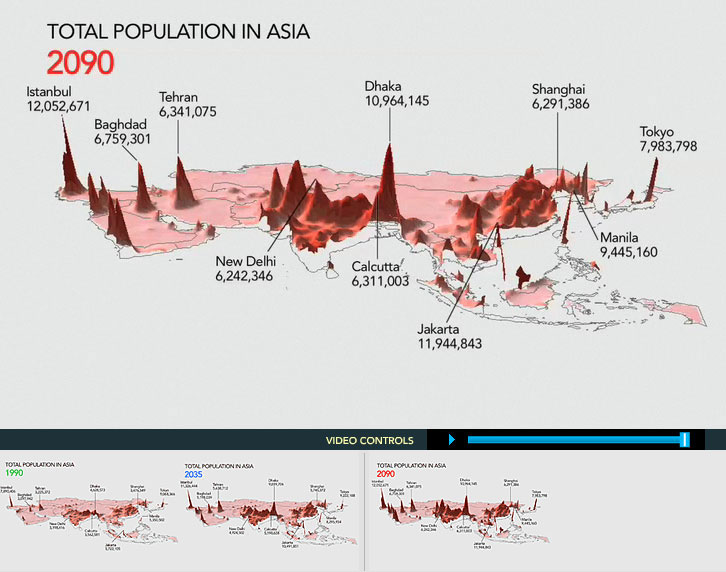
In addition, users can view three-dimensional maps of population growth in Africa and Asia for the years 1990, 2035, and 2090. These maps visually demonstrate the projected dramatic increases in population of these regions by the end of the century. According to the latest UN estimates, most of the world’s population growth will come from Africa and Asia due to persistently high fertility rates.
Image Credit: Population Action International. -
Connections Between Climate and Stability: Lessons From Asia and Africa
›“We, alongside this growing consensus of research institutes, analysts, and security agencies on both sides of the Atlantic, think of climate change as a risk multiplier; as something that will amplify existing social, political, and resource stressors,” said Janani Vivekananda of International Alert, speaking at the Wilson Center on May 10. [Video Below]
Vivekananda, a senior climate policy officer with International Alert’s Peacebuilding Program, was joined by co-presenter Jeffrey Stark, the director of research and studies at the Foundation for Environmental Security and Sustainability (FESS), and discussant Cynthia Brady, senior conflict advisor with USAID’s Office of Conflict Management and Mitigation, to discuss the complex connections between climate change, conflict, stability, and governance.
A Multi-Layered Problem
Climate change and stability represent a “double-headed problem,” said Vivekananda. Climate change, while never the only cause of conflict, can increase its risk in certain contexts. At the same time, “states which are affected by conflict will already have weakened social, economic, and political resilience, which will mean that these states and their governments will find it difficult to address the impacts of climate change on the lives of these communities,” she said.
“In fragile states, the particular challenge is adapting the way we respond to climate change, bearing in mind the specific challenges of operating in a fragile context,” said Vivekananda. Ill-informed intervention programs run the risk of doing more harm than good, she said.
For example, Vivekananda said an agrarian village she visited in Nepal was suffering from an acute water shortage and tried adapting by switching from rice to corn, which is a less water-intensive crop. However, this initiative failed because the villagers lacked the necessary technical knowledge and coordination to make their efforts successful in the long term, and in the short term this effort actually further reduced water supplies and exacerbated deforestation.
“Local responses will only be able to go so far without national-level coordination,” Vivekananda said. What is needed is a “harmony” between so-called “top-down” and “bottom-up” initiatives. “Adapting to these challenges means adapting development assistance,” she said.
“What we’re finding is that the qualities that help a community, or a society, or in fact a government be resilient to climate change are in fact very similar qualities to that which makes a community able to deal with conflict issues without resorting to violence,” said Vivekananda.
No Simple, Surgical Solutions
“The impacts of environmental change and management of natural resources are always embedded in a powerful web of social, economic, political, cultural, and historical factors,” said Stark. “We shouldn’t expect simple, surgical solutions to climate change challenges,” he said.
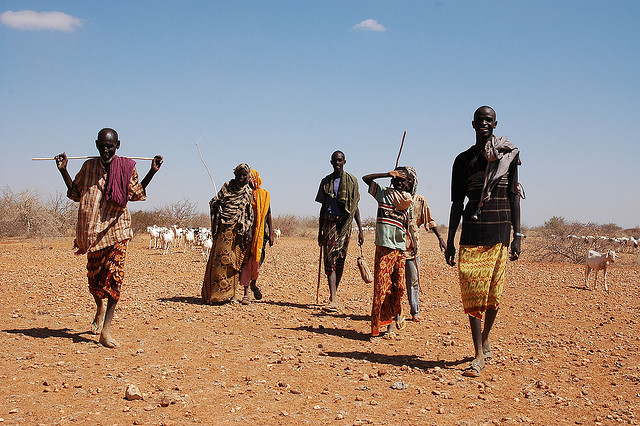
Uganda and Ethiopia, for example, both have rich pastoralist traditions that are threatened by climate change. Increasing temperatures, drought, infrequent but intense rains, hail, and changes in seasonal patterns are threatening pasture lands and livelihoods.
At the same time, pastoralists are confronting the effects of a rapidly growing population, expanding cultivation, forced migration, shrinking traditional grazing lands, anti-pastoralist attitudes, and ethnic tensions. As a result, “any intervention in relation to climate adaptation – whether for water, or food, or alternative livelihoods – has to be fully understood and explicitly acknowledged as mutually beneficial by all sides,” Stark said. “If it is seen in any way to be favoring one group or another it will just cause conflict, so it is a very difficult and delicate situation.”
Yet, the challenges of climate change, said Stark, can be used “as a way to involve people who feel marginalized, empower their participation…and at the same time address some of the drivers of conflict that exist in the country.”
Case Studies: Addressing the “Missing Middle”
When doing climate change work in fragile states, “you have to think about your do-no-harm parameters,” said Brady. “Where are the opportunities to get additional sustainable development benefit and additional stabilization benefit out of reducing climate change vulnerability?”
More in-depth case studies, such as the work funded by USAID and conducted by FESS in Uganda and Ethiopia, are needed to help fill the “missing middle” between broad, international climate change efforts – like those at the United Nations – and the community level, Brady said.
The information generated from these case studies is being eagerly awaited by USAID’s partners in the Departments of State, Defense, and Treasury, said Brady. “We are all hopeful that there will be some really significant common lessons learned, and that at a minimum, we may draw some common understanding about what climate-sensitive parameters in fragile states might mean.”
Image Credit: “Ethio Somali 1,” courtesy of flickr user aheavens. -
Southern Africa, China, and “Sustainable Access”
The Mineral Security of the United States
›In a report titled “Elements of Security: Mitigating the Risks of U.S. Dependence on Critical Minerals,” author Christine Parthemore from the Center for a New American Security writes, “Growing global demand coupled with the mineral requirements necessary for both managing military supply chains and transitioning to a clean energy future will require not only clearer understanding, but also pragmatic and realistic solutions.” Minerals and rare earth elements such as lithium, gallium, and rhenium are critical elements for many defense technologies (e.g. jet engines, satellites, missiles, etc.) and alternative energy sources (batteries and wind turbines). Parthemore argues that U.S. policy should focus on preventing suppliers from exerting undue leverage (as China did in 2010), mitigating fiscal risk and cost overruns, reducing disruption vulnerability, and ensuring the United States is able to meet its growth goals in clean energy and other high-tech fields.In a report from the U.S. Air War College, author Stephen Burgess writes of the potential for conflict over competition for “strategic minerals” in five southern African states: South Africa, the Democratic Republic of the Congo, Zambia, Zimbabwe, and Namibia. The report, titled “Sustainability of Strategic Minerals in Southern Africa and Potential Conflicts and Partnerships,” states that growing industrial countries like China will compete, potentially aggressively, with the United States for sustainable access to elements such as chromium, manganese, cobalt, uranium, and platinum group metals. Burgess recommends that the United States become more engaged in southern Africa by providing development assistance to mining communities and developing strategic partnerships. -
Watch: Edward Carr on Delivering Development and Rethinking Assumptions
›May 13, 2011 // By Schuyler NullWhile visiting West Africa first as an archaeologist, Edward Carr, an associate professor in the Department of Geography at the University of South Carolina and author of Delivering Development: Globalization’s Shoreline and the Road to a Sustainable Future, found that the villages in which he was working were far more resilient to the impacts of climate change than he expected. Increased frequency of drought, declines in rainfall, severe storms – these challenges are the sort of thing that can “totally destroy someone’s livelihood in a year,” he said in an interview with ECSP, “yet they were surviving and surviving really, really well.”
That experience and others challenged his understanding of “how I thought the world was supposed to work, how I’d been taught the world was supposed to work, versus what I was actually seeing happen on the ground,” said Carr. “I became so struck by what people were dealing with in the current context that my interest started to shift much more towards what they were doing now.”
Now serving as a AAAS fellow and the climate change coordinator for the Bureau for Democracy, Conflict, and Humanitarian Assistance at the U.S. Agency for International Development, Carr said he is trying to change how the U.S. government does development.
“The last 13 years of my career have been trying to figure out what’s actually happening on the ground first,” Carr said, and that led to writing Delivering Development.
“One of the key arguments I have is that the world does not work the way we assume it does – we are fundamentally misunderstanding what’s happening for most people living out, especially in rural areas, in the developing world,” said Carr. “The challenges they face are significant but not necessarily the ones we’re aimed at.”
For example, said Carr, “we see rising food prices globally and…the presumption is that the poorest people in the world are going to get really hammered by this.” But, he said, “That’s not entirely true, because a lot of the poorest people in the world living in rural areas have an option to just disconnect from markets completely – they go total subsistence if they need to.”
There’s an assumption that people shouldn’t be disconnecting like that, but, Carr pointed out, when new places are integrated into larger markets, “we’re also integrating them into new sources of risk that they may not be very well equipped to manage, and that becomes a really significant challenge.”
“We’re starting with the fundamental assumption that markets can be a solution, without necessarily really looking carefully at how markets can be part of the problem,” said Carr. -
Ten Billion: UN Updates Population Projections, Assumptions on Peak Growth Shattered
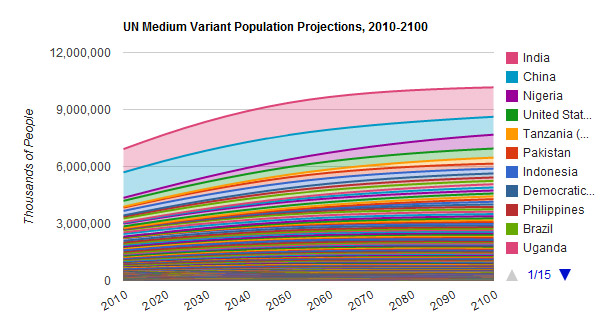
›May 12, 2011 // By Schuyler NullThe numbers are up: The latest projections from the UN Population Division estimate that world population will reach 9.3 billion by 2050 – a slight bump up from the previous estimate of 9.1 billion. The most interesting change however is that the UN has extended its projection timeline to 2100, and the picture at the end of the century is of a very different world. As opposed to previous estimates, the world’s population is not expected to stabilize in the 2050s, instead rising past 10.1 billion by the end of the century, using the UN’s medium variant model.
-
Isobel Coleman, Council on Foreign Relations
Report: Family Planning and U.S. Foreign Policy
›May 10, 2011 // By Wilson Center StaffThe original version of this brief, by Isobel Coleman of the Council on Foreign Relations, is based on the report, Family Planning and U.S. Foreign Policy: Ensuring U.S. Leadership for Healthy Families and Communities and Prosperous, Stable Societies, by Isobel Coleman and Gayle Lemmon.Click here for the interactive version (non-Internet Explorer users only).
U.S. support for international family planning has long been a controversial issue in domestic politics. Conservatives tend to view family planning as code for abortion, even though U.S. law, dating to the 1973 Helms Amendment, prohibits U.S. foreign assistance funds from being used to pay for abortion. Indeed, increased access to international family planning is one of the most effective ways to reduce abortion in developing countries. Investments in international family planning can also significantly improve maternal, infant, and child health. Support for international voluntary family planning advances a wide range of vital U.S. foreign policy interests – including the desire to promote healthier, more prosperous, and secure societies – in a cost-effective manner.
Saving Lives of Mothers and Children
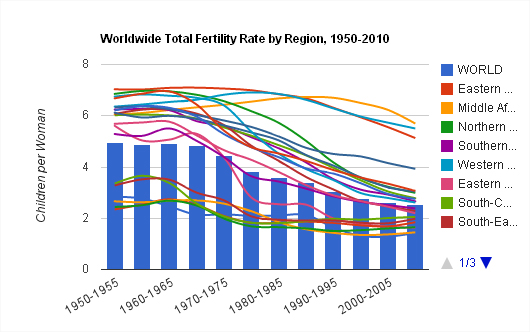
More than half of all women of reproductive age in the developing world, some 600 million women, use a form of modern contraception today, up from only 10 percent of women in 1960. This has contributed to a global decline in the average number of children born to each woman from more than six to just over three. Despite these gains, an estimated 215 million women globally – particularly in sub-Saharan Africa and southern Asia – are sexually active but are not using any contraception, even though they want to avoid pregnancy or delay the birth of their next child. With the world’s population poised to cross the seven billion mark later in 2011, and expected to grow by nearly 80 million people annually for several more decades, global unmet need for family planning is likely to increase.
Studies have shown that contraception could reduce maternal deaths by a third, from approximately 360,000 to 240,000; reduce abortions in developing countries by 70 percent, from 35 million to 11 million; and reduce infant mortality by 16 percent, from 4 million to around 3.4 million.
For a woman in the developing world, the lifetime risk of dying from pregnancy is still one of the greatest threats she will face. In developed countries, 1 out of 4,300 women will lose her life as a consequence of pregnancy, compared to sub-Saharan Africa, where that figure soars to 1 in 31, and Afghanistan, where the lifetime risk of dying from pregnancy is 1 out of 7.
Unsafe abortions are one factor contributing to high maternal death rates. As of 2008, 47,000 abortion-related maternal deaths occur annually, accounting for 13 percent of all maternal deaths. Filling the unmet need for modern family planning would lead to a reduction in mistimed pregnancies and a significant decline in abortions and abortion-related health complications. In 2000 alone, if women who wished to postpone or avoid childbearing had access to contraception, approximately 90 percent of global abortion-related and 20 percent of obstetric-related maternal deaths could have been averted.
Maternal mortality has a devastating and irreversible effect on children and families. Indeed, countries with the highest maternal mortality rates also experience the highest rates of neonatal and childhood mortality. When a mother dies, her surviving newborn’s risk of death increases to 70 percent.
Family planning presents an opportunity to curb maternal and under-five deaths not simply by giving women of all ages the ability to determine their family size, but by enabling women to delay pregnancy until at least age 18 and to space and plan their births. In this way, modern contraceptive methods help women avoid high-risk pregnancies. Studies suggest that short pregnancy intervals (when the pregnancy occurs less than twenty-four months after a live birth) are associated with an increased risk of maternal and under-five mortality. In fact, if all mothers were to wait at least 36 months to conceive again, it is estimated that 1.8 million deaths of children under five could be prevented annually.
Enhancing International Security
While much of the developed world is experiencing population stability or even decline, many countries in the developing world continue to see rapid population growth. Population imbalances have emerged as a serious issue affecting economic opportunity, global security, and environmental stability. Ongoing civil conflicts, radicalism, weak governance, and corruption are endemic problems for many fragile states. While high fertility rates are not the cause of their problems, they do complicate the challenges these countries face in trying to reduce poverty, achieve per capita income growth, provide education and productive opportunities for youth, and address increasing shortages of natural resources.With the world’s population poised to cross the 7 billion mark later in 2011, and expected to grow by nearly 80 million people annually for several more decades, global unmet need for family planning is likely to increase.
Yemen, for example, has the highest rate of unmet need for family planning of any country. Its population has doubled in less than 20 years, and it has the world’s second-youngest population. High fertility – around six children per woman – taxes Yemen’s infrastructure, education and health systems, and environment. In addition, its labor force is growing at a pace much faster than the growth of available jobs, resulting in high youth unemployment. Increasing access to family planning would help improve Yemen’s long-term prospects for achieving per capita growth and stability. Conversely, continued high fertility rates will only deepen Yemen’s current crises.
Many countries experiencing fast population growth – like Yemen – do not have the capacity to harness the potential of their young populations. In these cases, high fertility rates can lead to a vicious cycle of poverty at the community, regional, and national levels. Rapidly growing populations are also more prone to outbreaks of civil conflict and undemocratic governance. Eighty percent of all outbreaks of civil conflict between 1970 and 2007 occurred in countries with very young populations. Demographers have shown that the statistical likelihood of civil conflict consistently decreases as countries’ birth rates decline.
Countries with the highest population growth rates face real resource constraints, particularly arable land and clean water. As of 2010, 40 percent of populations in more than 35 countries have insufficient access to food, with the largest concentration in central and eastern sub-Saharan Africa. Given that many of these food-insecure countries will continue to experience significant population growth in decades ahead, malnutrition will remain a challenge.
Continue reading at the Council on Foreign Relations or download the full report, Family Planning and U.S. Foreign Policy: Ensuring U.S. Leadership for Healthy Families and Communities and Prosperous, Stable Societies.
Isobel Coleman is a senior fellow for U.S. foreign policy; director of the Civil Society, Markets, and Democracy Initiative; and director of the Women and Foreign Policy Program at the Council on Foreign Relations.
Sources: Council on Foreign Relations, Population Action International, Population Reference Bureau, UNFPA, World Health Organization.
Chart Credit: Arranged by Schuyler Null, data from UN Population Division, World Population Prospects, 2010 Revision.
Showing posts from category Africa.