• woodrow wilson center
  • ecsp

New Security Beat

Subscribe:
  • rss
  • mail-to
  • Who We Are
  • Topics
    • Population
    • Environment
    • Security
    • Health
    • Development
  • Columns
    • China Environment Forum
    • Choke Point
    • Dot-Mom
    • Friday Podcasts
    • Navigating the Poles
    • Reading Radar
  • Multimedia
    • Water Stories (Podcast Series)
    • Backdraft (Podcast Series)
    • Tracking the Energy Titans (Interactive)
  • Films
    • Water, Conflict, and Peacebuilding (Animated Short)
    • Paving the Way (Ethiopia)
    • Broken Landscape (India)
    • Scaling the Mountain (Nepal)
    • Healthy People, Healthy Environment (Tanzania)
  • Publications
  • Events
  • Contact Us

NewSecurityBeat

The blog of the Wilson Center's Environmental Change and Security Program
Showing posts by Schuyler Null.
  • Top 10 Posts for June 2016

    ›
    What You Are Reading  //  July 8, 2016  //  By Schuyler Null
    june-top-10

    “There are no walls high enough to insulate any of us from the consequences of extreme climate change,” wrote Nick Mabey last month. The same could be said for the refugee and migration crisis facing many parts of the world today, including an exasperated Kenya, detailed in another of our most popular posts. These are problems that no one nation can solve.

    MORE
  • Maxine Burkett on Why “Climate Refugees” Is Incorrect – and Why It Matters

    ›
    Friday Podcasts  //  July 1, 2016  //  By Schuyler Null
    Burkett

    More and more we are hearing stories about “climate refugees.”  U.S. Interior Secretary Sally Jewell used the term to describe the Biloxi-Chitimacha-Choctaw tribe, a community which this year became the first to receive federal funding to relocate in its entirety from their sinking island home on the Louisiana coast.

    MORE
  • Top 10 Posts for May 2016

    ›
    What You Are Reading  //  June 17, 2016  //  By Schuyler Null
    May-top-10

    Last year was the hottest on record and 2016 is shaping up to be even worse. Along with soaring temperatures though, climate change is most likely to affect you via water. A World Bank report released last month found that the difference between good and bad water management over the next four decades could swing GDP for some regions as much as 20 percent.

    MORE
  • El Niño Affects Food for 80 Million, “Paradigm Shift” Needed in Disaster Risk Assessment

    ›
    Reading Radar  //  June 9, 2016  //  By Schuyler Null

    EU-report2A report by the European Union on global food security finds 240 million people are in food stress thanks to conflict, refugee situations, flooding, drought, and El Niño. Part of a 2012 commitment by the EU to better target the root causes of food insecurity, the report analyzes the hunger situation in 70 countries and provides deeper analysis for 20.

    MORE
  • Minister Louise Mushikiwabo: “Rwanda Has Had to Make Extremely Difficult Choices”

    ›
    From the Wilson Center  //  May 25, 2016  //  By Schuyler Null

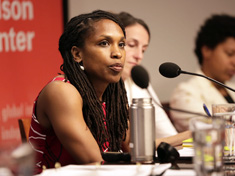
    Last month Rwanda Minister of Foreign Affairs and Cooperation Louise Mushikiwabo spoke at the Wilson Center on a wide-ranging set of issues, from the country’s development successes to the prominent role women have played in post-genocide society.

    MORE
  • Water Is the Climate Challenge, Says World Bank

    ›
    May 6, 2016  //  By Schuyler Null

    How will climate change affect you? Probably through water.

    That’s the major message of a new World Bank report that finds the ways governments treat water can have a profound effect on the economy.

    MORE
  • Top 10 Posts for April 2016

    ›
    What You Are Reading  //  May 5, 2016  //  By Schuyler Null
    April-top-10

    An alternative to rebuilding Iraq’s dangerously unstable Mosul Dam? Rapprochement between Turkey, Iraq, and the Kurds, writes Azzam Alwash for the Middle East Program in last month’s most-read story. Cooperation over water could be a mechanism for building stability and restoring vital natural resources.

    MORE
  • Top 10 Posts for March 2016

    ›
    What You Are Reading  //  April 4, 2016  //  By Schuyler Null
    March-top-10

    Water, water, everywhere. Water stories accounted for half of the most read last month. New Wilson Center Fellow Sherri Goodman outlined three principles to creating a “water-ready” world. Heather Chen highlighted a four-part update by the Kenya Broadcasting Corporation on Lake Turkana as the Gibe III Dam begins operation. Florian Krampe outlined results from a research project in rural Nepal on the effects of small hydro projects. And Alec Crawford and Angie Dazé explained lessons learned about incorporating migrant populations into conservation projects around Lake Albert.

    MORE
Newer Posts   Older Posts
View full site

Join the Conversation

  • RSS
  • subscribe
  • facebook
  • G+
  • twitter
  • iTunes
  • podomatic
  • youtube
Tweets by NewSecurityBeat

Trending Stories

  • unfccclogo1
  • Pop at COP: Population and Family Planning at the UN Climate Negotiations

Featured Media

Backdraft Podcast

play Backdraft
Podcasts

More »

What You're Saying

  • Volunteers,At,The,Lagos,Food,Bank,Initiative,Outreach,To,Ikotun, Pan-African Response to COVID-19: New Forms of Environmental Peacebuilding Emerge
    Rashida Salifu: Great piece 👍🏾 Africa as a continent has suffered this unfortunate pandemic.But it has also...
  • A desert road near Kuqa An Unholy Trinity: Xinjiang’s Unhealthy Relationship With Coal, Water, and the Quest for Development
    Ismail: It is more historically accurate to refer to Xinjiang as East Turkistan.
  • shutterstock_1779654803 Leverage COVID-19 Data Collection Networks for Environmental Peacebuilding
    Carsten Pran: Thanks for reading! It will be interesting to see how society adapts to droves of new information in...

What We’re Reading

  • Rising rates of food instability in Latin America threaten women and Venezuelan migrants
  • Treetop sensors help Indonesia eavesdrop on forests to cut logging
  • 'Seat at the table': Women's land rights seen as key to climate fight
  • A Surprise in Africa: Air Pollution Falls as Economies Rise
  • Himalayan glacier disaster highlights climate change risks
More »
  • woodrow
  • ecsp
  • RSS Feed
  • YouTube
  • Twitter
  • Facebook
  • Home
  • Who We Are
  • Publications
  • Events
  • Wilson Center
  • Contact Us
  • Print Friendly Page

© Copyright 2007-2021. Environmental Change and Security Program.

Woodrow Wilson International Center for Scholars. All rights reserved.

Developed by Vico Rock Media

Environmental Change and Security Program

Woodrow Wilson International Center for Scholars

Ronald Reagan Building and International Trade Center

  • One Woodrow Wilson Plaza
  • 1300 Pennsylvania Ave., NW
  • Washington, DC 20004-3027

T 202-691-4000