• woodrow wilson center
  • ecsp

New Security Beat

Subscribe:
  • rss
  • mail-to
  • Who We Are
  • Topics
    • Population
    • Environment
    • Security
    • Health
    • Development
  • Columns
    • China Environment Forum
    • Choke Point
    • Dot-Mom
    • Friday Podcasts
    • Navigating the Poles
    • Reading Radar
  • Multimedia
    • Water Stories (Podcast Series)
    • Backdraft (Podcast Series)
    • Tracking the Energy Titans (Interactive)
  • Films
    • Water, Conflict, and Peacebuilding (Animated Short)
    • Paving the Way (Ethiopia)
    • Broken Landscape (India)
    • Scaling the Mountain (Nepal)
    • Healthy People, Healthy Environment (Tanzania)
  • Publications
  • Events
  • Contact Us

NewSecurityBeat

The blog of the Wilson Center's Environmental Change and Security Program
Showing posts by Deekshita Ramanarayanan.
  • Highlights from COVID-19: Magnifying the World’s Inequities

    ›
    Covid-19  //  Dot-Mom  //  Friday Podcasts  //  May 29, 2020  //  By Deekshita Ramanarayanan

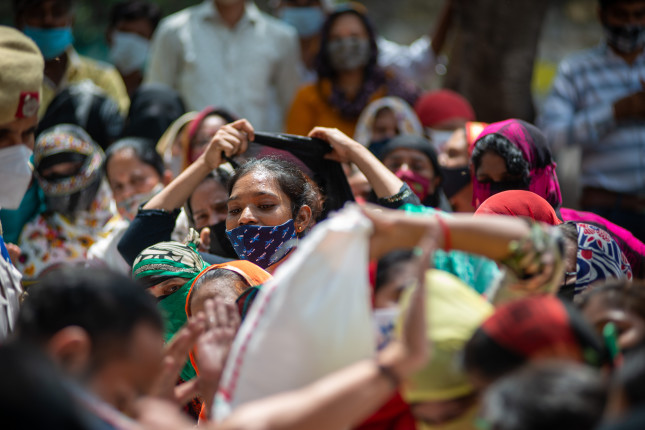
    Thumbnail-EMD-Friday-PodcastCOVID-19 has wreaked havoc the world over, and recent data shows that the hardest hit will be the world’s women and girls and populations impacted by racism and discrimination. This week’s Friday Podcast highlights remarks from a recent Wilson Center event sponsored by EMD Serono, the biopharmaceutical business of Merck KGaA, Darmstadt, Germany in the United States and Canada, on the impact of COVID-19 on race and gender inequities.

    MORE
  • COVID-19 Shines Spotlight on Race and Gender Inequities in Healthcare

    ›
    Covid-19  //  Dot-Mom  //  From the Wilson Center  //  May 12, 2020  //  By Deekshita Ramanarayanan
    49837047782_fa480c0713_c

    “While COVID-19 has wreaked havoc the world over, history has proven, and recent data agrees that the hardest hit will be the world’s women and girls and populations already impacted by racism and discrimination,” said Sarah Barnes, Project Director of the Maternal Health Initiative and Women and Gender Advisor at the Wilson Center, at a recent event on the impact of COVID-19 on race and gender inequities. Coronavirus has hurt women and girls in many ways. Among them, women have been pushed back into the home.  And healthcare workers and caregivers who are mostly women are jeopardizing their own health, caring for others.

    MORE
  • First Ever State of the World’s Nursing Report: Unlocking the Gender Dimensions

    ›
    Dot-Mom  //  From the Wilson Center  //  April 30, 2020  //  By Deekshita Ramanarayanan
    Nursing Event Photo

    “The year is 2020 and it’s a year none of us will forget due to the Covid-19 pandemic,” said Sarah Barnes, Women and Gender Advisor and Project Director of the Maternal Health Initiative at the Wilson Center at a recent webcasted Wilson Center event. “The year 2020, as designated by the World Health Organization, is also the Year of the Nurse and the Midwife and was meant to be a year of celebration and much due recognition of these two incredible professions.” This month, the first ever State of the World’s Nursing report was published by the World Health Organization (WHO), International Council of Nurses, and Nursing Now.

    MORE
  • Midwives Needed to Achieve Universal Health Coverage by 2030

    ›
    Dot-Mom  //  From the Wilson Center  //  March 25, 2020  //  By Deekshita Ramanarayanan

    midwifeWe are in the decade of action, said Anneka Knutsson, Chief of the Sexual and Reproductive Health Branch at the United Nations Population Fund (UNFPA), at a recent Wilson Center event on midwives’ crucial role in achieving universal health coverage by 2030. The World Health Organization (WHO) has designated 2020 as the Year of the Nurse and the Midwife to celebrate the accomplishments and importance of nurses and midwives in providing not just maternal health care, but care across the lifespan. Currently, 22 million nurses and 2 million midwives globally deliver 80 percent of all healthcare services in low-resource settings. However, the world will need 9 million more nurses and midwives by 2030 to meet rising healthcare demands.

    MORE
  • U.S. Representative Lauren Underwood on U.S. Maternal Health and Policy Solutions

    ›
    Dot-Mom  //  January 22, 2020  //  By Deekshita Ramanarayanan
    shutterstock_1108509287

    “This is a unique moment—a crisis that has demanded action for decades and is now getting the attention it deserves,” said U.S. Representative Lauren Underwood (D-IL-14) at a recent event on maternal health and disparities hosted at George Washington University’s Milken Institute School of Public Health. The United States has the highest maternal mortality rate among high-income countries and for every maternal death, there are 70 “near-misses.” It is important to take a “life-course” approach to address this issue from a policy perspective, said Underwood.

    MORE
  • CODE BLUE: Addressing NCDs in Maternal Health Starts with Increasing Access and Reducing Disparity

    ›
    Dot-Mom  //  From the Wilson Center  //  December 11, 2019  //  By Deekshita Ramanarayanan

    CODE BLUE Graphic 2

    We’ve got a crisis impacting our mothers and a crisis impacting our babies, said Dr. Lisa Waddell, Senior Vice President of Maternal Child Health and NICU Innovation and Impact Deputy Medical Director at the March of Dimes, at a recent Wilson Center event launching the Maternal Health Initiative’s CODE BLUE series, developed in partnership with EMD Serono, a business of Merck KGaA, Darmstadt, Germany. She was referring to non-communicable diseases (NCDs), which impact maternal health in the United States and globally. NCDs kill 18 million women of reproductive age each year, accounting for two in every three deaths among women.

    MORE
  • To Address Security in Africa, Focus on the Citizen: Ambassador Phillip Carter III on the Connections between Development and Security

    ›
    Africa in Transition  //  Friday Podcasts  //  December 6, 2019  //  By Deekshita Ramanarayanan

    Ambassador Carter 235x176To address the security challenges facing Sub-Saharan Africa we need to shift the focus from a concept of state security to one of citizen security, says Ambassador Phillip Carter III (ret.), former Ambassador to the Ivory Coast and the Republic of Guinea, in this week’s Friday Podcast. “Our current strategy of a military response to terrorist organizations or criminal networks is inadequate at best, and probably unsustainable at worst,” says Carter. “To me, the greatest security threat in Africa is poor or bad governance.”

    MORE
  • CODE BLUE: The Importance of Integrating Care for Maternal Health and Non-Communicable Disease

    ›
    CODE BLUE  //  Dot-Mom  //  From the Wilson Center  //  December 5, 2019  //  By Deekshita Ramanarayanan

    CODE-BLUE-Graphic-1 382

    “Non-communicable diseases have been the leading cause of death for women for at least the past 30 years but are often underreported and undertreated,” said Priya Kanayson, Policy and Advocacy Manager at NCD Alliance at a recent Wilson Center event on the impact of non-communicable diseases (NCDs) on maternal health. The event marked the official launch of the Maternal Health Initiative’s CODE BLUE series, developed in partnership with EMD Serono, a business of Merck KGaA, Darmstadt, Germany. Globally, in 2018, 73 percent of deaths among women were due to NCDs, amounting to 18 million women of reproductive age dying per year due to NCDs. The compounding effects of NCDs complicate women’s experiences in many unseen ways, and the rise and gravity of NCDs pose a growing and often overlooked challenge to maternal health worldwide.

    MORE
Newer Posts   Older Posts
View full site

Join the Conversation

  • RSS
  • subscribe
  • facebook
  • G+
  • twitter
  • iTunes
  • podomatic
  • youtube
Tweets by NewSecurityBeat

Trending Stories

  • unfccclogo1
  • Pop at COP: Population and Family Planning at the UN Climate Negotiations

Featured Media

Backdraft Podcast

play Backdraft
Podcasts

More »

What You're Saying

  • Volunteers,At,The,Lagos,Food,Bank,Initiative,Outreach,To,Ikotun, Pan-African Response to COVID-19: New Forms of Environmental Peacebuilding Emerge
    Rashida Salifu: Great piece 👍🏾 Africa as a continent has suffered this unfortunate pandemic.But it has also...
  • A desert road near Kuqa An Unholy Trinity: Xinjiang’s Unhealthy Relationship With Coal, Water, and the Quest for Development
    Ismail: It is more historically accurate to refer to Xinjiang as East Turkistan.
  • shutterstock_1779654803 Leverage COVID-19 Data Collection Networks for Environmental Peacebuilding
    Carsten Pran: Thanks for reading! It will be interesting to see how society adapts to droves of new information in...

What We’re Reading

  • Rising rates of food instability in Latin America threaten women and Venezuelan migrants
  • Treetop sensors help Indonesia eavesdrop on forests to cut logging
  • 'Seat at the table': Women's land rights seen as key to climate fight
  • A Surprise in Africa: Air Pollution Falls as Economies Rise
  • Himalayan glacier disaster highlights climate change risks
More »
  • woodrow
  • ecsp
  • RSS Feed
  • YouTube
  • Twitter
  • Facebook
  • Home
  • Who We Are
  • Publications
  • Events
  • Wilson Center
  • Contact Us
  • Print Friendly Page

© Copyright 2007-2021. Environmental Change and Security Program.

Woodrow Wilson International Center for Scholars. All rights reserved.

Developed by Vico Rock Media

Environmental Change and Security Program

Woodrow Wilson International Center for Scholars

Ronald Reagan Building and International Trade Center

  • One Woodrow Wilson Plaza
  • 1300 Pennsylvania Ave., NW
  • Washington, DC 20004-3027

T 202-691-4000