-
Gender Confluences and Divides: Insights from a New Afrobarometer Survey
December 8, 2025 By Joseph Asunka
The latest poll in a series of Afrobarometer surveys reveals just where Africans unite on sexual and reproductive health and rights (SRHR)—and where they diverge. There is strong support for women’s autonomy in marriage and reproductive decisions, but clear divisions on contraceptive access.
The survey on SRHR, which was implemented as part of Afrobarometer’s Round 10 surveys conducted between January 2024 and September 2025 in 38 African countries, is the first of its kind in Afrobarometer’s history. It sheds light on the extent and nuances of public attitudes toward SRHR across the continent. The findings are a timely snapshot of views on a crucial and often-contested space.
Large majorities support women’s autonomy in decisions about marriage and childbearing, as well as favoring the teaching of sexuality education in schools. Yet views are more mixed on who should have access to contraceptives, with critical divides existing on abortion as well. The broad acceptance of pregnancy termination if there is danger to a mother’s life or health is reduced significantly in other circumstances.
A Changing Landscape
The timing for such a survey is auspicious. Public opinion on SRHR in Africa is diverse and evolving. Across the continent, traditional and religious beliefs as well as cultural and social norms continue to shape citizens’ attitudes. In many communities, these topics are still considered sensitive or taboo. However, younger generations, women’s-rights advocates, and growing access to information are helping to shift perspectives.
Growing numbers of Africans believe that empowering women and girls to make informed choices about their bodies and health benefits families, communities, and economies. Women’s-empowerment initiatives and targeted interventions by governments and development partners have shored up support for access to family planning, maternal health care, and bolstered the fight against practices such as child marriage and female genital mutilation.
The results of the new Afrobarometer survey offer four key insights that allow a broader audience to track where progress has taken hold, and where work remains to be accomplished
Women’s Autonomy in Marriage and Childbearing Has Strong Support
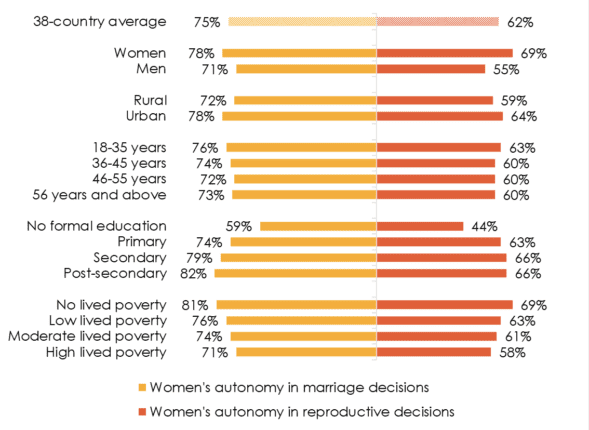
On average across 38 African countries, 75% of adults believe that girls and women should decide for themselves whether and when to marry. More than six out of 10 citizens (62%) also say that women should have the right to decide on when to have children and the number they want to have.
This support for women’s autonomy in marriage and reproductive decisions is stronger among women, urban residents, more educated citizens, and economically better-off respondents (Figure 1). Women are more likely than men to endorse women’s right to make decisions about childbearing (69% vs. 55%). Support for women’s autonomy in childbearing decisions increases from 58% among the poorest respondents to 69% among those who are economically well-off. And those with no formal schooling support women’s autonomy on childbearing decisions at 44%, as compared to 66% of those with secondary or post-secondary education.
Support for women’s autonomy regarding marriage decisions proved stronger across all demographic groups. It exceeded seven in 10 respondents except among those with no formal education (59%), yet the overall pattern is clear.
Figure 1: Support for women’s autonomy in decisions about marriage and childbearing
By demographic group | 38 countries | 2024/2025

Education Receives Solid Backing
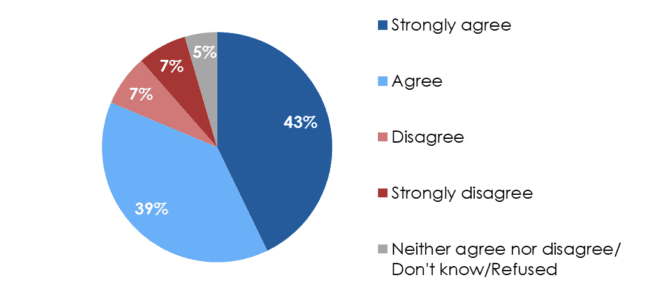
Africans strongly endorse allowing girls who become pregnant or have children to continue their education. Across the 38 countries surveyed, 81% hold this view (Figure 2), including majorities in all surveyed countries. Nearly all Gabonese (97%) and Zambian (95%) respondents replied in the affirmative.
Figure 2: Should girls who become pregnant should be allowed to stay in school?
38 countries | 2024/2025
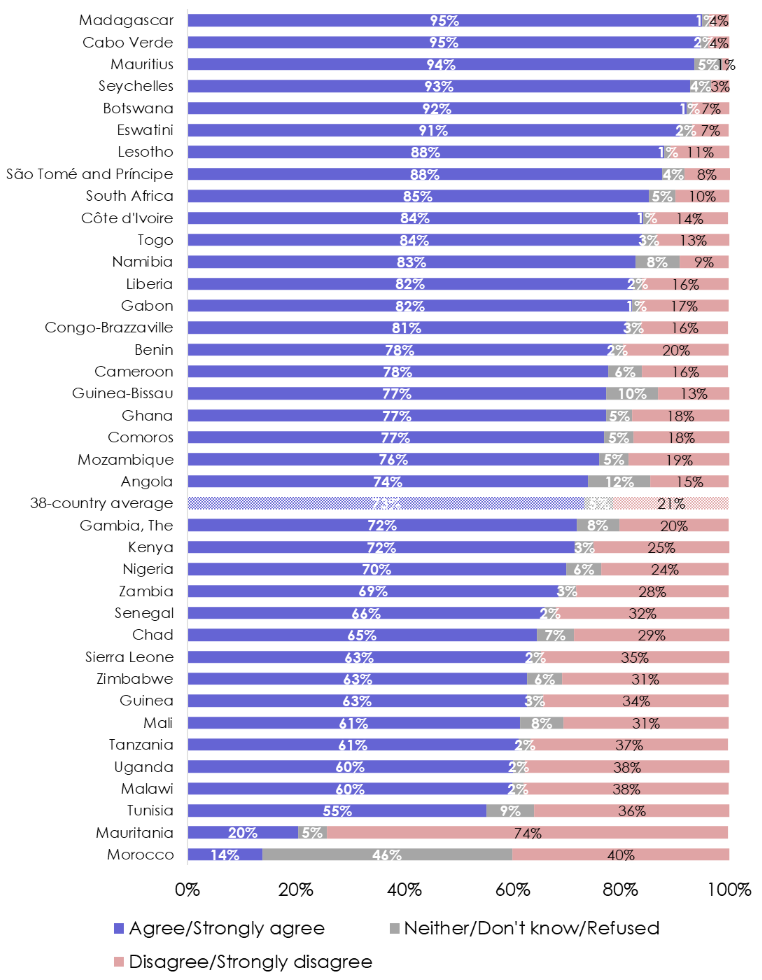
Support for teaching sexuality education in schools is also very high, with an average of 73% across the continent in favor. This view is strongly correlated with educational attainment, ranging from 60% among those with no formal schooling to 80% among those with post-secondary qualifications.
Significant country differences are apparent, however (Figure 3): More than 90% of citizens surveyed in Madagascar, Cabo Verde, Mauritius, Seychelles, Botswana, and Eswatini support teaching sexuality education in schools. By contrast, only 14% of Moroccans favor this view, while 40% oppose it and another 46% decline to express an opinion. Mauritania is the only country registering overwhelming opposition (74%) to teaching sexuality education in schools.
Figure 3: Should schools teach sexuality education?
38 countries | 2024/2025
Mixed Attitudes Toward Contraceptives
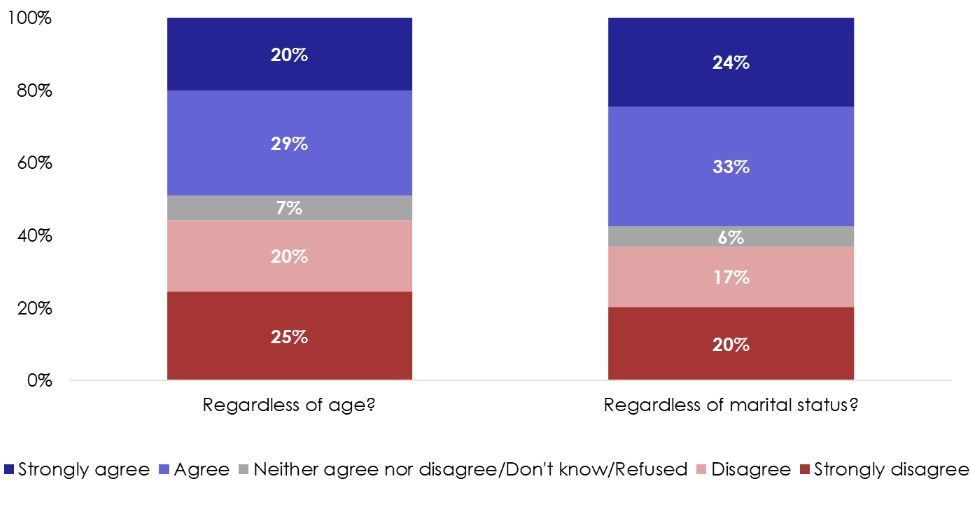
Africans across the 38 countries surveyed hold mixed views regarding access to contraceptives. A majority (58%) endorse the idea of making contraceptives available to anyone who is sexually active regardless of marital status, yet views are sharply divided on whether they should be made available to anyone who is sexually active regardless of age. In the latter case, 49% are in favor, while 45% oppose doing so (Figure 4).
Figure 4: Should contraceptives be available to all sexually active people?
38 countries | 2024/2025
Support for making contraceptives available to all sexually active individuals regardless of marital status and age is very strong in South Africa and Cabo Verde, where about eight in 10 respondents are in favor. Few Mauritanians, Moroccans, and Gambians endorse such access, however with Mauritanians expressing the strongest opposition (more than eight in 10 respondents). A large proportions of Moroccan respondents refused to offer an opinion.
Education appears to shape popular attitudes on this issue as well: Support for contraceptive access increases with respondents’ education level, with 28 percentage points separating those with no formal schooling (39%) from those with post-secondary qualifications (67%) on the question of access regardless of marital status.
Rationales for Pregnancy Termination Matter
The legality of abortion is variable (and in some cases, quite ambiguous) across the 38 countries surveyed by Afrobarometer. Yet the poll results show that on average, two in 10 Africans (22%) say women and girls in their community “often” terminate their pregnancies. Another 19% say it happens “occasionally.” Fewer than half of respondents (46%) say pregnancies are “rarely” or “never” terminated in their community, while a further 12% (including 49% of Moroccans) say they “don’t know” or declined to answer the question.
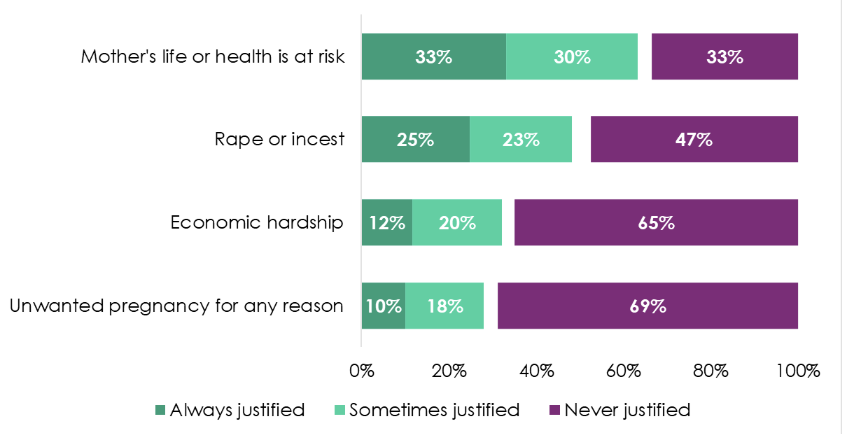
Views on conditions under which a woman is justified in seeking legal abortion also are mixed. A majority of those surveyed (63%) believe that abortion is “sometimes” or “always” justified if the mother’s health or life is at risk, and close to half (48%) believe a pregnancy occurring as a result of rape or incest may be terminated. Strong opposition remains to abortion when the pregnancy is unwanted (69% disapproval), with a further 65% demurring when the woman is economically unable to care for a child (Figure 5).
Figure 5: Justification of pregnancy termination | 38 countries* | 2024/2025 Younger Africans are somewhat more likely than their elders to see abortion as justified for any reasons cited in the survey, though the general pattern of acceptance for health reasons and reservations or opposition for other reasons holds true even for them.
Women and men do hold very similar views regarding the justifiability of terminating a pregnancy. Even in the case of rape or incest, women are only 3 percentage points more likely than men to see abortion as justifiable (50% versus 47%).
Results in individual countries do vary considerably on economic hardship as a possible justification. In South Africa, Mauritius, and São Tomé and Príncipe, about six in 10 respondents say it is “sometimes” or “always” justified to terminate a pregnancy in this case. Resistance to this notion is overwhelming (about nine in 10 respondents) in Senegal, Zambia, and Tanzania, however.
Can This New Data Shape Policy?
Afrobarometer’s new survey offers a crucial window on Africans’ views on SRHR issues. Its granular data should shape ongoing and future policy decisions and interventions on the continent.
Broad affirmation of support for women’s autonomy in choices about marriage and childbearing as well as the right of pregnant girls to continue their schooling and the teaching of sexuality education provide a firm foundation for women’s-empowerment efforts. Yet the knowledge that opinions remain far more divided when it comes to access to contraceptives and abortion is essential to shaping policy.
For women’s-rights activists especially, the survey’s assessment of differences by country, education, economic status, and local social norms should underline the importance of creating tailored, community-based approaches to sexual and reproductive health policy reform and implementation.
The overall results suggest a significant opportunity for African governments, civil society organizations, and development partners to build on public support for girls’ and women’s empowerment and autonomy to develop and implement progressive policies on SRHR. This is especially important as African countries work toward to achieve the UN’s Sustainable Development Goals — particularly those on gender equality, health, and education.
Afrobarometer’s new data does make one thing perfectly clear: Most African citizens are ready for policies that respect women’s rights and promote informed choices.
Details of the question wording and response categories for all charts used in this essay are available in this pan-African Profile publication.
Joseph Asunka is the CEO of Afrobarometer.
Sources: Afrobarometer
Photo Credits: Licensed by Adobe Stock.
 A Publication of the Stimson Center.