-
China Taps Indonesia’s Solar Potential
December 3, 2025 By Karen Teo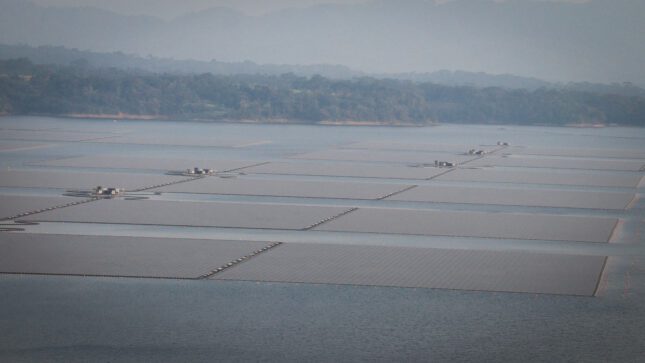
In late 2023, Indonesia’s then President Joko Widodo presided over the launch of the country’s first floating solar power plant on the Cirata reservoir in West Java. Widodo touted how at 192MW it was “the largest floating solar plant in Southeast Asia.” He added the solar plant could eventually reach 500MW, generating enough electricity to power over 100,000 households in Indonesia. This floating powerhouse, made up of 300,000+ Chinese-built PV panels stretching 250 hectares on the water, has become the poster child for Indonesia’s commitment to going solar.
Indonesia’s promising, yet under-developed, solar sector is growing as an outlet for Chinese solar company sales because profits in China’s domestic solar PV market are dropping and geopolitical tensions are shrinking western markets.
For years, Indonesia’s heavy reliance on fossil fuels such as coal and gas, lack of supportive clean energy policies, and regulatory hurdles have stymied western firms looking to invest in its renewables sector. Nevertheless, Chinese solar firms, desperate for new markets outside of China, have moved to meet Indonesia’s massive demand for renewables to achieve their 2040 renewables energy mix goals.
Reaching for the Sky
Indonesia aims to peak its greenhouse gas emissions by 2030 and achieve net zero emissions by 2060. To hit the 2060 goal, the government aims to generate 75GW of renewable power by 2040 and retire its coal fleet by 2050.
While China has installed a staggering 1,100GW of solar power capacity as of mid-2025, Indonesia currently has around 1GW in farm and rooftop solar, according to Fabby Tumiwa, executive director of Indonesian think tank, the Institute for Essential Services Reform (IESR).
While the climb to 75GW of renewable energy is steep, the Center for Research on Energy and Clean Air (CREA) views solar as the most promising path for Indonesia. There are at least 16.5GW of prospective solar power projects in Indonesia—over five times higher than what is outlined in the G-7’s Just Energy Transition Partnership (JETP) comprehensive investment and policy plan for Indonesia.
So far, only some 6 percent of the initial over $20bn pledged under the JETP has been mobilized in Indonesia, which Tumiwa blames largely on US withdrawal.
The US exit from the initiative in March this year is jeopardizing some $45bn in JETP funding to Indonesia, Vietnam and South Africa. But Chinese companies can fill the gap.
Indonesian President Prabowo Subianto in August unveiled a plan to install 100GW of solar power to fuel rural households, potentially Southeast Asia’s largest rural electrification effort. This mega-solar project comes with challenges but China can be the low-cost engine behind it, Yang Muyi, a senior analyst with Ember Energy stressed in an interview. “Over the past decade, China turned panels, inverters and now batteries, into mass-market products, driving prices down and supply up. That matters in villages. Cheap, reliable hardware can turn daytime sun into all-day power when paired with storage.”
China is Indonesia’s largest foreign investor, which has opened doors for Chinese solar firms that already have a strong presence in Indonesia. Trina Solar, in partnership with Sinar Mas of Indonesia is investing $100mn to build solar cell and modules in Kendal, in central Java. Chinese solar firm LONGi in June 2025 launched a project to build a photovoltaic-panel factory near Jakarta that will have a production capacity of 1.4GW per year.
Solar cells and wafers used in panels are driving China’s exports to Indonesia. In the first half of 2024, solar only accounted for 2 percent of China’s exports to Indonesia. But this year, they have skyrocketed to 15 percent. Chinese suppliers have also turned to Indonesia to re-export solar products to circumvent US tariffs.
Cooling China’s Solar “Neijuan”
Massive overproduction of solar panels in China has sparked an intense downward spiral (neijuan) in prices, sparking fierce domestic competition. All but two out of 10 major Chinese players reported losses in the first half of 2025, exacerbated by this demand and supply mismatch.
The China Photovoltaic Industry Association revised up its forecast of Chinese solar output for 2025 from 215-255GW to 270-300GW as producers frontloaded projects before the new renewable power pricing mechanism kicked in on 1 June. As the costs of new wind and solar installations fell, Beijing opted to shift towards market-based renewables power pricing, a departure from its previous subsidy system.
Jinko Solar blamed falling prices and fierce competition for its 2.9bn Yuan loss in January-June 2025. Since 2024, over 40 Chinese solar firms have announced delisting, bankruptcy or mergers and reorganizations, Jinko said in its interim report.
Spot solar power prices in China’s first provincial auction under its new renewable pricing mechanism came in at levels — 225 yuan or $32/MWh — lower than wind — 319 yuan or $45/MWh — and have raised industry concerns on the profitability of future projects inside China.
“It’s clear that China’s domestic market will not return to the volumes of the extraordinary boom seen in the first half of the year, at least for some time, according to Lauri Myllyvirta, lead analyst at CREA. Many solar companies are looking for new markets overseas.
Chinese companies could bring cheap low-cost solar panels to Chinese-owned industrial parks in Indonesia and elsewhere in Southeast Asia, “an obvious but still largely untapped potential for captive solar power projects” argued Myllyvirta.
Chinese firms have significant stakes in the highly polluting nickel processing industrial parks in Morowali (Sulawesi) and Weda Bay (North Maluku). Switching to solar power could help to lessen the air pollution from coal-fired power in these parks. Ironically, Chinese solar companies could face stiff competition from Chinese captive coal plants, which dominate and are expanding in generating electricity in Indonesia’s industrial parks.
Wanting a Piece of the Solar PV Pie
But Indonesia also wants to build its own solar supply chain.
“We can work with Chinese developers, but [provide conditions] that all the technology needs to be manufactured in Indonesia…. we don’t want just to import the technology from China. We want China to produce in Indonesia,” Tumiwa said.
However, Yang pointed out that Chinese and other investors need more procurement transparency and land permitting to increase the bankability of large-scale solar.
Indonesia, like its southeast Asian neighbors, is however facing mounting pressure from US tariffs. The US International Trade Commission is probing solar imports from India, Indonesia and Laos.
Despite this, Chinese solar investments in Indonesia will likely continue to grow. Overseas markets are strategically important for China to diversify and hedge, Yang said. “Given the stable bilateral relationship between Indonesia and China, you should expect continued Chinese interest in Indonesia’s clean energy projects.”
Karen Teo is an energy and climate journalist. She has over 20 years’ experience covering China, specializing in the fossil fuels and clean energy sectors as well as Chinese energy policies.
Sources: Bloomberg; China Global South Project; China Electricity Daily, Dialogue Earth; China National Energy Administration; China.org.cn; CREA; EMBER; IEEFA; IESR; JINKO Solar; JETP Indonesia; PV Tech; RE Invest; US International Trade Commissions
Photo Credits: Licensed by Adobe Stock.
 A Publication of the Stimson Center.