• woodrow wilson center
  • ecsp

New Security Beat

Subscribe:
  • rss
  • mail-to
  • Who We Are
  • Topics
    • Population
    • Environment
    • Security
    • Health
    • Development
  • Columns
    • China Environment Forum
    • Choke Point
    • Dot-Mom
    • Friday Podcasts
    • Navigating the Poles
    • Reading Radar
  • Multimedia
    • Water Stories (Podcast Series)
    • Backdraft (Podcast Series)
    • Tracking the Energy Titans (Interactive)
  • Films
    • Water, Conflict, and Peacebuilding (Animated Short)
    • Paving the Way (Ethiopia)
    • Broken Landscape (India)
    • Scaling the Mountain (Nepal)
    • Healthy People, Healthy Environment (Tanzania)
  • Publications
  • Events
  • Contact Us

NewSecurityBeat

The blog of the Wilson Center's Environmental Change and Security Program
  • Kaja Jurczynska, All Access

    In Pakistan, More Questions Than Answers When It Comes to Family Planning

    April 9, 2014 By Wilson Center Staff
    pakistan-clinic

    The original version of this article, by Kaja Jurczynska, appeared on Population Action International’s All Access blog.

    Imagine you’re a woman living in Pakistan who would like to decide if and when to have children. You’re going to school, or you’ve got a job, or you’ve had a child and simply want some space before your next pregnancy. How easy will it be for you to get your needs met?

    That question is harder to answer than you might think.

    Last month, we examined Pakistan’s key demographic indicators, finding that increased access to voluntary family planning is key for realizing the country’s potential demographic dividend. But is Pakistan really making progress toward improving access to family planning information, services and supplies?

    Pakistan was one of the first South Asian countries to initiate a family planning program (1960), though their efforts floundered until the 1990s, when outreach activities by female community health workers brought services and information to people’s doorsteps. Between 1990 and 2001, contraceptive prevalence increased sharply, from 12 to 28 percent, though progress has slowed significantly since. Pakistan’s family planning activities, which were divided between the Ministry of Health and the Ministry of Population Welfare, suffered from a lack of interdepartmental coordination, inefficiencies, weak political will and implementation as well as insufficient funding.

    Continue reading on All Access.

    Sources: Population Council.

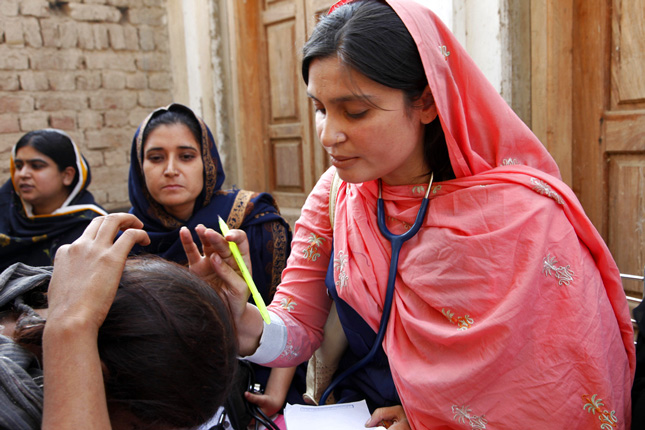
    Photo Credit: A doctor with International Medical Corps in Sindh after the 2010 floods, courtesy of the UK Department for International Development.

    Topics: demography, development, family planning, gender, global health, Pakistan, population, South Asia

Join the Conversation

  • RSS
  • subscribe
  • facebook
  • G+
  • twitter
  • iTunes
  • podomatic
  • youtube
Tweets by NewSecurityBeat

Trending Stories

  • unfccclogo1
  • Pop at COP: Population and Family Planning at the UN Climate Negotiations

Featured Media

Backdraft Podcast

play Backdraft
Podcasts

More »

What You're Saying

  • Volunteers,At,The,Lagos,Food,Bank,Initiative,Outreach,To,Ikotun, Pan-African Response to COVID-19: New Forms of Environmental Peacebuilding Emerge
    Rashida Salifu: Great piece 👍🏾 Africa as a continent has suffered this unfortunate pandemic.But it has also...
  • A desert road near Kuqa An Unholy Trinity: Xinjiang’s Unhealthy Relationship With Coal, Water, and the Quest for Development
    Ismail: It is more historically accurate to refer to Xinjiang as East Turkistan.
  • shutterstock_1779654803 Leverage COVID-19 Data Collection Networks for Environmental Peacebuilding
    Carsten Pran: Thanks for reading! It will be interesting to see how society adapts to droves of new information in...
  • woodrow
  • ecsp
  • RSS Feed
  • YouTube
  • Twitter
  • Facebook
  • Home
  • Who We Are
  • Publications
  • Events
  • Wilson Center
  • Contact Us
  • Print Friendly Page

© Copyright 2007-2021. Environmental Change and Security Program.

Woodrow Wilson International Center for Scholars. All rights reserved.

Developed by Vico Rock Media

Environmental Change and Security Program

Woodrow Wilson International Center for Scholars

Ronald Reagan Building and International Trade Center

  • One Woodrow Wilson Plaza
  • 1300 Pennsylvania Ave., NW
  • Washington, DC 20004-3027

T 202-691-4000
