• woodrow wilson center
  • ecsp

New Security Beat

Subscribe:
  • rss
  • mail-to
  • Who We Are
  • Topics
    • Population
    • Environment
    • Security
    • Health
    • Development
  • Columns
    • China Environment Forum
    • Choke Point
    • Dot-Mom
    • Friday Podcasts
    • Navigating the Poles
    • Reading Radar
  • Multimedia
    • Water Stories (Podcast Series)
    • Backdraft (Podcast Series)
    • Tracking the Energy Titans (Interactive)
  • Films
    • Water, Conflict, and Peacebuilding (Animated Short)
    • Paving the Way (Ethiopia)
    • Broken Landscape (India)
    • Scaling the Mountain (Nepal)
    • Healthy People, Healthy Environment (Tanzania)
  • Publications
  • Events
  • Contact Us

NewSecurityBeat

The blog of the Wilson Center's Environmental Change and Security Program
  • Lakis Polycarpou, State of the Planet

    Finding the Link Between Water Stress and Food Prices

    March 19, 2012 By Wilson Center Staff
    The original version of this article, by Lakis Polycarpou, appeared on State of the Planet.

    Over the past decade, average global food prices have more than doubled, with 2008 and 2010 seeing excruciating price spikes that each had far-reaching economic, geopolitical, and social consequences.

    What explains this long-term trend – and why did prices spike so much higher in the years that they did?

    For policymakers at all levels, answering that question is of vital importance if there is to be any hope of feeding the world’s growing population in the coming decades, much less maintaining social order.

    According to recent research by the New England Complex Systems Institute, spikes in food prices are so closely correlated with social unrest that they were able to identify a particular food-price threshold above which food riots are very likely.

    The most obvious cause for high food prices is oil – in fact, charts showing the correspondence between food and oil prices show an eerie overlap, especially in the last half decade. Water scarcity and climate are major players as well, however. According to the just released United Nations World Water Development Report, demand for water will grow by 55 percent in the next 40 years, and farmers will need 19 percent more water by 2050 just to keep up with growing food demands.

    Continue reading on State of the Planet.

    Sources: Nature, New England Complex Systems Institute, UNESCO.

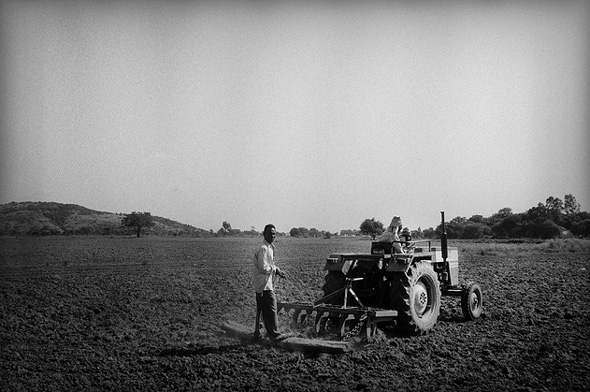
    Photo Credit: “Farmers work on the arid land in Hertela village few kilometers from Mahoba in Bundelkhand, India on September 26, 2008.” Courtesy of flickr user balazsgardi.
    Topics: agriculture, climate change, development, economics, environment, food security, population, security, water

Join the Conversation

  • RSS
  • subscribe
  • facebook
  • G+
  • twitter
  • iTunes
  • podomatic
  • youtube
Tweets by NewSecurityBeat

Trending Stories

  • unfccclogo1
  • Pop at COP: Population and Family Planning at the UN Climate Negotiations

Featured Media

Backdraft Podcast

play Backdraft
Podcasts

More »

What You're Saying

  • Volunteers,At,The,Lagos,Food,Bank,Initiative,Outreach,To,Ikotun, Pan-African Response to COVID-19: New Forms of Environmental Peacebuilding Emerge
    Rashida Salifu: Great piece 👍🏾 Africa as a continent has suffered this unfortunate pandemic.But it has also...
  • A desert road near Kuqa An Unholy Trinity: Xinjiang’s Unhealthy Relationship With Coal, Water, and the Quest for Development
    Ismail: It is more historically accurate to refer to Xinjiang as East Turkistan.
  • shutterstock_1779654803 Leverage COVID-19 Data Collection Networks for Environmental Peacebuilding
    Carsten Pran: Thanks for reading! It will be interesting to see how society adapts to droves of new information in...
  • woodrow
  • ecsp
  • RSS Feed
  • YouTube
  • Twitter
  • Facebook
  • Home
  • Who We Are
  • Publications
  • Events
  • Wilson Center
  • Contact Us
  • Print Friendly Page

© Copyright 2007-2021. Environmental Change and Security Program.

Woodrow Wilson International Center for Scholars. All rights reserved.

Developed by Vico Rock Media

Environmental Change and Security Program

Woodrow Wilson International Center for Scholars

Ronald Reagan Building and International Trade Center

  • One Woodrow Wilson Plaza
  • 1300 Pennsylvania Ave., NW
  • Washington, DC 20004-3027

T 202-691-4000