-
Edward Carr, University of South Carolina
Why the Poorest Aren’t Necessarily the Most Vulnerable to Food Price Shocks
February 8, 2011 By Wilson Center Staff
There have been an interesting series of blog posts going around about the issue of price speculation in food markets, and the impact of that speculation on food security and people’s welfare. Going back through some of these exchanges, it seems to me that a number of folks are arguing past one another.
The most recent discussion was spurred by a post on The Guardian’s Global Development blog by John Vidal that took on the issue of speculation in food markets. In the post, Vidal argues that food speculation is a key driver of price instability on global food markets, which results in serious impacts for the poorest people in the world – a sort of famine profiteering, as it were.
The weaknesses of this post, as I see it, are twofold. First, it doesn’t take the issue of price arbitrage seriously – that is, how speculation is supposed to function. Aid Thoughts, via one of the comments on Vidal’s post, takes Vidal to task for this. As Aid Thoughts/the commenter point out, the idea behind speculation is to pull future price impacts of shortage into the present, stimulating responses to future shortages before they occur. Thus, a blanket condemnation of speculation makes very little sense from the perspective of one who wants to see food security enhanced around the world – without speculation, there will be no market signal for future shortage, creating a world that addresses shortages in a reactive instead of proactive manner. This is a completely fair critique of Vidal, I think.
However, neither Vidal nor those responding to him actually address the evidence for significant market manipulation, and the intentional generation of instability for the purposes of profiteering. This evidence first emerged in a somewhat anecdotal manner in Fredrick Kaufman’s “The Food Bubble: How Wall Street Starved Millions and Got Away With It.” In this article, Kaufman uses a fairly limited number of informants to lay out a case for the intentional manipulation of wheat markets in 2008. It is an interesting read, though I argued in an earlier post that it suffers from trying to be a parable for the pervasive presence of complex investment vehicles in the modern world. And in the end, its findings can hardly be called robust.
Continue reading on Open the Echo Chamber.
Sources: Aid Thoughts, The Guardian, Harper’s Magazine.
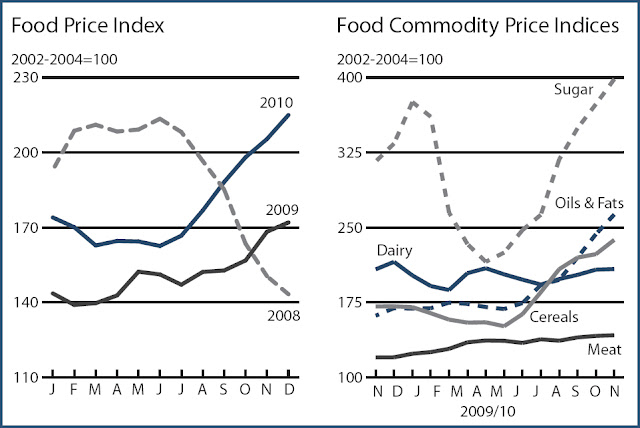
Image Credit: The Food and Agriculture Organization’s Food Price Index and Food Commodity Indices, extracted from Global Food Price Monitor, January 2011, courtesy of the Food and Agriculture Organization.
 A Publication of the Stimson Center.