Monthly archive for May 2010. Show all posts
-
Philippines’ Bohol Province: Elin Torell Reports on Integrating Population, Health, and Environment
›For 10 years, I have been working on marine conservation in Tanzania with the University of Rhode Island’s Coastal Resources Center. As part of that effort, I’ve helped forge links between HIV/AIDS prevention in vulnerable fishing communities and marine conservation. However, family planning and reproductive health (FP/RH) were relatively new to me. But a recent study tour of an integrated Population, Health, and Environment (PHE) program in the Philippines helped me understand that combining family planning services and marine conservation can help reduce overfishing and improve food security.
Together with developing country representatives from seven African and Asian countries, I spent two weeks in February visiting three PHE learning sites and a marine protected area in Bohol province in the central Philippines, as part of a South-to-South study tour sponsored by the USAID-funded BALANCED Project, for which I work. The tour focused on the activities of the 10-year-old Integrated Population and Coastal Resource Management Initiative (IPOPCORM) project, which is run by PATH Foundation Philippines, Inc. (PFPI).
IPOPCORM has garnered a wealth of lessons learned and best practices to share with PHE newbies like me. Its integrated programs train people to be community-based distributers (CBDs) of contraceptives and PHE peer educators, as well as work with local and regional government officials to build support for family planning as a means to improve food security.
I was most impressed with the ways in which PFPI identifies and cultivates dynamic and motivated local leaders–men, women, and especially youth–to reach out to the members of their community who are highly dependent on marine resources for their survival. My Tanzanian colleagues and I would like to foster the volunteer spirit and “can do” attitudes we experienced through our work in East Africa. (Similar PHE peer educators are successfully working in Ethiopia’s Bale Mountains, as reported by Cassie Gardener in a previous edition of the “Beat on the Ground.”
My favorite part of the tour was a trip to the Verde Island Passage to see PFPI’s efforts in this fragile hotspot. The insights my Tanzanian colleagues and I gained from talking to the field practitioners in the Verde Islands helped us refine our ideas for translating some of the PHE techniques used in the Philippines to the Tanzanian cultural context, including an action plan for strengthening our existing PHE efforts with CBDs and peer educators.
Thanks to the study tour, I now have a better understanding of how to address population pressures in the context of conservation. Overall, my Tanzanian colleagues and I were inspired by the successes we saw firsthand and hope to emulate them to some degree in our own projects.
Elin Torell is a research associate at the Coastal Resources Center at the University of Rhode Island. She is the manager of CRC’s Tanzania Program and coordinates monitoring, evaluation, and learning within the BALANCED project. -
Family Planning in Fragile States
›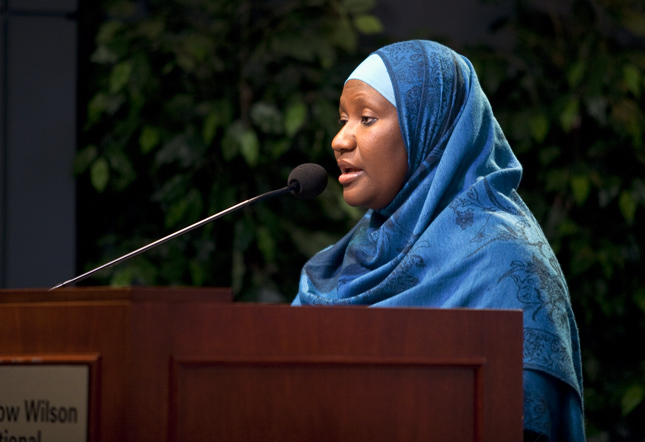
“Conflict-affected countries have some of the worst reproductive health indicators,” said Saundra Krause of the Women’s Refugee Commission at a recent Wilson Center event. “Pregnant women may deliver on the roadside or in makeshift shelters, no longer able to access whatever delivery plans they had. People fleeing their homes may have forgotten or left behind condoms and birth control methods.”
-
Thinking Outside the (Lunch) Box: Meat and Family Planning
›May 3, 2010 // By Dan AsinJoel Cohen, a renowned population expert and professor at Columbia and Rockefeller universities, recently gave a lecture simply titled “Meat.” As it was co-sponsored by the International Food Policy Research Institute and the Population Reference Bureau, I was hoping for an insightful discussion of meat eating and its implications for feeding a world of nine billion. While I think Cohen avoided the question of whether meat eating is ultimately sustainable, I was pleased that he included two key insights: the potential for family planning services to contribute to food security, and the importance of using multidisciplinary approaches to solve today’s global problems.
Family Planning for Food Security
In working to improve food security, Cohen said policymakers and practitioners need to focus on those who are most vulnerable. To this end, he identified five groups and suggested targeted policies for each:While the healthy eating policies will not surprise food security experts, his recommendations on family planning might. He highlighted what should be–but is not always–apparent: that tackling food security without thought for family planning is like attempting to fill an empty bucket without first plugging the holes.
Feeding the one billion hungry people in the world today is an enormous challenge that cannot be met by any single policy. Instead, it will take an array of partial solutions, and offering family planning services to women and young people is an important part of the package. Such projects can help reduce the number of children being born into hunger by allowing women and couples to assess their economic and food situations and plan according to their needs and wishes. Voluntary family planning services and materials will not solve the food security challenge on their own, but they can make it more manageable, especially in the long run.
Family planning’s potential contribution to food security is just one part of Cohen’s larger take-home message: population, economics, environment, and culture all interact. To meet today’s multidisciplinary challenges, single-sector approaches are not up to task.
The Many Faces of Meat
Cohen offered two competing perspectives on meat eating. On the one hand, average global meat production generates a fraction of the calories and protein, per unit of land, that could be derived from plant sources. It is likely the “largest sectoral source of water pollution,” said Cohen, and is at least partly responsible for the spread of over a dozen zoonotic diseases. It contributes to only 1.4 percent of world GDP while comprising 8 percent of world water consumption.
These hidden “virtual water” costs made headlines in Britain the other week, when a study on global water security published by the Royal Academy of Engineering popularized the Water Footprint Network’s earlier findings that that an average kilogram of beef requires 15,500 liters of water–over eight times the volume needed to produce the equivalent weight in soybeans and greater than 10 times that needed for the equivalent amount of wheat.
On the other hand, Cohen pointed out that meat production provides livelihoods for an estimated 987 million of the world’s rural poor, and has important cultural significance in many societies. And it can provide many essential nutrients, even in small doses.
In one study he cited, children living in Kenya who were provided 1 ounce of meat a day received 50 percent of their daily protein requirements and showed greater increases in physical activity and development, verbal and arithmetic test scores, and initiative and leadership behaviors as opposed to students who received the calorie-equivalent in milk or fat.
The Four Factors: Population, Economics, Environment, and Culture
Clearly, Cohen’s four factors all come in to play when evaluating meat’s role in food security. An analysis of any global health issue that looks at only one factor would miss indispensable parts of the problem.
“Population interacts with economics, environment, and culture,” Cohen concluded. “If you use that checklist when somebody gives you a simple-minded solution to a problem, you can save yourself a lot of simple-minded thinking.”
Photo: Pigs on a farm, courtesy Flickr user visionshare. -
Top 10 Posts for April 2010
›Peace parks remain at the top for two months in a row, but the rest of April’s faves includes new posts on population and climate change.
1. Guest Contributor Todd Walters, International Peace Park Expeditions: Imagine There’s No Countries: Conservation Beyond Borders in the Balkans
2. Climate Change and Energy in Defense Doctrine: The QDR and UK Defence Green Paper
3. Book Review: Global Warring: How Environmental, Economic, and Political Crises Will Redraw the World Map by Cleo Paskal
4. Guest Contributor Rear Admiral Morisetti: Climate Change: A Threat to Global Security
5. Copper in Afghanistan: Chinese Investment in Aynak
6. VIDEO: Peter Gleick on Peak Water
7. Megatrends: Embracing Complexity in Today’s Population and Migration Challenges
8. VIDEO: Joshua Busby on Climate Change and African Political Stability
9. The Beat on the Ground: Ethiopia’s Bale Mountains — Cassie Gardener Reports on Integrating Population, Health, and Environment
10. Canada Flip-Flops on Family Planning; Will the G-8 Follow?