Showing posts from category NCSE 2012.
-
Integration, Communication Across Sectors a Must, Say Speakers at 2012 NCSE Environment and Security Conference (Updated)
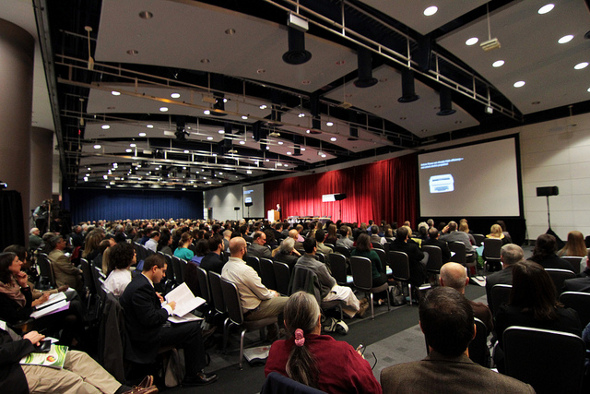
›February 23, 2012 // By Wilson Center StaffECSP staff were among the more than 1,000 attendees discussing non-traditional security issues at the 12th National Conference on Science, Policy, and the Environment last month at the Ronald Reagan Building. Our own Geoff Dabelko spoke on the opening plenary (above) and we collected other excerpts below, though they’re only a small slice of the conference. Find our full coverage by following the NCSE tag, see the full agenda on environmentalsecurity.org, and follow the conversation on Twitter (#NCSEconf).
Climate, Energy, Food, Water, and Health
At the conference’s lead-off plenary, Jeff Seabright (Vice President, The Coca-Cola Company), Daniel Gerstein (Deputy Under Secretary for Science and Technology, U.S. Department of Homeland Security), Rosamond Naylor (Director, Stanford’s Center on Food Security and Environment), and our ECSP’s Geoff Dabelko highlighted the challenges and opportunities of addressing the diverse yet interconnected issues of climate, energy, food, water, and health.
“We need to embrace diversity regardless of the complexity,” said Dabelko, and “abandon our stereotypes and get out of our stovepipes.” Government agencies, academics, and NGOs must be open to using different tools and work together to capture synergies. “If we know everyone in the room, we are not getting out enough,” he said.
“We have to be concerned with every level – national, state, tribal, regional, down to the individual,” said Gerstein. DHS recognizes that climate change affects all of its efforts, and has established three main areas of focus: Arctic impacts; severe weather; and critical infrastructure and key resources.
For Coca-Cola, “managing the complex relationship among [food, water, and energy] is going to be the challenge of the 21st century, said Seabright, who noted that the business community is “seeing a steady increase in the internalization of these issues into business,” including as part of companies’ competitive advantages and strategies.
Similarly, we must offer opportunities and not just threats, said Dabelko, such as exploring climate adaptation’s potential as a tool for peacebuilding rather than simply focusing on climate’s links to conflict. We need to “find ways to define and measure success that embrace the connections among climate, water, and energy, and does not try to pretend they aren’t connected in the real world,” he said.
Communicating Across Sectors: Difficult But Necessary
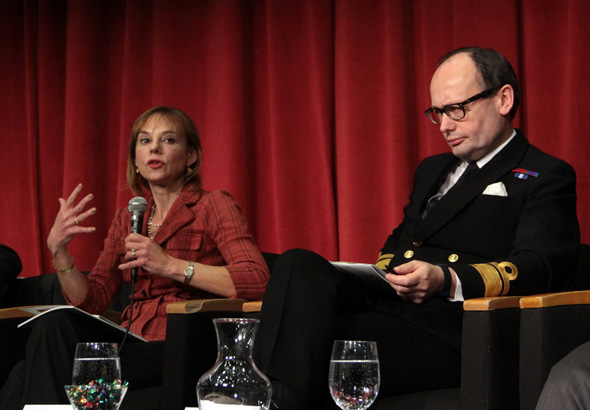
Next, Sherri Goodman (Executive Director, CNA Military Advisory Board), Nancy Sutley (Chair, White House Council on Environmental Quality), Rear Admiral Neil Morisetti (Climate and Energy Security Envoy, UK Ministry of Defence), and Susan Avery (Director, Woods Hole Oceanographic Institute) called on governments, militaries, and institutions to move away from traditional, vertically segmented responsibilities to address today’s environmental and security challenges.
“We live in an interdependent, connected world,” Morisetti said, but communicating that is a challenge. Militaries are likely to have new, broader missions, including conflict prevention, he said, which makes communications all the more important.
Science is moving from reductive to integrated outlooks to better address larger, systems-wide challenges, said Avery, but communicating results of this research to the public, and across and between disciplines, is difficult.
Confronting these communication and education challenges, particularly the difficulties of conveying the probability of various risks, is a key focus of the Council on Environmental Quality, said Sutley. “We confront the challenge of risk communication every day and it’s not limited to climate change,” she said.Challenging Conventional Wisdom on Climate and Conflict
The common argument is that climate change will lead to scarcity – less arable land, water, rain, etc. – and scarcity will lead to conflict, said Kate Marvel (Lawrence Livermore National Lab). But the link between scarcity and conflict is not that clear. It’s “very important to treat models as tools, not as magic balls,” she said. Developing better diagnostics to test models will help researchers and observers sort out which ones are best.
Kaitlin Shilling (Stanford University) called on the environmental security community to move beyond simple causal pathways towards finding solutions. After all, rolling back climate change is not an option at this point, she said; to find solutions, therefore, we need more detailed analysis of the pathways to violence.
The most common types of climate-conflict correlations are not likely to directly involve the state, said Cullen Hendrix (College of William and Mary). Traditional inter-state wars (think “water wars”) or even civil wars are much less likely than threats to human security (e.g., post-elections violence in Kenya) and community security (e.g., tribal raiding in South Sudan). For this reason, the biggest breakthroughs in understanding climate and conflict links will likely come from better interactions between social and physical scientists, he said.
Because the many unique factors leading to conflict vary from place to place, a better way to assess climate-conflict risk might be mapping human vulnerability to climate change rather than predicting conflict risk in a given place, said Justin Mankin (Stanford University). While human reactions are very difficult to predict, vulnerability is easier to quantify.
Yu Hongyuan (Shanghai Institute for International Studies) compared the concerns of U.S. and Chinese officials on climate change. Polling results, he said, show Chinese officials are most concerned with maintaining access to resources, while American policymakers focus on climate change’s effects on global governance and how it will impact responses to natural disasters, new conflicts, and humanitarian crises. Given the centrality of these two countries to international climate negotiations, Yu said he hoped the “same issues, different values” gulf might be bridged by better understanding each side’s priorities.
Schuyler Null, Lauren Herzer, and Meaghan Parker contributed to this article.
Video Credit: Lyle Birkey/NCSE; photo credit: Sean Peoples/Wilson Center. -
Kaitlin Shilling: Climate Conflict and Export Crops in Sub-Saharan Africa
›“There’s been a tremendous amount of work done on looking for a climate signal for civil conflict, particularly in sub-Saharan Africa, and a lot of this work draws a very clear and simple path – if it rains more, or if it rains less, there will be more or less conflict,” says Stanford University’s Kaitlin Shilling in this short video interview. Unfortunately, that straightforward research does little in the way of helping policymakers: “the only way to change the agricultural outputs due to climate change is to change climate change, reduce climate change, or stop it,” she says, “and we’re not really good at that part.”
Shilling moderated a panel at last month’s National Conference on Science, Policy, and the Environment on climate-conflict research. Agricultural export crops – cotton, coffee, cocoa, tea, vanilla – represent one area where policymakers might be able to intervene to prevent climate-driven conflict, says Shilling. Though not as important from a food security perspective, “these crops are really important” for sub-Saharan economies, as well as for “government revenues, which [are] closely related to government capacity.”
But “the effects of climate change on those crops are less well understood,” Shilling says. How they relate to “government revenues and how those relate to civil conflict is an area that I spend a lot of time doing research on.”
By “understand[ing] the mechanisms that underlie the potential relationship between climate and conflict, we can start identifying interventions that make sense to reduce the vulnerability of people to conflict and help them to adapt to the coming climate change.” -
Move Beyond “Water Wars” to Fulfill Water’s Peacebuilding Potential, Says NCSE Panel
›January 26, 2012 // By Schuyler Null
One of the best talks of last week’s NCSE Environment and Security Conference was thewater security plenary on Friday. Moderator Aaron Salzberg, who is the special coordinator for water resources at the Department of State, led with a provocative question: how many in attendance think there will be war over water in the future?
-
Ethan Goffman, SSPP Blog
Securing a Sustainable Future: The Military Takes On a New Mission
›January 25, 2012 // By Wilson Center StaffThe original version of this article, by Ethan Goffman, appeared on the Sustainability: Science, Practice, and Policy blog.
In a time of polarized politics in the United States, over the environment and just about everything else, an overlooked development is how much the military, as well as the national security apparatus, has taken on climate change and other environmental challenges. “Environment and Security” was thus a profoundly important choice of theme for the 2012 National Conference on Science, Policy, and the Environment, held last week in Washington, DC. With the early effects of climate change apparently already occurring, notably in an increase in natural disasters and in a new northwest passage through the Arctic, those responsible for our security can’t afford to sit around and engage in speculation that climate change is caused by sunspots or isn’t really occurring. It is the military’s job, after all, to take action against potential threats rather than getting immersed in domestic politics.
The concern with climate change is the next step in a widening of the concept of security from strict military matters, to include such interrelated strands as food and water access, public health, and the environment. Much of the military has already acknowledged that armed force alone won’t make us safe. “Energy security, economic security, environmental security, and national security are all inextricably linked. Address one and you need to think of the others,” explained Vice-Admiral Dennis McGinn at the conference.
One obvious linkage is the connection of our oil dependency with security risks that can easily draw us into conflict in politically unstable parts of the world. Just how much the recent wars in the Middle East are about oil, and how much about a clash of civilizations, is a matter of considerable debate, although undoubtedly both factors play a part. The Iranian threat to close the Strait of Hormuz, choking outgoing oil deliveries, underscores vulnerability on the energy issue. From another angle, in Afghanistan, the military experienced the fragility of supply lines for a force strongly dependent on large quantities of oil. The Air Force, in particular, is working on algal jet fuel to free us from such reliance. And the Navy’s need for more icebreakers and other capacity shows concern regarding shipping and resource exploitation enabled by the melting of Arctic ice and the new passage.
Continue reading on the SSPP blog.
Photo Credit: Sherri Goodman and Rear Admiral Neil Morisetti, courtesy of Sean Peoples/Wilson Center. -
ECSP at the 12th Annual NCSE Environment and Security Conference
›January 17, 2012 // By Schuyler NullThe National Council for Science and the Environment’s 12th annual Environment and Security Conference starts tomorrow at the Ronald Reagan Building with a high profile line-up of speakers and participants, including Rajiv Shah, Gro Harlem Brundtland, Lisa Jackson, Marcia McNutt, Amanda Dory, Sherri Goodman, and more.
If you are attending, be sure to see ECSP’s own Geoff Dabelko on the opening plenary, “Integrating Climate, Energy, Food, Water, and Health,” at 9:30 a.m. tomorrow and the “Water and Conflict” symposium at 2:00 p.m.. We will also have a booth on the floor which we’d encourage you to swing by for more information on our work at the Wilson Center and upcoming events.
There are a host of panels on essentially every environment-security topic you can think of at the conference, so be sure to check out the full agenda for details. Follow our Twitter feed for updates and watch here for any news or interviews in the coming days too.