
-
2008 Failed States Index Highlights Remarkable Gains—and Losses
›June 26, 2008 // By Sonia SchmanskiThe 2008 Failed States Index, released on Monday by the Fund for Peace and Foreign Policy magazine, draws attention to the increasingly interconnected spheres of politics, environment, population, and security. The Index contains a number of widely anticipated inclusions, as well as a few surprises. Somalia, ranked third last year, is currently ranked first—a consequence of its weak transitional government, offshore pirates, and a refugee crisis that saw some 700,000 people flee Mogadishu last year alone.
But the news isn’t all bad. Among the bright spots in the Index:=- Liberia, still progressing on the path to stability after being last year’s most improved country, thanks to robust anti-corruption efforts and the resettlement of almost 100,000 refugees;
- The Ivory Coast, recently rocked by electoral discord, gaining stability as a result of a new peace agreement between between the rebels in the north of the country and the government-controlled south; and
- Haiti, despite recent protests against rising food prices, because of security improvements in Port-Au-Prince.
Both Bangladesh and Pakistan stumbled in the rankings this year, as did Israel, which has been steadily losing ground in the Index for some time as a result of deteriorating conditions in the West Bank and marked economic disparities. Bangladesh saw a number of destabilizing events this year, including postponed elections, a divided government, protracted emergency rule, and the devastating November cyclone, which displaced some 1.5 million people and destroyed vast tracts of agricultural land. Similarly, neighboring Pakistan suffered under the imposition of martial law, with the assassination of Benazir Bhutto creating serious questions about the country’s future.
Natural resources, the Index makes clear, can be a double-edged sword for developing countries. They offer the potential for huge amounts of state revenue, but there is no guarantee that citizens will benefit. Whether that revenue is distributed equitably is a critical determinant of stability. The authors write that “oil continues to be more burden than boon to the world’s most vulnerable states,” as government regimes often use profit from natural resource extraction to finance militaries and suppress opposition rather than foster development. For instance, a former finance minister from Sudan claims that President Oman Hassan al-Bashir directs over two-thirds of Sudan’s oil revenue to defense spending. Record-high food prices and high levels of inflation also contribute to state weakness; combine these factors with unpredictable natural events, many of which have rocked the world in the past year, and, as the Index authors put it, “the cracks of vulnerability open wider.” -
Council on Foreign Relations Report Calls Climate Change an “Essential” Foreign Policy Issue
›June 24, 2008 // By Sonia Schmanski“Domestic policy alone is not enough; a new U.S. foreign policy to tackle climate change is also essential,” argues a Council on Foreign Relations Independent Task Force in Confronting Climate Change: A Strategy for U.S. Foreign Policy. “Unchecked climate change,” the authors write, “is poised to have wide-ranging and potentially disastrous effects on…human welfare, sensitive ecosystems, and international security.”
The Independent Task Force report comes on the heels of CFR’s widely publicized November 2007 report, “Climate Change and National Security.” ECSP Director Geoff Dabelko spoke with author Joshua Busby in a January podcast examining the links between climate and security.
In an interview, Task Force Director Michael A. Levi said, “climate change is a global problem that requires a global solution.” Rather than remaining “mired in domestic discussions,” as Levi argues the Bush administration has been, the task force calls for a shift in the way policymakers frame the issue of carbon emissions. “The point of this task force,” said Levi, “was to pull back and put this back where it belongs, in the context of American foreign policy.”
The United States, uniquely positioned to “steer international efforts to confront climate change,” must take a leadership role in advancing global policies, Levi said. Unchecked, American emissions will overwhelm any reductions made by other countries. U.S. policymakers have a valuable opportunity to show that environmental responsibility is consistent with robust economic performance, a concern in both developed and developing countries and a leading impediment to addressing climate change.
However, the report strongly cautions against the United States entering into any global framework to which other large emitters, like China and India, are not willing to adhere. The authors argue that the United States should lead through its domestic policies but use a “wide range of levers” to compel other countries to move in the right direction. The challenge of global climate change calls for a multi-pronged solution. “[J]ust like scientists tell us that no one technology is going to solve the problem, there’s no one diplomatic solution that’s going to solve it,” warned Levi. The challenge, then, is translating broad global concern over climate change into collective, and productive, action.
-
In Ethiopia, Food Security, Population, Climate Change Align
›June 24, 2008 // By Daniel Gleick“The only future is resettlement,” a local Ethiopian official recently told the Economist, commenting on dire conditions in the Goru Gutu district, which is facing starvation following unpredictable rains and insect infestations. “Ethiopia has been synonymous with disastrous famine since the 1980s,” notes Sahlu Haile in “Population, Development, and Environment in Ethiopia“, his award-winning article for Environmental Change and Security Program Report 10. In fact, writes Haile, “the agricultural sector—the mainstay of the national economy—is less productive per capita today than it was 20 years ago.”
If resettlement were to take place in Goru Gutu, roughly 4,000 people would have to be resettled every year, and the government has a budget equal to only a fraction of the task. In addition, previous resettlement attempts have been disastrous. According to Haile, “previous resettlement programs were not voluntary…neither were they based on serious economic, social, and environmental studies.” As a result, they led to hardship for the migrants and to conflict with local populations, who felt threatened by the newcomers.
In “The Missing Links: Poverty, Population, and the Environment in Ethiopia,” Mogues Worku points out that in coming years, a rapidly growing population—the result of a lack of access to family planning and education among women—will put additional stress on the country’s ability to feed itself. In addition, Worku explains that climate change “has intensified these environmental problems by altering the region’s rainfall patterns.” Ethiopia’s population and climate challenges will likely lead to additional pressure for resettlement, paving the way for possible conflict. There are many national and international NGOs doing impressive work in Ethiopia on food security, family planning, sustainable livelihoods, and other issues, but much work remains to be done. -
Weekly Reading
›An alert from USAID’s Famine Early Warning Systems Network warns that despite generally good rains, “conflict, livestock disease, and high prices for cereals and other essential goods have minimized the extent to which pastoralists can benefit from these rains, undermining their recovery from drought and elevating their food insecurity, which is evidenced by alarming rates of child malnutrition in several areas.”
The UN Security Council held a special session on gender-based violence this week, and the New York Times’ Nicholas Kristof applauded the Council’s (belated) attention to the issue. ECSP recently sponsored an event on gender-based violence in conflict and post-conflict situations.
East Timor’s citizens are demanding that the government revoke an MOU signed with an Indonesian company that would grant the company 100,000 hectares of land to plant sugarcane. -
Danger: Demographic Change Approaching
›June 20, 2008 // By Rachel Weisshaar“From ‘youth bulges’ in the Muslim world to a population implosion in Russia to ‘premature aging’ in China, striking demographic trends the world over will reshape the future environment for U.S. policy,” says a new report from the Center for Strategic and International Studies, which aims to provide a comprehensive analysis of how demographic change will affect national and international security in the 21st century. As its title—The Graying of the Great Powers: Demography and Geopolitics in the 21st Century—indicates, the report focuses primarily on aging populations in developed countries, although one chapter does address the developing world.
The Graying of the Great Powers does a thorough job exploring the economic, geopolitical, and cultural implications of aging in Europe, Japan, and the United States, and it is to be praised for its readability and attention to concrete policy implications. But its focus on the developed world sometimes causes it to downplay the serious economic, socio-political, environmental, and security challenges posed by high population growth in developing countries—and by a global population that is expected to top 9 billion by 2050.
For instance, the authors use the past tense to refer to a time “when the prevailing worry was overpopulation.” Now, the word “overpopulation,” with its implication that some of us should not be here, is somewhat problematic. Nevertheless, it is clear that today, billions of human beings are consuming record amounts of natural resources at unsustainable rates—witness Yemen, where current annual water use is 30 percent greater than renewable water resources. Furthermore, many of the countries least able to provide employment and health care to their citizens have the highest population growth rates—for instance, Somalia and Afghanistan, which both have total fertility rates of 6.8 children per woman.
Wrapped up in their worries about the impact of low birth rates on armed services recruitment and government spending on pensions and health care for the elderly, the authors seem to forget what is actually at stake here: a woman’s decision to give birth to a child. Politicians can institute reforms that will make having children an easier proposition, but they should not pressure people to have children because they wish to avoid geopolitical upheaval. Ultimately, wanting to have a child is the only good reason to bring one into the world. -
MEND Makes Headlines With Most Ambitious Oil Attack Yet
›June 19, 2008 // By Sonia Schmanski The Movement for the Emancipation of the Niger Delta, or MEND (seen in a photo by Dulue Mbachu, courtesy of ISN Security Watch and Flickr), has attacked Nigeria’s oil infrastructure again, this time significantly enough to cause Royal Dutch Shell to suspend its production at the damaged facility. Worldwide crude price levels rose in the wake of the attack, as well as amidst concerns that a Nigerian oil worker strike could be imminent.
The attack, which took place today in the Bonga oil field some 75 miles off Nigeria’s coast, is being described as unusually ambitious for a group that has focused mainly on the creeks and swamps of the Niger Delta. In a statement released to the media, the group explained that “the location for today’s attack was deliberately chosen to remove any notion that off-shore oil exploration is far from our reach.” Shell spokeswoman Eurwen Thomas said that the attack marked the first time MEND has managed to achieve the sophisticated planning and acquire the advanced equipment required to successfully target such a remote rig.
Though Nigeria is Africa’s biggest oil producer and a member of OPEC, most areas remain mired in poverty and plagued by pollution. Widespread resentment over inequitable revenue disbursement has spawned numerous groups agitating for a greater share of the country’s vast oil wealth. MEND is only the latest of these groups, but it has made a name for itself through attention-grabbing attacks like this one. The group’s claim to have captured an American worker was substantiated by private security officials, who said that two other workers were injured. Since the upswing in violence that began in early 2006, Nigerian rebel groups have taken more than 200 hostages.
Eleven percent of U.S. oil imports—46 percent of Nigeria’s total production—come from Nigeria, making this escalating series of attacks particularly relevant to American officials, and perhaps providing incentives to mediate talks between Nigeria’s government and Niger Delta militants, which have thus far been unsuccessful. Yet negotiations will be difficult between such polarized players. Said MEND, “the oil companies and their collaborators do not have any place to hide in conducting their nefarious activities.”
-
New International Peace Institute Paper Examines Resource Scarcity, Insecurity
›June 18, 2008 // By Daniel Gleick“Often, those who are already vulnerable to threats because they are poor, illiterate, lack political power, or face gender or ethnic discrimination are the ones who find themselves in the front lines of the negative dimensions of environmental change,” writes Richard Matthew of the Center for Unconventional Security Affairs at the University of California, Irvine, in “Resource Scarcity: Responding to the Security Challenge,” a new paper from the International Peace Institute. Vulnerable populations “face water and land scarcity, are displaced into marginal ecosystems where they encounter unfamiliar parasites, experience severe weather events, lose everything to floods and mudslides, and daily eke out an existence in peri-urban areas awash with human waste.”
Researchers continue to debate the security implications of various kinds of resource scarcity, but according to Matthew, there are at least four areas of general agreement:
• Resource scarcity is never the sole cause of conflict, but is often a contributing factor;
• Migration is frequently the link between resource scarcity and conflict;
• Rapid changes in access to resources are more likely to cause conflict than gradual changes; and
• Climate change will lead to resource scarcity in many areas that are experiencing or vulnerable to conflict.
Despite these dire circumstances, Matthew believes key actions and policies could significantly reduce the likelihood that resource scarcity will lead to conflict and insecurity. He offers 14 specific recommendations for NGOs, governments, and international organizations, which include supporting “the effort in UNEP to integrate the environment into post-conflict assessment, disaster management, and peacebuilding” and mobilizing “the enormous capacity of the private sector and NGO communities…around sustainable development, conflict resolution, and peacebuilding.”
-
Africa Atlas’s Exquisite Images Reveal Effects of 40 Years of Environmental Degradation
›June 16, 2008 // By Daniel GleickOn June 10, at the 12th session of the African Ministerial Conference on the Environment, the UN Environment Programme (UNEP) released Africa: Atlas of Our Changing Environment, a comprehensive look at the environmental devastation being wrought in Africa. Highlighting the ecological damage caused by high population growth, climate change, and the unsustainable use of natural resources, the atlas shows before-and-after satellite images of “disappearing forests, shrinking lakes, vanishing glaciers and degraded landscapes.” The above image, courtesy of UNEP, shows how Lake Chad has shrunk to one-twentieth of its size 30 years ago.
As The Independent put it: “Put it all together and you have a picture that is hard to credit, so enormous is the destruction.” Much of the impetus behind the atlas was to spur African governments to improve their environmental records.
On July 1, ECSP will host UNEP Executive Director Achim Steiner at the Washington, DC, launch of the atlas.
 A Publication of the Stimson Center.
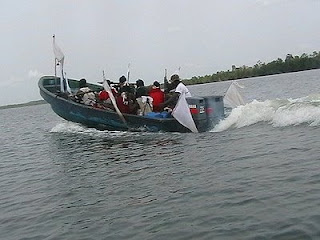 The Movement for the Emancipation of the Niger Delta, or MEND (seen in a photo by Dulue Mbachu, courtesy of ISN Security Watch and
 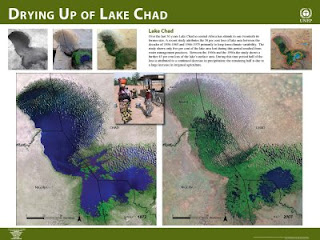 On June 10, at the 12th session of the

