-
Going Gaga Over Grain: Pakistan and the International Farms Race
›September 17, 2009 // By Wilson Center Staff Written by Michael Kugelman and originally published in Dawn.
Last May, while Pakistan’s military was waging its offensive in Swat, Islamabad officials were simultaneously launching another offensive in the Gulf: a charm offensive to secure investment in Pakistani farmland.
Appearing at “farmland road shows” across the region, the investment ministry representatives depicted Pakistan’s soil as the perfect solution to the Gulf nations’ food insecurity.
Such efforts have paid off for Islamabad (and according to media reports, more shows have been staged in recent days). Pakistan’s farmland is an increasingly popular target for wealthy, food-importing nations who, because of the volatility of world food markets, are taking food security matters into their own hands. These states (and also private investors) aim to buy or lease farmland overseas, grow their own crops and export them back home.
Given their lack of transparency, the details surrounding these investments are sketchy and the facts elusive. In Pakistan, uncertainty reigns over the exact amount of land made available to investors, the quantum of land sold or leased so far, and who is in fact doing the investing.
Still, even without these details, there is strong evidence to suggest that the race for Pakistan’s farmland — if not halted prematurely by farmers’ opposition or investor change-of-hearts — could trigger droves of land deals, acute resource shortages and even political strife.
Islamabad has established an extraordinarily welcoming investment environment that financiers will find hard to resist. The government’s Corporate Agriculture Farming (CAF) policy — spelled out on the Board of Investment’s website — effectively legalizes foreign land acquisitions. It permits state land to be purchased outright or leased for 50 years, and allows investors to determine the size of their acquisitions (with no upper ceiling). These features apply to a broad range of agriculture from crops, fruits and vegetables to forestry and livestock farming.
Land investors flock to countries with strong legal protections. Cambodia’s government has reportedly established a national land concession authorizing public land to be allocated to foreigners — and the country is now experiencing what the BBC describes as an “epidemic of land-grabbing.” Conversely, in India, foreign companies are banned from owning farmland — and considerably fewer investors have come calling.
Pakistan, like Cambodia, provides the legal cover farmland investors look for. However, the CAF goes beyond legal protections. It also offers generous financial incentives such as 100 per cent foreign equity; exemptions on land transfer duties; and customs-duty-free, sales-tax-free agricultural machinery imports.
Legal protection and financial incentives — what more could a foreign land investor in Pakistan want? Security, of course, and Islamabad purports to have this covered as well, through the formation of a 100,000-strong security unit. Pakistan’s government is so serious about concluding land deals that it has offered to deploy a force almost a fifth the size of the army to protect investors’ new holdings.
A rash of foreign land acquisitions in Pakistan would deepen the country’s resource crisis. Pakistan already suffers widespread water shortages, and could be water-scarce by 2020. However, supplies could dry up much sooner if enormous quantities of water are siphoned off to support large-scale, water-intensive agricultural production schemes.
To understand the scale of Pakistan’s water shortages, take a look at Aquastat, the FAO’s water statistics database. Of all the nations most often associated with relinquishing farmland, only one — Kenya — has less water availability per capita than Pakistan’s 1400 cubic meters. In fact, of the nearly 200 countries listed in the database, only 35 have less water than Pakistan — many of them the parched countries of the Gulf that are seeking the water-laden farmland they lack at home.
Indeed, quests for overseas farmland are water hunts as much as they are land hunts. Yet investors are seemingly so seduced by Islamabad’s legal and financial inducements that they disregard the fact that Pakistan’s water supply can barely sustain its own farming, much less that of immense foreign agribusiness projects.
Pakistan’s water and energy shortages could also limit the possible benefits accruing from the deals, including better technology, more employment and higher crop yields. With limited energy to operate upgraded farm machinery, and limited water to irrigate cropland, farming job prospects could suffer and talk of increased yields could become irrelevant.
Land deals could mean not just compromised small-holder livelihoods but also widespread displacement. Not surprisingly, critics argue that big land acquisitions could spark violent responses and mass political unrest. Such predictions may be premature — other than in Madagascar, opposition has been relatively localized — but they are not far-fetched in Pakistan.Here’s why. According to the World Food Program, 77 million Pakistanis are already food-insecure, and many of them live in the country’s most volatile areas. Foreign land holdings could cause a flare-up of this food vulnerability powder keg at the worst possible time. During the height of last year’s global food crisis, Pakistan imposed export bans to keep domestic food prices down.
According to a report by the International Institute for Sustainable Development, the UAE — which hopes to grow rice and wheat in Pakistan — then requested blanket exemptions from these bans.
Islamabad eventually relaxed export restrictions on Basmati rice. So a politically explosive scenario — such as the UAE trucking rice out of a drought-stricken or war-ravaged Pakistan and exporting it back to the Gulf while hungry locals look on — is not at all unrealistic. Throw that investment-protecting security force into the mix, and things could get really ugly.
Furthermore, there are long-standing rifts between Pakistan’s rural poor and its wealthy, landholding elite. Scores of huge land acquisitions — particularly if they displace poor laborers — would exacerbate these class-based cleavages.
Ominously, the Taliban’s actions in Swat reveal a new ability to exploit class divisions by pitting landless farmers against their landlords. Militants may well use farmland acquisitions as a pretext for fomenting a fresh class revolt in Punjab, the fertile, populous province coveted by the Taliban and reportedly ground zero for the farms race in Pakistan. Such a thought is enough to make one wonder if those farmland road shows are really worth the effort.
Michael Kugelman is program associate with the Asia Program at the Woodrow Wilson International Center for Scholars.
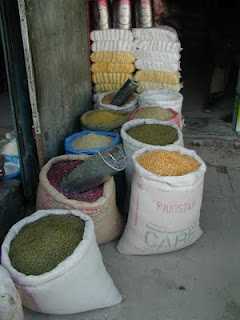
Bottom photo: CARE food aid in Pakistan. Courtesy flickr user Feinstein International Center.
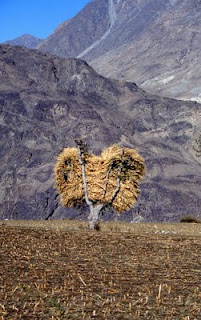
Top photo: Gilgit, Pakistan. Courtesy flickr user michaelnewport. -
Weekly Reading
›The American Security Project (ASP) launched its Climate Security Index, which identifies climate change “a clear and present danger to the national security of the United States,” at an event hosted by George Washington University. ASP warns that “American leaders will face a multitude of tough choices as climate-induced national security threats begin to compete with and crowd out our ability to respond to traditional threats,” reports ClimateWire.
According to “Fewer Emitters, Lower Emissions, Less Cost,” contraception is almost five times cheaper than conventional green technologies as a means of combating climate change. “[E]ach $7 spent on basic family planning (2009 US$) would reduce CO2 emissions by more than one ton,” researchers conclude, while low-carbon technologies would add an extra $25 per ton.
Experts at a recent forum on sexual and reproductive health and development in Berlin also argued for making the population-climate link, although it did not appear in the Call to Action. Helen Clark, administrator of the UN Development Programme (UNDP), said that there is a “virtuous cycle formed by educating women and families in the developing world on the number of children they actually wish to have, improving the health of women and promoting gender equality, reducing poverty and hunger, and mitigating climate change.”
The World Bank has suspended International Finance Corporation (IFC) funding of operations in the palm oil sector over concerns that lending could be causing social and environmental harm, says Mongabay.com. World Bank President Robert Zoellick announced the move in a letter to NGO leaders who argued that IFC-backed palm oil production in Indonesia was fuelling deforestation, land grabbing, and human rights abuses.
In “Urban Poverty and Vulnerability in Kenya,” Oxfam warns that Kenya “is facing a new urban timebomb, with millions of Nairobi residents suffering a daily struggle for food and water as the divide between rich and poor widens.” The group points out that “the price of staple foods such as maize has more than doubled in the past year” and drought has led to an outbreak of cholera “as almost 90% of slum dwellers have no piped clean water.”
“Water and Conflict: Incorporating Peacebuilding into Water Development” from Catholic Relief Services outlines a way for development and human rights practitioners to integrate water and peacebuilding in their projects, drawing on the experiences of CRS and other development organizations, mainly in Central and South America. -
The Creek Runs Black in West Virginia – and Dry in Mexico City
›September 14, 2009 // By Meaghan ParkerTwo articles in the Sunday New York Times revealed that some residents of Mexico City and Charleston, West Virginia, share a common bond: lack of clean water. While drought and leaks have drained Mexico City’s reservoirs, pollution and run-off from coal plants has befouled water supplies in West Virginia’s small towns. But in both cases, the less powerful are the ones stuck up the creek without a paddle.
-
Is the White Ribbon the New Black? Making Maternal Health Fashionable
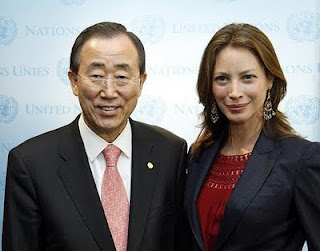
›Celebrity philanthropists such as Bono, Angelina Jolie, and George Clooney have shined their star power on global issues like AIDS, genocide, and refugees. In last month’s Vogue, supermodel Christy Turlington turned the light on one of the most overlooked problems: maternal mortality.
-
Weekly Reading
›In an Economist.com debate on population growth between John Seager of Population Connection and Michael Lind of the New America Foundation, Seager argues that rapid population growth is “the source of many of the world’s—especially the poor world’s—woes,” as it accelerates environmental degradation and “undermines both security and development.” On the other hand, Lind counters that “countries are not poor because they have too many people,” and asserts that “technology and increased efficiency have refuted what looks like imminent resource exhaustion.”
In Foreign Policy, David J. Rothkopf contends that actions to mitigate climate change—though necessary to avoid very serious consequences—could subsequently spur trade wars, destabilize petro-states, and exacerbate conflict over water and newly important mineral resources (including lithium).
The International Crisis Group (ICG) reports that “the exploitation of oil has contributed greatly to the deterioration of governance in Chad and to a succession of rebellions and political crises” since construction of the World Bank-financed Chad-Cameroon pipeline was completed in 2003. Chad must reform its management of oil resources in order to avoid further impoverishment and destabilization, ICG advises.
The Royal Society and the Institution of Mechanical Engineers (IME)—both based in the United Kingdom—released independent reports on geoengineering the climate. While calling reduction of greenhouse gas emissions “the safest and most predictable method of moderating climate change,” the Royal Society recommends that governments and international experts look into three techniques with the most potential: CO2 capture from ambient air, enhanced weathering, and land use and afforestation. The IME identified artificial trees, algae-coated buildings, and reflective buildings as the most promising alternatives. “Geo-engineering is no silver bullet, it just buys us time,” IME’s Tim Fox told the Guardian.
In “Securing America’s Future: Enhancing Our National Security by Reducing Oil Dependence and Environmental Damage,” the Center for American Progress (CAP) argues that unless the United States switches to other fuels, it “will become more invested in the volatile Middle East, more dependent on corrupt and unsavory regimes, and more involved with politically unstable countries. In fact, it may be forced to choose between maintaining an effective foreign policy or a consistent energy supply.”
The Chinese government is “drawing up plans to prohibit or restrict exports of rare earth metals that are produced only in China and play a vital role in cutting edge technology, from hybrid cars and catalytic converters, to superconductors, and precision-guided weapons,” The Telegraph relates. The move could send other countries scrambling to find replacement sources.
In studying the vulnerability of South Africa’s agricultural sector to climate change, the International Food Policy Research Institute finds that “the regions most vulnerable to climate change and variability also have a higher capacity to adapt to climate change…[and that] vulnerability to climate change and variability is intrinsically linked with social and economic development.” South African policymakers must “integrate adaptation measures into sustainable development strategies,” the group explains. -
Connecting the Dots on Natural Interdependence
›September 3, 2009 // By Brian KleinA vast symphony of natural processes sustains our life on Earth. Recognizing the complex interdependence of nature’s concert reminds us of a simple fact: the social, economic, and environmental challenges we face are not isolated from one another, and neither are their solutions. Tom Friedman drives this point home in a recent New York Times op-ed, “Connecting Nature’s Dots.”
“We’re trying to deal with a whole array of integrated problems—climate change, energy, biodiversity loss, poverty alleviation and the need to grow enough food to feed the planet—separately,” Friedman argues.
“[W]e need to make sure that our policy solutions are as integrated as nature itself. Today, they are not,” he says.
Take, for example, water scarcity—a looming problem that the increasing global incidence of droughts, floods, melting glaciers, and drying rivers will likely exacerbate.
“Droughts make matters worse, but the real problem isn’t shrinking water levels. It’s population growth,” says Robert Glennon, author of Unquenchable: America’s Water Crisis and What To Do About It, in a Washington Post op-ed that points out the integrated nature of our environmental problems. “Excessive groundwater pumping has dried up scores of lakes,” many of which—including Lake Superior—can no longer “float fully loaded freighters, dramatically increasing shipping costs.” Companies reliant on rivers to run their factories or discharge their wastewater have furloughed workers as low flows disrupt normal operations. “Water has become so contentious nationwide,” Glennon continues, “that more than 30 states are fighting with their neighbors over water.”
In addition, while “more people will put a huge strain on our water resources…another problem comes in something that sounds relatively benign: renewable energy, at least in some forms, such as biofuels.” Growing enough corn to refine one gallon of ethanol, for example, can take up to 2,500 gallons of water.
“In the United States, we’ve traditionally engineered our way out of water shortages by diverting more from rivers, building dams, or drilling groundwater wells,” Glennon says. “[But] we’re running out of technological fixes.”
Global food security is also affected. We need the oceans, seas, lakes, rivers, and streams to provide habitat for fish and other marine life—a vital source of sustenance for the poorest segments of our population. Furthermore, wetland areas play a critical role in mitigating the consequences of natural disasters, buffering vulnerable coastal communities from storm surges.
Addressing water scarcity thus requires a complex understanding of the hydrological cycle, its relationship to other natural processes, and humanity’s place in that system.
For years, celebrated environmentalist and entrepreneur Paul Hawken has emphasized the interconnectedness of indigenous, environmental, and social justice movements. In his 2007 book Blessed Unrest, Hawken contends that groups as disparate as land rights reformers in the DR Congo and community members fighting to protect the Anacostia Watershed share fundamental values. Grassroots campaigns of a similar bent have sprung up across the globe, all seeking to right humans’ relationships with the Earth, and with each other.
Policymakers in the U.S. and abroad should take a page from Hawken’s book, recognize the natural interdependence of our problems, and design integrated solutions. Otherwise, our strategies to confront the myriad challenges enumerated by Friedman will fall flat.
Photo courtesy Flickr user aloshbennett. -
Climate Change Is Linked to Security, But Don’t Overplay It
›August 31, 2009 // By Wilson Center StaffAs the impacts of climate change on national security are beginning to receive attention at the highest levels of government, climate-security experts must avoid oversimplifying these complex connections, said Geoff Dabelko, director of the Environmental Change and Security Program at the Woodrow Wilson Center.
“Today, with climate change high on the political agenda, powerful actors in the security community are assessing its potentially dangerous effects on conflict and military readiness,” Dabelko said. In “Planning for Climate Change: The Security Community’s Precautionary Principle” in the journal Climatic Change, Dabelko views the defense community’s interest in climate change as an understandable development. “Climate change poses threats and opportunities that any risk analysis calculation should take seriously—including the military’s planning efforts, such as the Quadrennial Defense Review,” he says.
“However, it is important to remember that in the mid-1990s, advocates oversold our understanding of environmental links to security, creating a backlash that ultimately undermined policymakers’ support for meeting the very real connections between environment and conflict head-on. Today, ‘climate security’ is in danger of becoming merely a political argument that understates the complexity of climate’s security challenges.”
In a new op-ed in the Bulletin of the Atomic Scientists, Dabelko offers some advice to scientists, politicians, and the media:- Don’t oversimplify the links between climate change and violent conflict or terrorism.
- Don’t neglect ongoing natural resource and conflict problems.
- Don’t assume we know the precise scale and location of climate-induced migration.
- Don’t forget that climate mitigation efforts can introduce social conflict and needs to be factored into both mitigation and adaptation efforts.
-
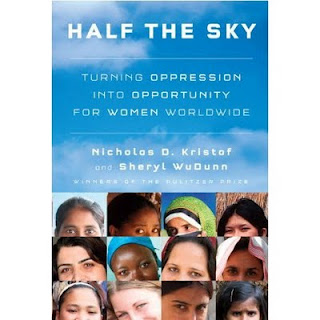
Half the Sky, All the Promise: The Personal is Political in NYT Special Issue
›“The world is awakening to a powerful truth: Women and girls aren’t the problem; they’re the solution,” write Nicholas Kristof and Sheryl WuDunn in the lead article of this Sunday’s The New York Times Magazine.
In this special issue devoted to “Saving the World’s Women,” five articles document global failures and personal horrors, but also offer forward-looking solutions from the individual to the institutional. As the subtitle says—“changing the lives of women and girls in the developing world can change everything”— this vital effort can help us not only improve the lives of women, but meet larger goals including international security, global health, and economic development.
In “The Women’s Crusade,” Pulitzer Prize-winners Kristof and WuDunn, whose new book Half the Sky will be published on September 8, outline the ways in which the world’s women and girls are abused, neglected, and overlooked. They use devastating data to detail how women around the world suffer from lack of education, maternal mortality, sexual violence, trafficking, and economic and political oppression, and then bring these figures to life with women’s personal stories.
They argue that elevating women is not a “soft” issue, but rather has the power to transform economies and address security threats—a point echoed in an interview with Hillary Clinton, in which she calls women and girls “a core factor in our foreign policy.”
“I happen to believe that the transformation of women’s roles is the last great impediment to universal progress,” says Clinton, long an informed and passionate advocate for global women’s issues. She encouraged President Obama to create a new ambassadorship for global women’s issues, and filled the opening with Melanne Verveer, a respected activist and former head of the Vital Voices Global Partnership.
Clinton most strongly emphasizes the connection between women’s issues and national security, calling it “an absolute link”: “If you look at where we are fighting terrorism, there is a connection to groups that are making a stand against modernity, and that is most evident in their treatment of women.” She goes so far as to agree that spending taxpayer money on education and healthcare for girls and women in Pakistan would be more effective than military aid to the country.
“A woman who is safe enough in her own life to invest in her children and see them go to school is not going to have as many children. The resource battles over water and land will be diminished,” she says. “And it’s an issue of how we take hard power and soft power, so called, and use it to advance not just American ends but, in advancing global progress, we are making the world safer for our own children.”
Also in the magazine:
The New York Times’ website adds a slide show of Katy Grannan’s portraits of women in South Asia and Africa, and launches a contest soliciting personal stories from the field. Submit your photos and blog posts to Kristof’s blog by September 19.- Dexter Filkins investigates the acid attacks on girl students in Afghanistan in the horrifyingly vivid storytelling he displayed in his best-seller, The Forever War.
- Lisa Belkin takes note of an emerging generation of female philanthropists using their money to “deliberately and systematically to aid women in need,” spurred by the Hunt sisters’ “Women Moving Millions” campaign.
- Tina Rosenberg describes how sex-selective abortion and inadequate health care for young girls has led to a “daughter deficit” in China and India, where, somewhat paradoxically, “development can worsen, not improve, traditional discrimination.”
- Africa’s first female President, Liberia’s Ellen Johnson-Sirleaf, tells NYT that if women ran the world, it would be “better, safer and more productive.”
To me, such vital voices are the most powerful, proving that the personal is political. The quotes in the lead article from academic studies, local NGO personnel, and women themselves map the way forward:- “When women command greater power, child health and nutrition improves” – Esther Duflo of MIT, on micro-finance.
- “Girls are just as good as boys” – An unidentified man who once beat his wife for not having sons, but changed his mind when a micro-loan turned her into the family breadwinner.
- “Gender inequality hurts economic growth” – Goldman Sachs, Global Economics Paper, 2008
- “I can’t talk about my children’s education when I’m not educated myself … If I educate myself, then I can educate my children” – Terarai Trent, a Zimbabwean woman now completing a PhD in the United States.
 A Publication of the Stimson Center.
 Written by Michael Kugelman and originally published in
  Here’s why. According to the World Food Program,
 A vast symphony of natural processes sustains our life on Earth. Recognizing the complex interdependence of nature’s concert reminds us of a simple fact: the social, economic, and environmental challenges we face are not isolated from one another, and neither are their solutions. Tom Friedman drives this point home in a recent New York Times op-ed, “