-
Stephanie Hanson Reports on PHE in Agricultural Development and Rwanda’s ‘One Acre Fund’
›Driving from Kigali into rural Rwanda, the hills that flank either side of the paved road are covered with bananas, maize, coffee, and beans under cultivation. Most Rwandans are farmers, using any bit of available land to feed their families and generate income. In this country—the most densely populated in Africa—little arable land is left untended.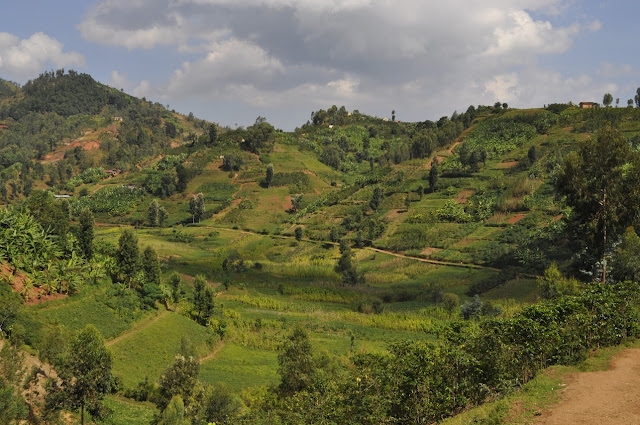
My organization, One Acre Fund, offers loans and education to smallholder farmers in Kenya and Rwanda. We work with 18,000 farmers in three districts in the southwestern and western part of Rwanda, where we are know as Tubura, which means “multiply” in Kinyarwanda.
Though One Acre Fund is not a traditional population, health, and environment (PHE) project, agricultural development work inherently is PHE work, particularly in Rwanda, which faces significant population and environment challenges.
Our farmers have small plots of land because Rwanda’s population density is so high—375 people per square kilometer, higher than Japan—leaving only .13 hectares of arable land per person. They struggle to grow enough food because it’s difficult to support a big family on a small piece of land, especially without access to high-quality seed and fertilizer.
When farmers don’t grow enough to ensure basic food security for their families, their children are malnourished, which makes them more susceptible to illness.
Finally, agriculture both depends on and affects the environment. Farmers need favorable growing conditions—good soil and adequate rainfall—for a good harvest. Sustainable agriculture practices, such as composting and preventing soil erosion, ensure the environment remains healthy to support future farming.One Acre Fund is acutely aware of the challenges that our farmers face due to high population density, food insecurity, and environmental degradation. We offer a service model that addresses all the needs of a smallholder farmer: financing, farm inputs, education, and market access.
When a farmer enrolls with One Acre Fund in Rwanda, she joins as part of a group of 6-15 farmers. She receives an in-kind loan of seed and fertilizer, which is guaranteed by her group members. One Acre Fund delivers this seed and fertilizer to a market point within two kilometers of where she lives. A field officer provides in-field training on composting, techniques to prevent soil erosion, land preparation, planting, fertilizer application, and weeding.
Over the course of the season, the field officer monitors the farmer’s fields. At the end of the season, he trains her on how to harvest and store her crop. One Acre Fund also offers a harvest buyback program that farmers can choose to participate in.
On average, One Acre Fund farmers double their farm income per acre in one growing season. Ninety-eight percent of our farmers repay their loans, which are due several weeks after harvest.
With their increased harvests, One Acre Fund farmers are able to feed their children, which reduces malnutrition. Anecdotally, we also know that One Acre Fund children experience less illness; this year, we are working to incorporate health indicators into our monitoring and evaluation work.
At a harvest buyback last month, I met many farmers who had benefited from One Acre Fund’s services. One woman, Tamar, had sold 400 kilograms (880 pounds) of beans at the previous season’s buyback, which earned her roughly 132,000 Rwandan francs ($235 USD). She told me that she was using the money to build a bigger home for the six of her ten children who lived at home.However, Tamar really wanted to buy a cow, but she knew that she would not earn enough money this year to afford one. With so many children, she struggled to earn enough money to invest in something that might generate additional income for her and her family.
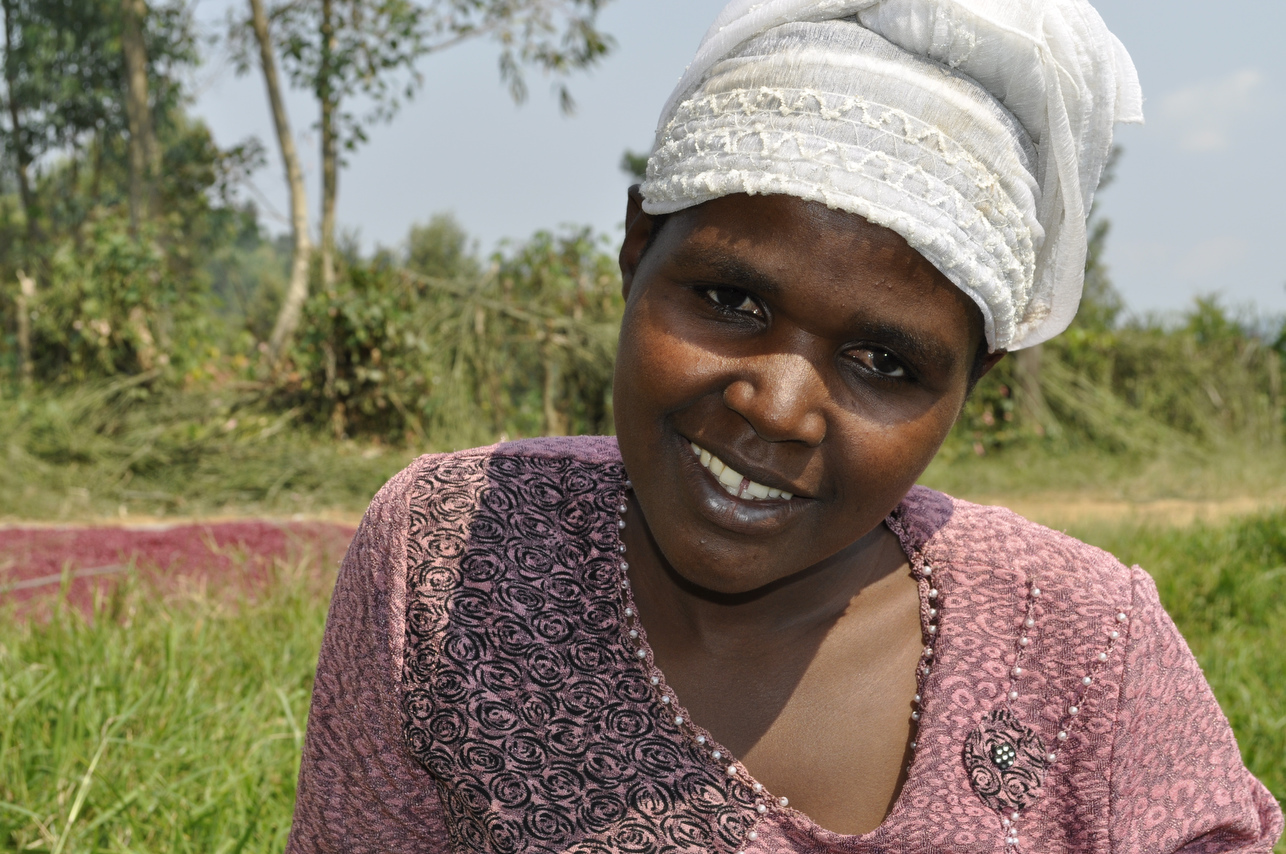
Another woman, Medeatrice, had also made $235 USD from the sale of her beans. With that income, she had opened a small shop with her husband in a nearby market. Unusually for Rwanda, where the average woman has 5.5 children, Medeatrice only had one, a three-year old boy named Prince. I asked her if she planned to have more children.
“I only want one more child,” she told me. “If I only have two children, it is easy to educate and to take care of them.”
The Rwandan government has invested in educating its population on family planning, but it will take time for birth rates to drop. For now, families with five, six, or nine children are not uncommon.
However, research shows that when women have increased access to economic opportunities, birth rates drop. One Acre Fund is focused on helping Rwanda’s families increase their harvests so that they not only have enough to eat, but they can start investing in their futures.
Guest Contributor Stephanie Hanson is the director of policy and outreach at One Acre Fund.
Photo Credit: Rwanda’s hills and Medeatrice, courtesy of Stephanie Hanson. -
Landmark Law Takes Aim at the “Resource Curse”
›July 22, 2010 // By Schuyler NullBy signing the financial overhaul package on Wednesday, President Obama also enacted the first major U.S. government attempt to require transparency in the international oil, gas, and mineral trade, aimed at reducing the risk of “resource curse” scenarios that have plagued countries like Nigeria and the Democratic Republic of Congo.
The amendment, sponsored by Senators Bill Cardin and Richard Lugar, requires extractive companies registered with the SEC to publicly disclose their tax and revenue payments to foreign governments. The amendment singles out the DRC for additional scrutiny: companies trading in tin, coltan, wolframite, and gold – minerals found commonly in eastern Congo – will need to report whether they are sourcing from the DRC or its neighbors and disclose what steps they have taken to ensure that their supplies are conflict-free.
The international community will be eagerly watching the results of this effort. Can a U.S. law on conflict minerals reduce violence in the DRC’s complex civil war? I recently argued that while the legislation is a great initial effort, it will have little immediate impact on the violence and suffering in the country. In a recent interview with New Security Beat, EITI expert Jill Shankleman called the Cardin-Lugar bill “an important step” but pointed out that it only covers companies who are listed with the SEC and does not reduce the need for countries to enter into EITI.
Will this new law help Afghanistan – with its allegedly vast stores of valuable minerals – avoid the fate of the DRC? While some fear that corruption and lack of transparency may lead to conflict around the new Chinese contract to operate Afghanistan’s Aynak copper field, a recent U.S. Army War College paper argues that contrary to prevailing opinion, the Chinese approach to large-scale extractive investments could complement Western-led military stabilization efforts.
Photo Credit: “Wolframite” from the DRC, courtesy of flickr user Julien Harneis. -
Harnessing the Peace Potential of Youth in Post-Conflict Societies
›July 22, 2010 // By Marie HokensonIn many post-conflict societies throughout the world, young people must deal with poverty, exploitation, and neglect. It is perhaps not surprising then that many youth eventually find themselves embroiled in violence, either as perpetrators or victims of crime. However, often overlooked are young people’s current and potential future contributions to peace, since with the proper support, youth can prove instrumental in a society’s rebuilding process.
In her new book Youth in Post-Conflict Reconstruction: Agents of Change, Stephanie Schwarz examines the intersections between youth, war, and peace. These linkages were examined at a book launch and panel discussion held last week at the U.S. Institute of Peace.
According to Schwarz, youth are often ignored despite their potentially strong influence on society. Traditionally, children and adults—easier age cohorts to define—dominate the focus of aid programs and government outreach efforts in nations recovering from war, she said.
Yet in post-conflict environments, youth are highly vulnerable, since they often comprise a large portion of society, but have few opportunities available to lead a peaceful life. Schwarz broadly defines youth to encompass those that should be targeted in order to improve the prospects for a successful post-war reconstruction process.
Schwarz challenged those that link “youth bulge” with instability, describing the concept as an “exaggerated youth theory.” She asserted that youth can play either negative or positive roles in post-conflict societies, but specifically emphasized young people’s positive contributions as community leaders, with their ability to raise a “coordinated political voice…through spontaneous motivation.”
Communities and governments need to support young people engaged in these positive roles, Schwarz added. Otherwise, youth could become a “resource for perpetuation of violence,” she warned, especially if they become apathetic toward the reconstruction process, or are recruited as child soldiers. Schwarz advised that young people need empowerment programs to “provide skills to be productive in [their] community,” as well as to boost their sense of belonging.
Marc Sommers, also with the U.S. Institute of Peace, described obstacles that youth programs currently face in post-conflict societies. He pointed out that although post-war populations are often “youth dominated,” many young people are disengaged from programs linked to reconstruction efforts, which he said exacerbates the feeling of exclusion. In turn, he said, it becomes difficult for youth to reintegrate themselves into their communities, increasing the likelihood that they fall victim to child-soldier recruiters, or become drawn into other negative roles.
Lessons From Kenya: Integrate Young People to Avoid Conflict
In an interview, Margaret Muthee, a scholar with the Wilson Center’s Africa Program, used her personal observations and experiences from Kenya to shed some light on the obstacles young people often face in the developing world. She emphasized that while “youth are very resilient with lots of potential,” they often find themselves in a “disadvantaged position.”
In Kenya, Muthee said, youth suffer from a vicious cycle, where a lack of educational or economic opportunity places young people—especially men—on a slippery slope toward crime and violence. In turn, she explained, “male youth are vilified” and sometimes dealt with through government-supported “shoot to kill…[measures] designed to instill fear rather than reintegrate them into society.”
Muthee recommended countering the top-down approach of dealing with youth, asserting that with the right approach and improved support from government and civil society, peaceful paths can be developed for young people, which would help achieve a greater sense of security for entire communities.
Marie Hokenson is a cadet at the United States Military Academy at West Point and an intern with the Woodrow Wilson Center’s Environmental Change and Security Program.
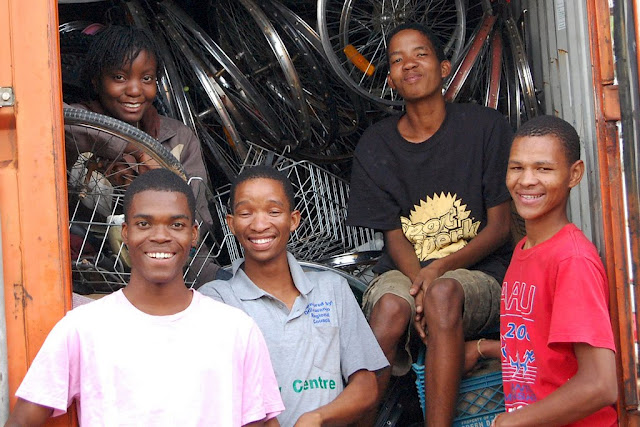
Photo Credit: “Joy Centre – BEC,” used courtesy of flickr user Ben Namibia.
-
In Kampala, African Leaders Discuss Maternal Health While Attacks Renew Concern over Somalia
›July 19, 2010 // By Schuyler NullLeaders from 49 African countries are meeting today in Kampala, Uganda, at the start of a scheduled week-long African Union (AU) summit on maternal and child health. Uganda is a fitting location, as it faces some of the toughest health and demographic challenges in Africa, including a very young and rapidly growing population and poor maternal health services. However, with the memory of last week’s twin bomb blasts still fresh, peace and security issues will surely be on the agenda as well.
Somalia’s lead insurgency group, Al Shabab, took responsibility for the attacks in Kampala, which killed more than 70 people. Al Shabab’s first prominent cross-border attack is only the latest sign that Somalia’s issues – which also include a very young and rapidly growing population – are starting to spill over its borders. For more on Somalia’s deepening crisis and its effects on the East African region, see New Security Beat’s recent analysis: “As Somalia Sinks, Neighbors Face a Fight to Stay Afloat.”
Sources: AP, Washington Post.
Photo Credit: Adapted from “Ugandan African Union contingent in Mogadishu, Nov. 25, 2007” courtesy of flickr user david axe. -
Local Case Studies of Population-Environment Connections
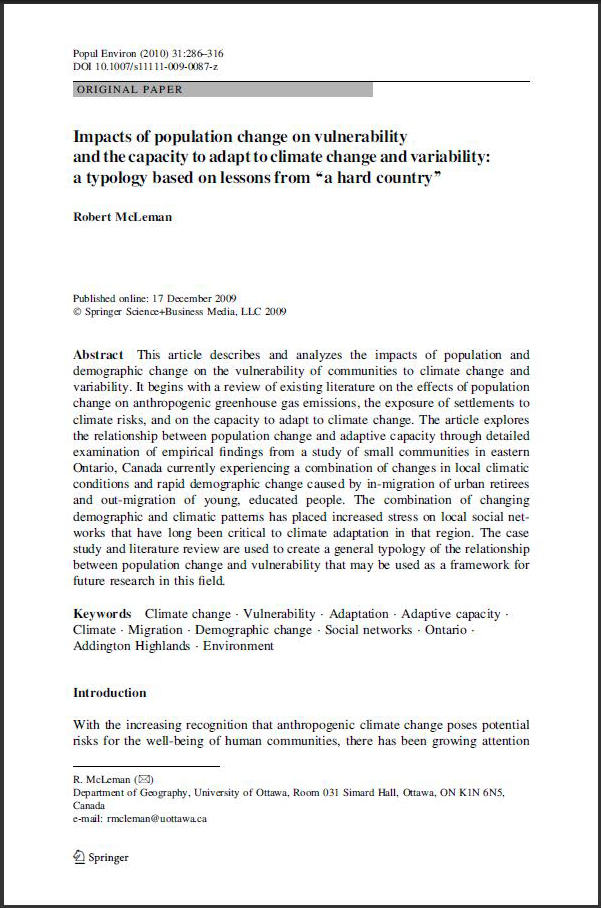
›“The role of intergenerational transfers, land, and education in fertility transition in rural Kenya: the case of Nyeri district” in Population & Environment by Karina M. Shreffler and F. Nii-Amoo Dodoo, explores the reasons for a dramatic and unexpected decline in fertility in rural Kenya. In one province, total fertility rate (TFR) declined from 8.4 to 3.7, from 1978 to 1998. The study found numerous contributing factors for this decline, which occurred more quickly and earlier than demographers expected, but land productivity seemed to be the primary motivator. A growing population and the tradition of dividing family land among sons made continuing to have large families unrealistic for these Kenyan families. “Family planning is, therefore, not the primary causal explanation for limiting the number of children, but rather serves to help families attain their ideal family sizes,” the authors conclude.Also in Population & Environment, “Impacts of population change on vulnerability and the capacity to adapt to climate change and variability: a typology based on lessons from ‘a hard country,’” by Robert McLeman, explores the potential for human communities to adapt to climate change. The article centers on a region in Ontario that is experiencing changes in both local climatic conditions and demographics. The study finds that demographic change can have both an adverse and positive effect on the ability of a community to successfully adapt to climate change and highlights the importance of social networks and social capital to a community’s resilience or vulnerability. McLeman also presents a new typology that he hopes will “serve the purpose of drawing greater attention to the degree to which adaptive capacity is responsive to population and demographic change.”
SpringerLink offers free access to both these articles through August 15. -
DRC’s Conflict Minerals: Can U.S. Law Impact the Violence?
›July 13, 2010 // By Schuyler NullApple CEO Steve Jobs, in a personal email posted by Wired, recently tried to explain to a concerned iPhone customer the complexity of ensuring Apple’s devices do not use conflict minerals like those helping to fund the civil war in the Democratic Republic of Congo. However much one might be tempted to pile on Apple at the moment, Mr. Jobs is on to something with regard to the conflict minerals trade – expressing outrage and raising awareness of the problem is one thing but actually implementing an effective solution is quite another.
As finely articulated in a number of recent articles about conflict minerals in the DRC (see the New York Times, Guardian, and Foreign Policy for example), the Congo is, and has been for some time, a failed state.
Although a ceasefire was signed in 2003, fighting has continued in the far east of the country around North and South Kivu provinces, home to heavy deposits of tin, gold, coltan, and other minerals. The remote area is very diverse ethnically and has seen clashing between government troops and various militias from the Congo itself as well as encroachments by its neighbors Rwanda, Uganda, and Burundi. Referred to as “the Third World War” by many, there are by some accounts 23 different armed groups involved in the fighting, and accusations of massacres, rampant human rights abuses, extortion, and pillaging are common. According to the UN Special Representative on Sexual Violence in Conflict, “there is almost total impunity for rape in the Congo,” and a survey by the International Rescue Committee puts the estimated dead from preventable diseases, malnutrition, and conflict in the area at over five million over the past decade (or 45,000 deaths a month).
At a recent event in Washington, DC on this terrible conflict (see Natural Security for an excellent summary), DRC Ambassador Faida Mitifu expressed her hope to the audience and panel (including U.S. Under Secretary of State Robert Hormats) that they would not limit themselves to “just talking.” Hosts John Pendergast and Andrew Sullivan of the NGO Enough Project hope to address the demand side of Congo’s mineral trade by pushing Congress to pass the Conflict Minerals Trade Act, which would require U.S. companies to face independent audits to certify their products are conflict mineral-free.
But Laura Seay, of Texas in Africa and the Christian Science Monitor, is dubious of this proposal, pointing out that:Without the basic tools of public order in place and functioning as instruments of the public good in the DRC, the provisions of this bill are likely to work about as well as the Kimberley Process Certification Scheme does in weak states that lack functioning governmental institutions – which is to say, not at all.
The Kimberely Process (KP) is a certification scheme that is supposed to stem the flow of “blood diamonds” that support corrupt regimes and fuel human rights abuses. But the KP’s governing body has recently reached a crisis of action over whether or not to punish Zimbabwe for alleged abuses, with one diamond magnate even claiming, according to IRIN, that “corrupt governments have turned the KP on its head – instead of eliminating human rights violations, the KP is legitimizing them.”
The problem with international transparency schemes like the Kimberely Process, the proposed Conflict Minerals Act, or even EITI, is that at the very least, a functioning government – if not a beneficent one – is needed to enforce regulations at the source. In the DRC’s case, not only does the government have little to no authority over the affected areas, but the mining militias are smuggling their loot, on foot in some cases, directly into neighboring countries anyway. By the time they reach U.S. companies (if ever – Americans are not the only consumers in the world), conflict minerals have passed hands so many times that proving their provenance is next to impossible.
Then there is the question of whether or not cutting off the militias, rogue military officials, and government forces from conflict mineral monies would even end violence in the region in the first place. Certainly many armed groups gain a great deal from their illegal mining activities (as do some locals), but is it the root cause of their discontent? In the best case scenario where mining revenues are actually decreased, would that really convince the remnants of the Hutu Interahamwe, fleeing retribution from the now majority-Tutsi Rwandan government, to suddenly put down their weapons? How about the Mai Mai, who are fighting the Hutu incursion into their homeland?
I for one find that hard to believe. Stopping the conflict mineral trade from afar is very difficult, if not impossible, and even if we could end the trade, it would not necessarily stop the suffering. Illegal mining does play a large part in supporting rebel groups, but to address the human security problems that have so horrified the world, international attention ought to first be turned toward improving governance mechanisms in the Congo and rethinking the troubled UN peacekeeping mission (how about more involvement out of U.S. AFRICOM too?). The failure of the current UN mission is well documented, but withdrawing the largest peacekeeping force in the world in the face of continued violence, including the recent death of Congo’s most famous human rights activist under suspicious circumstances, seems more likely to cause harm than good.
Would passing the Conflict Minerals Act make Apple consumers feel better? Perhaps. But that’s not the point. Environmental security measures that prevent the DRC’s tremendous mineral wealth from being used to fund conflict can only make an impact if the government has some measure of accountable control over the area. To make a real difference in east Congo, human security must first be addressed directly and forcefully.
Sources: BBC, Christian Science Monitor, Daily Beast, Human Rights Watch, IPS News, IRIN News, International Rescue Committee, Enough Project, Foreign Policy, GlobalSecurity.org, Globe and Mail, New York Times, Share the World’s Resources, Southern Times, Times Online, UN, Wired.
Image Credit: “Minerals and Forests of the DRC” from ECSP Report 12, courtesy of Philippe Rekacewicz, Le Monde diplomatique, Paris, and Environment and Security Institute, The Hague, January 2003. -
New Film Looks at Sub-Saharan Africa’s Unmet Need for Family Planning
›A new documentary film released recently by Population Action International brings attention to the plight of women across sub-Saharan Africa who lack access to basic reproductive health supplies, such as condoms and contraceptives. Funded with the support of the Reproductive Health Supplies Coalition, “Empty Handed” documents the unmet need for family planning services in the region, which has some of the world’s highest fertility rates.
PAI filmmaker Nathan Golon shot the film in Uganda earlier this year. The film’s focus on Ugandan women’s struggles in particular is with good reason, as the country has a well-documented history of providing insufficient family planning services. According to the CIA’s World Factbook, Uganda has the world’s second highest total fertility rate at 6.73 children per woman.
“Empty Handed” examines how a lack of family planning tools and services can lead to a slippery slope of unintended consequences, from unplanned pregnancies to the rampant spread of sexually transmitted diseases. The film revolves around interviews conducted with women who share common hardships as they try to access family planning from under-resourced local healthcare clinics, often traveling long distances only to find upon arrival that no contraceptives or condoms are available.
In addition to identifying past and current issues with reproductive healthcare access in sub-Saharan Africa, “Empty Handed” also puts forward some ideas for better meeting family planning needs of the more than 200 million women throughout the world without access to even basic contraception.
To watch the full film online, visit the “Empty Handed” website.
Sources: C.I.A., FHI, Population Action International, Reproductive Health Supplies Coalition -
Interview With Wilson Center Scholar Jill Shankleman: Could Transparency Initiatives Mitigate the Resource Curse in Afghanistan?
›June 25, 2010 // By Schuyler NullIn the wake of The New York Times article detailing a potential mineral bonanza in Afghanistan, Senators Ben Cardin and Dick Lugar earlier this week published an op-ed in support of a bill that would create “an international standard for transparency in law” by requiring oil, gas, and mining industries to report amounts paid for drilling/mining rights in their SEC filings. A similar program, albeit a voluntary one, already exists – the Extractive Industries Transparency Initiative (EITI). The senators, however, raised questions about the ability of EITI to ensure transparency and accountability of payments for future mining rights to Afghanistan’s government. Joining EITI was a “good first step,” they say, “but too many countries and companies remain outside this system.”
Showing posts from category Africa.