

Showing posts from category energy.
-
Weekly Reading
›“A New Military Mission: Clean Energy,” part of the Center for American Progress’ “It’s Easy Being Green” series, highlights the military’s attempts to become more energy-efficient. Read more about the U.S. military’s environmental initiatives.
Simon Dalby, a professor at Carleton College, discusses the evolution of environmental security with John Tessitore, executive editor of the Carnegie Council, in a video interview (transcript available).
Climate Change, Food Security, and the Right to Adequate Food examines climate change’s expected impact on food production, with a special focus on Africa and Asia.
The BDA Foundation, a Canadian charity, and PharmAfrica, a pharmaceutical company, are working to create a medicinal plants industry that will lift local people out of poverty in the Democratic Republic of the Congo. -
Mind the Gap: Forging a Consensus on Security and Climate Change in EU and US Foreign Policy
›March 5, 2009 // By Will Rogers “There are political and economic vulnerabilities that are in fact more important—or seem more important—to the participants of conflict than the physical vulnerability to climate change,” said Clionadh Raleigh at the February 19, 2009, event, “Climate Security Roundtable: U.S. and EU Research and Policy.” Raleigh, a lecturer at Trinity College Dublin, was joined by Nick Mabey, founding director and chief executive of E3G, and Sharon Burke, a senior fellow at the Center for a New American Security, to discuss climate change’s impact on conflict and how the United States and European Union (EU) have begun to adapt their foreign and security policies to the threat of climate change.
Ecological Change, Migration, and Conflict: A Complex Story
“The lack of access to power for certain communities, certain ethnic groups in sub-Saharan Africa, and basic access to resources among the most vulnerable populations has led to people misinterpreting the relationship that ecological change plays in their decision to either participate in conflict or to migrate,” Raleigh said. Although Raleigh’s research, which examined civil conflicts from 1990 to 2004, found that population density and growth were related to higher risks of conflict, “environmental pressures were not more likely to cause conflict in poor states—and not more likely during periods of instability,” she concluded. “Social, political, and economic factors are the most important determinants of civil war within developing countries,” she emphasized. “Poverty and unequal development come up time and time again.”
According to Raleigh, fears of mass international migration in response to climate change are overplayed. “Individuals and communities have quite a lot of coping mechanisms to deal with ecological difficulty,” including migration from rural to urban areas in the same country, she explained. Most migration, including labor and distress migration, “is temporary, internal, and circular,” she emphasized. “There is very little to no evidence that there will be an increase in international migration” in response to ecological change, although “there is evidence that there will be an increase in internal migration.”
Climate Change and Security: Perspectives from the EU“Climate change is serious,” emphasized Mabey. “It’s a threat multiplier, it will make unstable places less stable—it’s going to change strategic interests, alliances, borders, threats, economic relationships, comparative advantages, the nature of international relations, and the legitimacy of the UN.” In the future, “security policy will need to get more preventive and risk-based because climate change just injects a huge bolt of uncertainty into the future,” said Mabey. He urged the expansion of forward-looking information systems that provide policymakers with the data they need to make decisions at the geopolitical, strategic, and operations levels. He also said security experts should strive to communicate the potential consequences of climate change to decisionmakers.
The EU has taken steps to integrate climate change into its security strategy; Great Britain, Germany, and Denmark have taken the lead. The Arctic has been a particular focus, with security experts examining trade routes, maritime zones, and new access to resources. Climate change “is not all about instability” in fragile, impoverished states, Mabey explained. “The Arctic is by far the most important climate security issue in the minds of traditional foreign-policy types in Europe.”
Environmental Security Gets a New Tool: The Climate War GameLast year, Burke helped conduct a climate change war game based on a scenario of extreme weather events like droughts, wildfires, and cyclones. “Every country sort of hewed to what you would expect,” said Burke of the high-profile participants from China, India, Europe, and the United States. “The EU team spent the first two hours debating whether they could really be a country; the Indian team instantly came up with a negotiating strategy that sounded cooperative and brilliant but was completely impossible to execute; the Chinese team was, ‘No, we’re not going to do anything unless you pay us’; and the American team was keen to lead, only nobody was following.” One of the key lessons from the game, Burke explained, was that “everything comes down to what China is prepared to do.”
In developing the game, Burke and her colleagues discovered “that there’s a vast poverty of the kinds of information that you need to make decisions.” As Burke explained, policymakers need specific data “to obligate large amounts of money and personnel,” and the game revealed that “policymakers don’t have the information they need to make decisions.”
Photos: From top to bottom, Clionadh Raleigh, Nick Mabey, and Sharon Burke. Courtesy of Dave Hawxhurst and the Woodrow Wilson Center. -
Weekly Reading
›From Conflict to Peacebuilding: The Role of Natural Resources and the Environment, based on the work of the UN Environment Programme’s Expert Advisory Group on Environment, Conflict and Peacebuilding, summarizes the links between the environment, conflict, and peacebuilding, and includes 14 case studies of how natural resources affect—or are affected by—conflict.
The authors of “On Population Growth Near Protected Areas” come to an opposite conclusion from Wittemyer et al., who found a pattern of higher population growth near protected areas in Africa and Latin America. “To understand the disagreement, we re-analyzed the protected areas in Wittemyer et al.’s paper. Their results are simply artifacts of mixing two incompatible datasets,” write the authors. “Protected areas may experience unusual population pressures near their edges; indeed, individual case studies provide examples. There is no evidence, however, of a general pattern of disproportionate population growth near protected areas.”
“The President and I agreed to a new initiative that will further cross-border cooperation on environmental protection and environmental security,” said Canadian Prime Minister Stephen Harper yesterday, announcing plans for a U.S.-Canada Clean Energy Dialogue.
Scientists at Purdue University have teamed up with Google Earth to create an interactive map of U.S. CO2 emissions.
Mark Weston, who writes for the Global Dashboard blog, posted an edited version of a recent talk he gave on West African demography and security. -
New Director of National Intelligence Assesses Climate, Energy, Food, Water, Health
›February 18, 2009 // By Rachel WeisshaarIn the annual threat assessment he presented last week to the Senate Select Committee on Intelligence, new Director of National Intelligence Dennis Blair named the global economic crisis—not terrorism—the primary near-term threat to U.S. national security, prompting accusations of partisanship from the Washington Times. Yet as the U.S. Naval War College’s Derek Reveron notes, “the economic turmoil of the early 20th century fueled global instability and war,” and today’s economic collapse could strengthen extremists and deprive U.S. allies of the funds they need to deploy troops or increase foreign assistance to vulnerable regions.
Further down the list of potential catastrophes—after terrorism, cybersecurity, and the “arc of instability” that stretches from the Middle East to South Asia—the assessment tackles environmental security threats. The four-page section, which likely draws on sections of the recent National Intelligence Council report Global Trends 2025: A Transformed World, summarizes the interrelated natural-resource and population challenges—including energy, food, water, demography, climate change, and global health—the U.S. intelligence community is tracking.
The world will face mounting resource scarcity, warns Blair. “Access to relatively secure and clean energy sources and management of chronic food and water shortages will assume increasing importance for a growing number of countries. Adding well over a billion people to the world’s population by 2025 will itself put pressure on these vital resources,” he writes.
Drawing on the conclusions of the 2008 National Intelligence Assessment on the impacts of global climate change to 2030, Blair portrays climate change as a variable that could place additional strain on already-stressed agricultural, energy, and water systems: “We assess climate change alone is unlikely to trigger state failure in any state out to 2030, but the impacts will worsen existing problems such as poverty, social tensions, environmental degradation, ineffectual leadership, and weak political institutions.” Direct impacts to the United States include “warming temperatures, changes in precipitation patterns, and possible increases in the severity of storms in the Gulf, increased demand for energy resources, disruptions in US and Arctic infrastructure, and increases in immigration from resource-scarce regions of the world,” writes Blair.
Africa, as usual, is the last of the world’s regions to be analyzed in the assessment. Blair notes that “a shortage of skilled medical personnel, deteriorating health systems, and inadequate budgets to deal with diseases like HIV/AIDS, malaria, and tuberculosis” is threatening stability in sub-Saharan Africa, and explains that agriculture, which he rightly calls “the foundation of most African economies,” is not yet self-sufficient, although some countries have made significant improvements in infrastructure and technology. He highlights ongoing conflicts in the Democratic Republic of the Congo, Nigeria, Sudan, and Somalia as the most serious security challenges in Africa. He fails to note, however, that all four have environmental/natural resource dimensions (see above links for details). -
Natural Gas Standoff Between Russia, Ukraine Brings New Meaning to “Cold War”
›January 15, 2009 // By Rachel WeisshaarAs the dispute between Russia and Ukraine over natural gas pricing and delivery heads into its second week, it has grown into a larger political standoff between the two countries. The Council on Foreign Relations’ Jeffrey Mankoff explains that the “background is a long-running dispute between Russia and Ukraine in terms of gas relationships over two things: One is over the price that Ukraine pays, and the second is over debt that Ukraine owes Russia for gas shipments in the past that it hasn’t paid for. There’s also a political subtext because Ukraine, since 2004, has had a government that is interested in pursuing integration with Euro-Atlantic institutions, including NATO.”
Europe receives one-fifth of its natural gas from Russia; Bulgaria, Slovakia, and other countries in Eastern and Southeast Europe have been particularly hard-hit by the shutdown. Russia and Ukraine agreed to resume natural-gas deliveries to Europe on Monday, but that EU-brokered agreement has fragmented, and the two countries continue to argue over which pipelines to use and how much gas to deliver. Russian Prime Minister Vladimir Putin and Ukranian Prime Minister Yulia Tymoshenko are scheduled to meet at an EU-sponsored summit on Saturday.
Natural resources are frequently involved when Russia makes international headlines. For instance, in August 2008, Russia and Georgia went to war over resource-rich, geopolitically strategic South Ossetia. In addition, in January 2006, Russia and Ukraine got into a similar dispute over natural gas—although that one did not last as long as the present one. It remains to be seen which side—if either—will benefit from the manipulation of natural resources in the current situation. -
How to Win (Green) Friends and Influence People (Who Are Interested the Environment)—Without Leaving Your Computer
›November 28, 2008 // By Rachel WeisshaarNew York Times environment reporter Andrew Revkin recently invited readers to post cost-effective environmental proposals on his blog, Dot Earth. He promised to send the 10 best ones, as determined by readers’ recommendations, to the Obama transition team on energy and the environment.
Intriguingly, two of the proposals focus on population. “In a world of increasing scarcity, if we do not get a handle on our own population, it will get a handle on us,” writes one reader. “Because of sustained exponential population growth, we are collectively destroying what remains of the natural world. We are also putting our species at grave risk for rapid catastrophic population decline. We cannot expect to sustain exponential population growth indefinitely,” warns another.
If you missed this opportunity to put in your $0.02 on environmental and population issues, don’t worry: You can submit your comments directly to the energy and environment policy team on the Obama transition website.
Yet another venue for influencing influential people is Thomas Friedman’s Chapter 18 Project. Friedman’s latest book, Hot, Flat, and Crowded: Why We Need a Green Revolution—And How It Can Renew America, consists of 17 chapters, but he has said that the second edition will include an additional chapter comprising readers’ best ideas on how to make the transition to clean energy, improve our global environmental stewardship, and revitalize America’s economy and international reputation by “going green.” You can submit your proposals on his website. -
PODCAST – Lester Brown on Climate Change and Energy Security
›November 13, 2008 // By Wilson Center Staff“When looking at what we need to do, I think stabilizing climate, stabilizing population are the two big ones. If we fail at either of those…civilization is in serious trouble,” warns Lester Brown, founder of the Earth Policy Institute in Washington, DC, in the latest podcast from the Environmental Change and Security Program (ECSP). Following a recent event, “Thinking Outside the Grid: An Aggressive Approach to Climate and Energy,” co-sponsored by Wilson Center on the Hill and ECSP, Brown elaborated on the themes of his latest book, Plan B 3.0: Mobilizing to Save Civilization, and addressed climate change’s impact on natural resources, food security, and energy independence. He argues that the United States must critically re-examine its energy infrastructure and invest heavily in alternative energy technologies. -
Support Grows for Integrating Environment, Energy, Economy, Security in U.S. Government
›November 5, 2008 // By Rachel WeisshaarA new presidential administration always gives rise to a certain amount of bureaucratic restructuring. But for months now, momentum has been building behind the notion that governments need to improve the integration of their environmental, energy, economic, and security policies. Last month, Edward Miliband was named head of the UK government’s new department of energy and climate change. Last week, Canadian Prime Minister Stephen Harper tapped former industry minister Jim Prentice to lead a new ministry of environment, economy, and energy security. “I think that, as more and more countries are coming to realize, we cannot separate environmental and economic policy,” said Harper.
Yesterday, Grist’s David Roberts, noting that responsibility for addressing climate change is currently spread among the departments of State, Defense, Interior, Agriculture, Housing and Urban Development, Transportation, and Energy, offered several possibilities for restructuring the U.S. government to improve its ability to address climate change and energy, including creating a cabinet-level Secretary of Climate; expanding and empowering the Department of Energy or the Environmental Protection Agency; or—my favorite—appointing “some kind of czar,” because “[e]verybody loves a czar.”
Initiatives linking these challenges are popping up in Congress, universities, and the military. Senator Ken Salazar (D-CO) frequently speaks of the interrelated challenges of energy, environment, security, and economic growth “[O]ur addiction to foreign oil is a threat to our economic security, environmental security, and national security,” he said last year. The University of Colorado Law School recently established the Center for Energy and Environmental Security, which develops practical solutions to help move the world toward a sustainable energy future. In addition, the 2008 National Defense Strategy explicitly links energy, environment, and security: “Over the next twenty years physical pressures—population, resource, energy, climatic and environmental—could combine with rapid social, cultural, technological and geopolitical change to create greater uncertainty.”
A few small-scale initiatives to integrate environmental, economic, energy, and security policies within the U.S. government already exist. Yesterday, Carol Dumaine, deputy director for energy and environmental security at the Department of Energy, delivered a talk at the Harvard University Center for the Environment where she discussed a fledgling project to use unclassified data and a global network of experts in government, industry, and NGOs to identify interrelated environmental and energy security threats. Dumaine presented on the same project at a September 2008 conference on open-source intelligence sponsored by the Office of the Director of National Intelligence. It remains to be seen whether the Obama administration will continue this and other ongoing projects, or instead launch new projects of its own on these issues.
 “There are political and economic vulnerabilities that are in fact more important—or seem more important—to the participants of conflict than the physical vulnerability to climate change,” said Clionadh Raleigh at the February 19, 2009, event, “
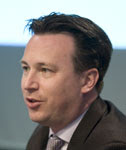 “Climate change is serious,” emphasized Mabey. “It’s a threat multiplier, it will make unstable places less stable—it’s going to change strategic interests, alliances, borders, threats, economic relationships, comparative advantages, the nature of international relations, and the legitimacy of the UN.” In the future, “security policy will need to get more preventive and risk-based because climate change just injects a huge bolt of uncertainty into the future,” said Mabey. He urged the expansion of forward-looking information systems that provide policymakers with the data they need to make decisions at the geopolitical, strategic, and operations levels. He also said security experts should strive to communicate the potential consequences of climate change to decisionmakers.
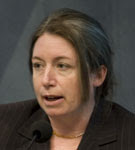 Last year, Burke helped conduct a

