

-
Weekly Reading
›In a foreign policy speech on Tuesday attended by several of the New Security Beat’s authors, Senator Barack Obama said the danger posed by the price of oil “is eclipsed only by the long-term threat from climate change, which will lead to devastating weather patterns, terrible storms, drought, and famine. That means people competing for food and water in the next 50 years in the very places that have known horrific violence in the last fifty: Africa, the Middle East, and South Asia. Most disastrously, that could mean destructive storms on our shores, and the disappearance of our coastline. This is not just an economic issue or an environmental concern—this is a national security crisis.”
“The US security community has been looking at environment and security links for much longer than the current attention around climate/security linkages would suggest,” ECSP Director Geoff Dabelko told the Yale Forum on Climate Change & the Media, which published a piece examining climate change and national security earlier this week.
“The next president must strengthen civilian professional capacity to carry out diplomatic and development operations. More funding is needed to address the current 17 to 1 spending imbalance in staffing and resources between defense and diplomatic/development operations, and to reduce the use of contractors in foreign assistance programs,” argues a report from Refugees International, U.S. Civil-Military Imbalance for Global Engagement: Lessons From the Operational Level in Africa.
An opinion piece by Laurie Mazur and Priscilla Huang argues against blaming immigrants for environmental degradation. “Environmental impact is determined not just by our numbers, but by how we use resources—our systems of production and consumption and the policies that shape them,” they write. “It’s laughable to blame immigrants and population growth for traffic, as the [anti-immigrant] ads do, without mentioning, say, our chronic neglect of public transportation.” -
Weekly Reading
›Mark Jenkins explores the July 2007 murders of the Virunga mountain gorillas in a piece in National Geographic. The piece is accompanied by a stunning photo slideshow by photographer Brent Stirton.
The Toronto Star takes a look at female feticide and infanticide in India, and how young women are now being trafficked from rural areas to serve as brides in areas where the gender gap is widest.
Climate change is responsible for an upswing in malaria in Kenya’s highlands, reports IPS News. “There is a clear correlation between climatic variations and malaria epidemics,” said Dr. Willis Akhwale, head of Kenya’s National Malaria Control Programme.
A New York Times article explores the causes of low birthrates in Europe—and particularly low ones in southern Europe.
The World Health Organization has released Safer water, better health, the first report to provide country-level estimates of the burden of disease caused by unsafe water and inadequate sanitation and hygiene. -
House Energy Subcommittee Debates Economic, Human, Security Costs of Climate Change
›June 30, 2008 // By Rachel WeisshaarThe cost of taking no action to reduce greenhouse gas emissions would be “equivalent to a 3.6% loss of the U.S. GDP in 2100,” said Sir Nicholas Stern in his written testimony to the Energy and Commerce Subcommittee on Energy and Air Quality last week (archived webcast). “We should emphasize, however, that there are many likely, larger, and deeply damaging, effects which will occur after 2100 and these calculations take no account of the effects on the USA of the damages and devastation which occur outside the USA.”
Stern, who authored the 2006 Stern Review on the Economics of Climate Change, discussed the non-economic costs of climate change, as well. Extreme climate change scenarios “involve movements of population, and we know that movement of population means not only the hardship around the movements themselves, but also conflict,” he said at the hearing.
Sherri Goodman, general counsel of the Center for Naval Analysis (CNA) Corporation, asserted the interdependence of climate change, national security, and energy dependence. “Numerous DoD studies have concluded that high fuel demand by combat forces detracts from combat capability, makes our forces more vulnerable, diverts combat assets from offense to supply line protection, and increases operating costs,” said Goodman’s testimony.
Energy is also a security issue at home. “The Defense Department is almost completely dependent on electricity from the national grid to power critical missions at fixed installations,” explained Goodman. “The national electric grid is fragile and can be easily disrupted, as happened in the Northeast Blackout of 2003, caused by trees falling onto power lines in Ohio. It affected 50 million people in eight states and Canada, took days to restore and caused a financial loss in the U.S. estimated to be between $4 billion and $10 billion. As extreme weather events become more common [due to climate change], so do the threats to our national electricity supply.”
A day earlier, two other House committees discussed the newly completed—and still classified—National Intelligence Assessment on the U.S. national security implications of climate change. -
Sparks Fly at Joint Hearing on National Intelligence Assessment of Climate Change’s National Security Implications
›June 26, 2008 // By Rachel Weisshaar“Climate change alone is unlikely to trigger state failure in any state out to 2030, but the impacts will worsen existing problems—such as poverty, social tensions, environmental degradation, ineffectual leadership, and weak political institutions,” said National Intelligence Council Chairman Thomas Fingar at yesterday’s joint hearing of the House Select Committee on Energy Independence and Global Warming and the House Subcommittee on Intelligence Community Management.
The hearing allowed Democrats and Republicans alike to question Fingar and other witnesses on the newly completed, classified National Intelligence Assessment (NIA) on the national security implications of global climate change through 2030. The NIA relies on the mid-range projections in the Intergovernmental Panel on Climate Change’s Fourth Assessment Report, as well as the expert opinions of scientists from the U.S. government and U.S. universities.
“Climate change could threaten domestic stability in some states, potentially contributing to intra- or, less likely, interstate conflict, particularly over access to increasingly scarce water resources. We judge that economic migrants will perceive additional reasons to migrate because of harsh climates, both within nations and from disadvantaged to richer countries,” said Fingar, adding that the United States should be prepared to assist people fleeing flooded coastal areas in the Caribbean.
Domestically, Fingar warned the representatives to expect severe water scarcity in the Southwest, increasingly frequent wildfires, and powerful storms on the East and Gulf Coasts, which could threaten nuclear power plants, oil refineries, and U.S. military installations. The military could also find its capacity overstretched abroad: AFRICOM will be tasked with responding to more frequent disease outbreaks, food scarcity, and land clashes in sub-Saharan Africa, and the U.S. military in general will be called upon to alleviate increasingly common humanitarian emergencies around the world.
According to Fingar, the NIC plans to analyze three subtopics in greater detail: climate change’s security implications for individual countries; its implications for cooperation and competition among the world’s great powers, including the United States, Russia, China, and India; and the security implications of possible climate change mitigation strategies.
Democrats and Republicans butted heads over whether the NIA was a commendable achievement or a distraction from more important security issues, such as terrorism. At one point, Representative Edward Markey (D-MA), chairman of the House Select Committee on Energy Independence and Global Warming, asked Fingar whether he thought climate change could worsen the drivers of terrorism, and Fingar responded that yes, he thought climate change would probably increase the pool of recruits for terrorist activity, which was cause for concern.
Virtually the only issue on which Democrats and Republicans could agree—although for differing reasons—was that the NIA should be declassified. Democrats believed declassification was important so that government agencies and private businesses could begin to prepare for climate change’s impacts, while Republicans argued the NIA should be declassified because they believed the NIC’s analysts, having based their analysis entirely on open-source information, hadn’t contributed anything new to the existing body of knowledge on climate change. Fingar disagreed that secret intelligence is more valuable than open-source information: “Information is information; knowledge is knowledge.”
For her part, Representative Anna Eshoo (D-CA), chairwoman of the Subcommittee on Intelligence Community Management, seemed content to ignore the misgivings of some of her colleagues regarding the NIA. “From this day forward, the words ‘climate change’ and ‘international security’ will be forever linked,” she proclaimed.
Selected news coverage:
Wall Street Journal: Global Warming as Security Issue: Intelligence Report Sees Threat
Reuters: Climate change may strain U.S. forces
MSNBC: Climate change could threaten U.S. security
CNN: Global warming could increase terrorism, official says -
Council on Foreign Relations Report Calls Climate Change an “Essential” Foreign Policy Issue
›June 24, 2008 // By Sonia Schmanski“Domestic policy alone is not enough; a new U.S. foreign policy to tackle climate change is also essential,” argues a Council on Foreign Relations Independent Task Force in Confronting Climate Change: A Strategy for U.S. Foreign Policy. “Unchecked climate change,” the authors write, “is poised to have wide-ranging and potentially disastrous effects on…human welfare, sensitive ecosystems, and international security.”
The Independent Task Force report comes on the heels of CFR’s widely publicized November 2007 report, “Climate Change and National Security.” ECSP Director Geoff Dabelko spoke with author Joshua Busby in a January podcast examining the links between climate and security.
In an interview, Task Force Director Michael A. Levi said, “climate change is a global problem that requires a global solution.” Rather than remaining “mired in domestic discussions,” as Levi argues the Bush administration has been, the task force calls for a shift in the way policymakers frame the issue of carbon emissions. “The point of this task force,” said Levi, “was to pull back and put this back where it belongs, in the context of American foreign policy.”
The United States, uniquely positioned to “steer international efforts to confront climate change,” must take a leadership role in advancing global policies, Levi said. Unchecked, American emissions will overwhelm any reductions made by other countries. U.S. policymakers have a valuable opportunity to show that environmental responsibility is consistent with robust economic performance, a concern in both developed and developing countries and a leading impediment to addressing climate change.
However, the report strongly cautions against the United States entering into any global framework to which other large emitters, like China and India, are not willing to adhere. The authors argue that the United States should lead through its domestic policies but use a “wide range of levers” to compel other countries to move in the right direction. The challenge of global climate change calls for a multi-pronged solution. “[J]ust like scientists tell us that no one technology is going to solve the problem, there’s no one diplomatic solution that’s going to solve it,” warned Levi. The challenge, then, is translating broad global concern over climate change into collective, and productive, action.
-
In Ethiopia, Food Security, Population, Climate Change Align
›June 24, 2008 // By Daniel Gleick“The only future is resettlement,” a local Ethiopian official recently told the Economist, commenting on dire conditions in the Goru Gutu district, which is facing starvation following unpredictable rains and insect infestations. “Ethiopia has been synonymous with disastrous famine since the 1980s,” notes Sahlu Haile in “Population, Development, and Environment in Ethiopia“, his award-winning article for Environmental Change and Security Program Report 10. In fact, writes Haile, “the agricultural sector—the mainstay of the national economy—is less productive per capita today than it was 20 years ago.”
If resettlement were to take place in Goru Gutu, roughly 4,000 people would have to be resettled every year, and the government has a budget equal to only a fraction of the task. In addition, previous resettlement attempts have been disastrous. According to Haile, “previous resettlement programs were not voluntary…neither were they based on serious economic, social, and environmental studies.” As a result, they led to hardship for the migrants and to conflict with local populations, who felt threatened by the newcomers.
In “The Missing Links: Poverty, Population, and the Environment in Ethiopia,” Mogues Worku points out that in coming years, a rapidly growing population—the result of a lack of access to family planning and education among women—will put additional stress on the country’s ability to feed itself. In addition, Worku explains that climate change “has intensified these environmental problems by altering the region’s rainfall patterns.” Ethiopia’s population and climate challenges will likely lead to additional pressure for resettlement, paving the way for possible conflict. There are many national and international NGOs doing impressive work in Ethiopia on food security, family planning, sustainable livelihoods, and other issues, but much work remains to be done. -
New International Peace Institute Paper Examines Resource Scarcity, Insecurity
›June 18, 2008 // By Daniel Gleick“Often, those who are already vulnerable to threats because they are poor, illiterate, lack political power, or face gender or ethnic discrimination are the ones who find themselves in the front lines of the negative dimensions of environmental change,” writes Richard Matthew of the Center for Unconventional Security Affairs at the University of California, Irvine, in “Resource Scarcity: Responding to the Security Challenge,” a new paper from the International Peace Institute. Vulnerable populations “face water and land scarcity, are displaced into marginal ecosystems where they encounter unfamiliar parasites, experience severe weather events, lose everything to floods and mudslides, and daily eke out an existence in peri-urban areas awash with human waste.”
Researchers continue to debate the security implications of various kinds of resource scarcity, but according to Matthew, there are at least four areas of general agreement:
• Resource scarcity is never the sole cause of conflict, but is often a contributing factor;
• Migration is frequently the link between resource scarcity and conflict;
• Rapid changes in access to resources are more likely to cause conflict than gradual changes; and
• Climate change will lead to resource scarcity in many areas that are experiencing or vulnerable to conflict.
Despite these dire circumstances, Matthew believes key actions and policies could significantly reduce the likelihood that resource scarcity will lead to conflict and insecurity. He offers 14 specific recommendations for NGOs, governments, and international organizations, which include supporting “the effort in UNEP to integrate the environment into post-conflict assessment, disaster management, and peacebuilding” and mobilizing “the enormous capacity of the private sector and NGO communities…around sustainable development, conflict resolution, and peacebuilding.”
-
Africa Atlas’s Exquisite Images Reveal Effects of 40 Years of Environmental Degradation
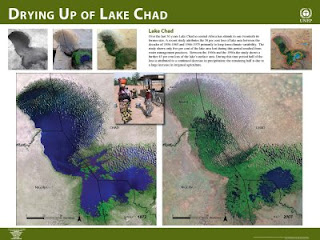
›June 16, 2008 // By Daniel Gleick On June 10, at the 12th session of the African Ministerial Conference on the Environment, the UN Environment Programme (UNEP) released Africa: Atlas of Our Changing Environment, a comprehensive look at the environmental devastation being wrought in Africa. Highlighting the ecological damage caused by high population growth, climate change, and the unsustainable use of natural resources, the atlas shows before-and-after satellite images of “disappearing forests, shrinking lakes, vanishing glaciers and degraded landscapes.” The above image, courtesy of UNEP, shows how Lake Chad has shrunk to one-twentieth of its size 30 years ago.
As The Independent put it: “Put it all together and you have a picture that is hard to credit, so enormous is the destruction.” Much of the impetus behind the atlas was to spur African governments to improve their environmental records.
On July 1, ECSP will host UNEP Executive Director Achim Steiner at the Washington, DC, launch of the atlas.
Showing posts from category climate change.
 On June 10, at the 12th session of the

