

Showing posts from category climate change.
-
Weekly Reading
›The Feeding of the Nine Billion: Global Food Security for the 21st Century, a report from Chatham House, puts forth 10 proposals designed to make the global food system more resilient, sustainable, and equitable.
Strategic Implications of Global Health, a recent report from the National Intelligence Council, builds on a 2000 National Intelligence Estimate analyzing the links between global health and U.S. national security, but places more emphasis on non-infectious issues like maternal mortality, malnutrition, and chronic diseases.
Bill Gates’ first annual letter about his work at the Gates Foundation includes a chart showing that better overall health is linked to smaller families.
“How Much Would You Pay to Save the Planet? The American Press and the Economics of Climate Change,” a discussion paper from Harvard University’s Joan Shorenstein Center on the Press, Politics, and Public Policy, examines coverage of the economic debate over the Lieberman-Warner Climate Security Act of 2008.
Population Connection’s February 2009 Reporter features stories on Ghana’s slow progress on reproductive health and Thomas Friedman’s book Hot, Flat, and Crowded, among others.
The Economist examines the connections between failed states and conflict, terrorism, poverty, and disease. Failed states were a major concern of the recent U.S. National Defense Strategy. -
United States Elevates Arctic to National Security Prerogative
›January 16, 2009 // By Will Rogers “The United States has broad and fundamental national security interests in the Arctic region and is prepared to operate either independently or in conjunction with other states to safeguard these interests,” states National Security Presidential Directive 66 (NSPD-66), issued by President Bush on Monday. NSPD-66 does pay some attention to “softer” Arctic issues, such as environmental protection, international scientific cooperation, and the involvement of the Arctic’s indigenous communities in decisions that affect them. But it still takes a tough stance on access to natural resources, boundary issues, and freedom of the seas/maritime transportation. With the rapid shrinking of Arctic ice caps making the region more accessible, the world is likely to see increased competition between the eight Arctic states—the United States, Canada, Denmark, Finland, Norway, Russia, and Sweden—over territorial claims and natural resources like oil and natural gas.
The opportunity to gain control over nearly a quarter of the world’s untapped oil and natural gas reserves will cause “a recalibration of geo-strategic power,” writes Scott Borgerson, visiting fellow for ocean governance at the Council on Foreign Relations, in the November 2008 issue of the Atlantic. With the world economic crisis slowing the development of alternative energy technologies, energy consumers will continue to be held hostage by volatile oil and natural gas markets, making those with control over these resources strong geopolitical players. Europe receives one-fifth of its natural gas from Russia, which has abundant reserves. And Russia has leveraged these reserves in an effort to slow the pace of former Soviet states’ accession into NATO and the EU.
Sweden and Norway recently forged a new defense relationship to address the rise of Russian power, and Finland, “also spooked by an increasingly assertive Russia,” will likely join the new Nordic defense pact. Among the pressing concerns for the Nordic alliance is to “make plans for what they call the ‘high north’, the energy-rich area that lies between Europe and the North Pole,” writes Edward Lucas in the Economist’s The World in 2009.
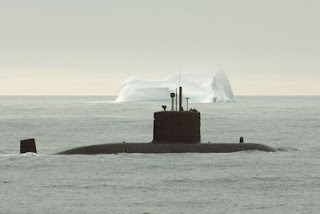
If the Nordic states gain significant control of Arctic oil and natural gas reserves, the European balance of power could shift further toward the West, a situation Russia is eager to prevent. Meanwhile, Canada, “alarmed by Russian adventurism in the Arctic,” has also strongly asserted its claims to Arctic sovereignty. “Canada has taken its sovereignty too lightly for too long,” said then-Prime Minister Stephen Harper in 2007. “This government has put a big emphasis on reinforcing, on strengthening our sovereignty in the Arctic.” Denmark, Great Britain, and Iceland, also mindful of the importance of Arctic resources, will likely stake claims to newly discovered resources. With the United States prepared to operate independently—at least according to the outgoing Bush administration—and its Arctic neighbors not likely to back away from their own interests, this once-frozen region could become a political hotspot.Photo: A Canadian naval submarine, the HMCS Corner Brook, patrols in Arctic waters as part of a Canada Command sovereignty operation in the Hudson Strait in August 2007. Courtesy of MCpl Blake Rodgers, Formation Imaging Services, Halifax, Nova Scotia, and flickr user lafrancevi.
-
Weekly Reading
›A study in Science warns that climate change “is likely to have more dramatic effects on global agriculture than previously predicted, leaving around half the world’s population facing serious food shortages,” reports SciDev.Net.
In an op-ed for Defense News, Sherri Goodman and David Catarious express hope that President-Elect Barack Obama will take steps to reduce climate change’s security impacts.
“Much of politics is repetitive and unproductive, but sometimes a logjam breaks. In the past two years, most politicians have ceased being in denial about climate change, greenhouse emissions, limits to water, and peak oil. All these crises reflect the deeper underlying problem: our population growth is out of control. Waiting for the population debate to begin is like waiting for the other shoe to drop,” writes Mark O’Connor for the Sydney Morning Herald.
Regional Water Cooperation and Peacebuilding in the Middle East, an Initiative for Peacebuilding paper by Annika Kramer of Adelphi Research, surveys peacebuilding challenges and opportunities around water among Israelis, Palestinians, and Jordanians.
Stephan Faris outlines the global divisions over climate change policy on Global Post, a new online-only international media site. -
The 10 Most Popular Posts of 2008
›From climate change to coltan, poverty to population, and water to war: These are the 10 most popular New Security Beat stories of the year. Thanks for your clicks, and we’ll see you in 2009!
1. Desertification Threatening China’s Human, Economic Health
2. PODCAST – Climate Change and National Security: A Discussion with Joshua Busby, Part 1
3. In the Philippines, High Birth Rates, Pervasive Poverty Are Linked
4. Climate Change Threatens Middle East, Warns Report
5. Population, Health, Environment in Ethiopia: “Now I know my family is too big”
6. Guest Contributor Colin Kahl on Kenya’s Ethnic Land Strife
7. Coltan, Cell Phones, and Conflict: The War Economy of the DRC
8. “Bahala na”? Population Growth Brings Water Crisis to the Philippines
9. Population Reference Bureau Releases 2008 World Population Data Sheet
10. Guest Contributor Sharon Burke on Climate Change and Security -
Weekly Reading
›“Climate change of that scale [a 5° C increase] will cause enormous resource wars, over water, arable land, and massive population displacements. We’re not talking about ten thousand people. We’re not talking about ten million people, we’re talking about hundreds of millions to billions of people being flooded out, permanently,” said Steven Chu, President-elect Barack Obama’s choice for secretary of energy, at the National Clean Energy Summit this summer.
“As the world focuses on the outcomes of the meeting on climate change that just concluded in Poznan, Poland, I am sitting in a workshop in Nazret, Ethiopia, listening to a panel of farmers talking about the effects of climate change on their lives – less rain, lower crop yields, malaria, no milk for their children,” writes Karen Hardee on Population Action International’s blog. “They are acutely aware that farm sizes shrink with each generation and speak eloquently of the need for access to family planning so they can have fewer children.”
The New York Times reports on the fight for control over uranium deposits in northern Niger, part of its ongoing series on resource conflict.
The current volume of Global Governance: A Review of Multilateralism and International Organizations examines global water governance.
On the Carnegie Council’s “Policy Innovations” website, Rebecca Laks reports on efforts to incorporate alternative fuels into refugee camps in order to reduce deforestation in the surrounding environment.
The Center for American Progress has released “Putting Aid and Trade to Work: Fostering Development for Sustainable Security,” along with related documents.
The Sabaot Land Defence Force and the Kenyan army have been fighting over the rights to land in western Kenya for years, and local women are suffering, reports IRIN News. Fighters from both sides often rape women, giving them HIV/AIDS.
“Cleaning the environment has been identified as major tool in waging war against mosquitoes” and malaria in Nigeria, reports the Vanguard. -
Weekly Reading
›The Center for Global Development’s interactive 2008 Commitment to Development Index rates 22 wealthy countries on how much they help poor countries in seven areas: aid, trade, investment, migration, environment, security, and technology.
“Destitution, distortion and deforestation: The impact of conflict on the timber and woodfuel trade in Darfur,” a new report from the UN Environment Programme’s Post-Conflict and Disaster Management Branch, says that saw-mills and wood-fired brick kilns are devastating Darfur’s fragile environment.
“If we are successful in reaching peak population sooner, at a lower number of people, rather than later with more people, we will be much more able to confront the myriad interlocking crises we face — a comparatively less crowded planet is an easier planet on which to build a bright green future,” writes Worldchanging’s Alex Steffen.
“In the case of the South American farms studied in this report, average simulated revenue losses from climate change in 2100 are estimated to range from 12 percent for a mild climate change scenario to 50 percent in a more severe scenario, even after farmers undertake adaptive reactions to minimize the damage,” finds a World Bank report on climate change and Latin America. Foreign Policy’s Passport blog comments.
In A Framework for Achieving Energy Security and Arresting Global Warming, Ken Berlin of the Center for American Progress sets out five sets of issues the federal government will have to address in order to reduce U.S. greenhouse gas emissions and dependence on foreign oil.
“Ask any environmental organisation what it thinks about birth control; it’ll sidestep the issue, and say it’s not their place to comment. If a commentator says there are too many people on the planet, their words smack of authoritarian dictatorships and human rights violations, and echo traces of unpalatable eugenics. However, the reality is that every time we eat, switch on a light, get in a car, drink a beer, go on holiday or buy something to wear or use, we are adding to our environmental footprint,” writes Joanna Benn in BBC’s Green Room, in an article that generated a lively stream of commentary.
Land Conflicts: A practical guide to dealing with land disputes, a report by GTZ, is available online. -
Weekly Reading
›The U.S. Army’s first annual sustainability report details its environmental “bootprint.” It reveals that the Army reduced its facility energy intensity use by 8.4 percent from FY04-FY07, but increased its hazardous waste generation by 35 percent from 2003-2006. The New York Times’ Green, Inc. blog weighs in.
The Economist’s “The World in 2009” features a special section on the environment. UN Under-Secretary-General Sir John Holmes discusses the urgency of preparing for and responding to climate change-related disasters, while Peter Brabeck-Letmathe, chairman of Nestle, highlights the links between water scarcity, agriculture, and biofuels.
The Year of the Gorilla 2009, a project of the United Nations, will promote low-volume wood-burning stoves, ecotourism, anti-poaching projects, and human health care in an effort to save endangered gorillas. Gladys Kalema-Zikusoka, founder of Ugandan NGO Conservation Through Public Health (CTPH), describes CTPH’s efforts to protect mountain gorillas through human health care and family planning, community outreach and education, and support for alternative livelihoods.
“While policymakers, wedded to an outmoded worldview, fret about what Arctic climate change might do to national power directly in the basin, human wellbeing could be devastated around the world by cascading consequences of shifts in the Arctic’s energy balance,” writes Thomas Homer-Dixon in “Climate Change, the Arctic, and Canada: Avoiding Yesterday’s Analysis of Tomorrow’s Crisis.” “Ironically, these changes could – in the end – do far more damage to state-centric world order and even to states’ narrowly defined interests than any interstate conflicts we might see happen in the newly blue waters of the Arctic.”
A new paper from the Stockholm International Peace Research Institute explores the links between mining and conflict in the Democratic Republic of the Congo (DRC) and Sierra Leone.
Diamonds and Human Security: Annual Review 2008 examines the socio-political impacts of diamond extraction in 13 countries, including the DRC, Sierra Leone, Angola, and Cote d’Ivoire.
Former ECSPer and current freelance writer Ali Gharib dissects “greenocons,” arguing that “the apparent convergence of the right-wing with environmentalism, typically a politics of the left, is complex and conflicted.” -
“I’d Like to Thank the Academy…”: ‘New Security Beat’ Wins Global Media Award
›November 26, 2008 // By Rachel WeisshaarUpon arriving in Los Angeles last week to accept a Global Media Award for Excellence in Population Reporting from the Population Institute (PI) —the New Security Beat won the “Best Online Commentary” award—I was greeted by a massive gift basket from PI. The rest of the week was equally bountiful, full of interesting people and vibrant exchanges of ideas.
After a dinner for the award-winners and PI and Population Media Center (PMC) board members and staff on Monday night, we spent most of Tuesday at a conference sponsored by PMC designed to help Hollywood writers and producers incorporate climate change and other serious environmental issues into their work. After Dr. Howard Frumkin of the Centers for Disease Control and Vice Admiral Dennis McGinn (Ret.) outlined the health and security impacts of climate change, various industry insiders—from “CSI” and Fox, for instance—shared how they have managed to include climate change impacts in their jokes, dialogue, and storylines without sacrificing entertainment value. It was truly fascinating, and I encourage you to read more about it in another New Security Beat post.
Paul Ehrlich, who is Bing Professor of Population Studies at Stanford University, was the keynote speaker at the awards ceremony on Tuesday night, and he discussed the connections between population and environment in his trademark candid manner. “As long as you keep the population and consumption growing, you are, in the technical term, screwed,” he said. Bill Ryerson, president of both PI and PMC, and former CNN anchor Carol Lin presented the awards:- Best Combined Media Effort: DZMM Radio, Philippines
- Best News Service: Reuters
- Best Online News Service: PUSH Journal (Communications Consortium Media Center)
- Best Individual Reporting Effort: More: Population, Nature, and What Women Want (Robert Engelman)
- Best Film or Miniseries: “Planet in Peril” (CNN)
- Best Print Editorial: “Global Overpopulation Is the Real Issue” (Boris Johnson, Mayor of London)
- Best Online Commentary: New Security Beat blog (Environmental Change and Security Program, Wilson Center)
- Best Magazine Article: “Why Have Scientists Succumbed to Political Correctness?” (Albert Bartlett)
- Best Radio Show: “The Naked Scientists” (BBC Radio)
- Best TV Show: “Morning Joe” (Joe Scarborough)
- Best Editorial Cartoonist: Don Wright (Winner of the Pulitzer Prize for Editorial Cartooning, 1966 and 1980)
Population remains an underreported issue, but as challenges like climate change, food shortages, water scarcity, and lack of youth opportunity in the Middle East rise to the top of the international agenda, a growing number of journalists seem to be incorporating demographic angles into their stories. Thanks go to PI for calling attention to some of these important contributions.
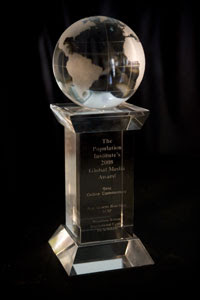
Photo: The New Security Beat‘s Global Media Award for “Best Online Commentary.” Courtesy of Dave Hawxhurst and the Wilson Center.
 “The United States has broad and fundamental national security interests in the Arctic region and is prepared to operate either independently or in conjunction with other states to safeguard these interests,” states
  Upon arriving in Los Angeles last week to accept a Global Media Award for Excellence in Population Reporting from the Population Institute (PI) —the New Security Beat won the “Best Online Commentary” award—I was greeted by a massive gift basket from PI. The rest of the week was equally bountiful, full of interesting people and vibrant exchanges of ideas.

