Showing posts from category climate change.
-
Population Growth and Climate Change Threaten Urban Freshwater Provision
›May 6, 2011 // By Emanuel FeldBy 2050, more than one billion urban dwellers could face perennial freshwater shortages if major improvements are not made to water management practices and infrastructure, according to a recent study published in the journal PNAS, “Urban Growth, Climate change, and Freshwater Availability.” These challenges will arise as hydrologic changes due to climate change compound “an unprecedented wave of urban growth,” with nearly three billion additional urban residents forecast by 2050. “It is a solvable problem,” the study argues, “but one that will take money, time, political will, and effective governance.”
Using demographic data from the Earth Institute at Columbia University, as well as a variety of climate and city-level demographic scenarios, the researchers estimate per-capita water availability for cities in the developing world, where urban growth will be most rapid. They advise, however, that their findings should be taken as conservative estimates, since the study assumes cities can use all nearby water and does not account for key challenges relating to water quality and delivery to urban centers.
In 2000, 150 million people in developing countries lived in urban areas that could not support their own water requirements (i.e. less than 100 liters available per person per day). By 2050, according to the study, urban population growth alone could bring this figure to 993 million and more than three billion could face intermittent shortages at least one month out of the year. When the researchers expanded the area on which cities can draw upon to include a 100 km buffer zone, these values drop to 145 million and 1.3 billion, respectively.
However, once climate and land use change are included in the models, the aggregate number of people facing perennial shortages rises a further 100 million, if only water stores within the urban area are considered, or 22 million, for the 100 km buffer zone model.
Remarkably, these aggregate figures differ very little among the various demographic and climate scenarios. The particularities of the challenge do however vary at the regional level. Perennial water shortage will generally be limited to cities in the Middle East and North Africa. Seasonal water shortages, on the other hand, will be geographically widespread, although rapidly urbanizing India and China will be especially hard hit.
The study acknowledges the temptation to view water shortage “as an engineering challenge.” Still, the lead author, Rob McDonald of The Nature Conservancy, cautions against exclusive reliance on grey infrastructure solutions (e.g. canals and dams) in an article for Nature Conservancy, saying:Some new infrastructure will be needed, of course – that’s the classic way cities have solved water shortages. But especially in parts of the world where there’s lots of cities, just going out farther or digging deeper to get water can’t be the only solution.
Instead, McDonald and co-authors Pamela Green, Deborah Balk, Balazs M. Fekete, Carmen Revenga, Megan Todd, and Mark Montgomery, emphasize the need for cities to encourage more efficient water use by their industrial and residential sectors, as well as the potential to engage the water-intensive agriculture sector in surrounding rural areas.
“Bottom line,” McDonald said in an interview with Robert Lalasz of The Nature Conservancy’s Cool Green Science blog, “don’t think of those high numbers as a forecast of doom. They are a call to action.”
Emanuel Feld is a student at Yale University studying economics and the environment.
Sources: Cool Green Science, PNAS, The Nature Conservancy.
Photo Credit: Adapted from “Chennai prayed too hard…. Part I,” courtesy of flickr user Pandiyan. -
Momentum Magazine
Where Does It Hurt? Climate Vulnerability Index
›The original version of this article appeared in the University of Minnesota’s Momentum Magazine. Text by Mary Hoff, page layout by Todd Reubold.
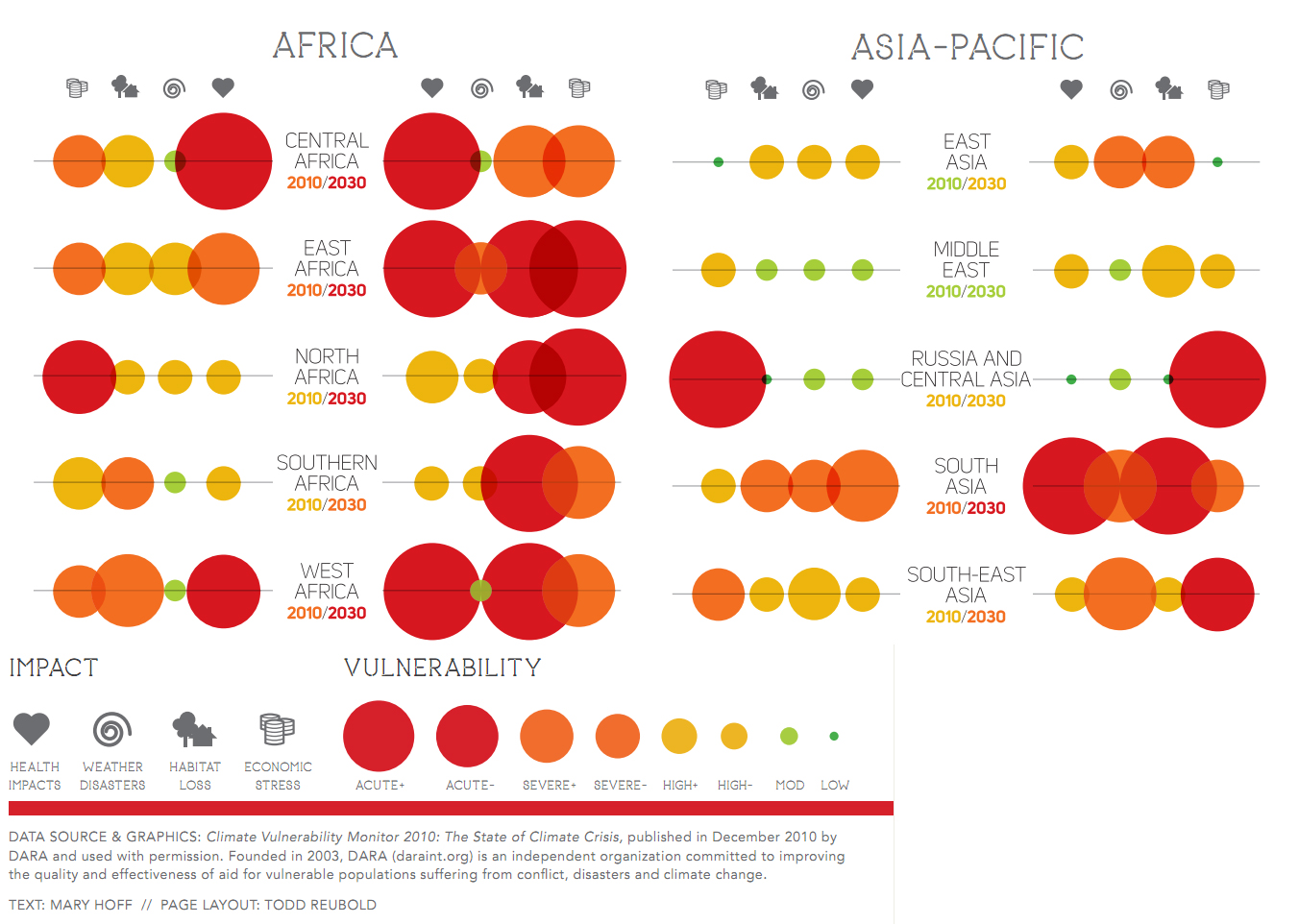
The punch climate change packs varies from one country, region, or continent to another. DARA, a Madrid-based humanitarian advocacy organization, recently partnered with the Climate Vulnerable Forum, comprising countries particularly vulnerable to climate change, to create Climate Vulnerability Monitor 2010, an atlas of vulnerability. This infographic presents a small portion of the picture the Climate Vulnerability Monitor paints.
Vulnerability is grouped into four categories: health impacts, weather disasters, habitat loss and economic stress. Circles on the left side of each set indicate relative magnitude of vulnerability in 2010. Circles on the right indicate the same for 2030.
See the full “Where Does it Hurt?” infographic on the Momentum site or download the Climate Vulnerability report from DARA.
Image Source: Climate Vulnerability Monitor 2010: The State of Climate Crisis, published in December 2010 by DARA (daraint.org). Used with permission. -
Managing Our Forests: Carbon, Climate Change, and Fire
›“We cannot manage our planet if we cannot manage our forests,” said William Sommers, a research professor with the Center for Climate and Society at George Mason University, during a recent event at the Woodrow Wilson Center. The event, which coincided with the International Year of Forests, was the fourth in a series co-sponsored by George Mason University and the Environmental Change and Security Program on “Managing the Planet.” Sandra Brown, director and chief scientist of the Ecosystems Services Unit at Winrock International and David Cleaves, climate change advisor to the chief of the U.S. Forest Service, joined Sommers and moderator Thomas Lovejoy, professor at George Mason, to discuss the impact of climate change, carbon, and fire on the world’s forests. [Video Below]
Fire: A “Critical Element”
“Forests have evolved over Earth’s history,” said Sommers, with fire being a “constant shaper” of this evolution. Humans first used fire as a tool about 400,000 years ago, and around 10,000 years ago, we began using fire for agricultural purposes, which, Sommers said, can be considered the beginning of forest management.
The resulting carbon dioxide (CO2) emissions have been an important consequence of this human intervention, Sommers said. CO2 emissions have an “exceptional persistence” in the atmosphere, which, explained Sommers, “commits us to irreversible warming over the next 1,000 years.”
In order to counteract these warming effects, a replacement for the “business-as-usual” approach is needed, Sommers said. If not, he warned, CO2 concentrations could reach a thousand parts per million by the end of the century: “It has been 30 to 100 million years since Earth experienced that level of atmospheric CO2 concentration, and Earth was extremely warm at that time.”
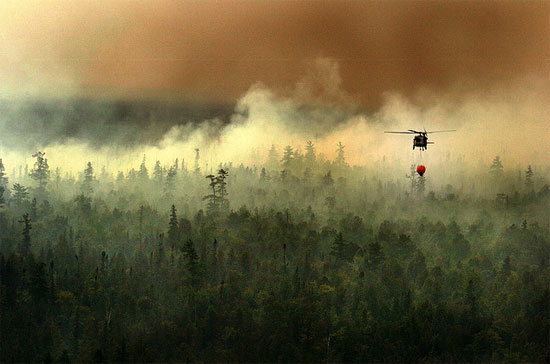
“Fire remains a critical element of the earth’s system and is highly sensitive to climate change,” said Sommers. The potential feedback relationship between fire and climate change was illustrated in dramatic fashion in the summer of 2010 with the outbreak of wildfires in Russia after the hottest summer temperatures on record.
Time is running short, Sommers warned, to answer the question of whether humans can anticipate and respond to climate change and manage forests in a sustainable manner.
Reducing Emissions & Improving Management
“Logging can be well-planned and well-designed or maybe not so well-planned,” said Brown as she spoke about her research on the logging industry in the tropics. Sustainable forest management in the tropics is still “a bit of the wild west” in some countries, though the situation is improving slightly, she said.
One way to improve management and reduce greenhouse gas emissions would be through the REDD+ (Reducing Emissions from Deforestation and Degradation) program of the United Nations. REDD+ can provide incentives, Brown said, for people to come up with useful innovations and improvements to forest management. But, she warned, “the longer we keep waiting, [the more] forests are diminishing.”
When a tree is felled, Brown said, there is a lot of collateral damage. An estimated one billion metric tons of CO2 are released every year from logging in the tropics of Africa and Latin America, she explained. One-half of these emissions are from the harvesting itself and the other half is from incidental damage and infrastructure, such as from the skid trails and haul roads needed to transport the logs out of the forest.
Therefore, it is important for all possible reduction steps to be taken, Brown said: “Where we have opportunities to produce goods with reducing emissions, we need to take those opportunities. We just can’t keep thinking, ‘That’s too small to worry about.’ If there’s what we call ‘low-hanging fruit,’ why not go for it?”
In order to reduce emissions and improve management, Brown suggested reducing avoidable waste by trimming more off of felled logs to increase volume, creating a management plan wherein felled logs are accurately mapped and skid trails are better planned, and using silvicultural treatments to speed the forest’s recovery.
Integrating Climate Change Into Risk Management
The job of the U.S. Forest Service has always been that of a “stress manager,” said Cleaves. Climate change is likely to ramp up existing stressors, such as drought and wildfires, which is why it is necessary for the Forest Service to integrate climate change adaptation techniques into the existing stress manager role. “We feel that there is no such thing as a separate climate change program,” he said.
Many difficult choices will have to be made to address climate change, Cleaves said: “We can’t afford the scale of the problem; we can’t afford to solve it all. We need to be able to prioritize.” These choices will have to be based on economic, social, and ecological values in order to “manage risks around the full sweep of the elements of sustainability,” he said.
The country’s forests are changing and we have already seen whole system change, Cleaves explained. For example, climate change has altered snow cover patterns leading to the decline of over half a million acres of yellow-cedar forest in Alaska.
Other threats facing U.S. forests include disease (such as white pine blister rust), increased variability of fires, increased housing growth near forested areas, and the possibility of forests turning from carbon sinks into carbon sources. That is to say, as forests are destroyed through fires, clearing, or disease, they release back into the environment the carbon they have absorbed.
Risk must be integrated into the decision-making process of the agency, and to this end the Forest Service has created the National Roadmap for Responding to Climate Change. But in order to meet these climate change challenges, Cleaves said, “we have to get moving.”
Sources: U.S. Fish and Wildlife Service, USA Today.
Photo Credit: “Michigan,” courtesy of flickr user The U.S. Army. -
David Biello, Momentum Magazine
Coping with Change: Climate Adaptation Today
›May 2, 2011 // By Wilson Center StaffThe original version of this article, by David Biello, appeared in the University of Minnesota’s Momentum Magazine.
The view from space offers a clarity about our changing planet less visible from the ground: spring thaw coming sooner year after year, the iconic snows of Kilimanjaro and glaciers across the globe dwindling – and a great green wall of vegetation spreading across the region just south of Africa’s Sahara Desert.
This arid expanse, known as the Sahel, stretches from the Atlantic Ocean to the Red Sea. It has undergone a remarkable transformation since farmers in nations across the region began to allow trees to grow amidst their crops.
In some places it was by accident, as seeds sprouted from manure spread as fertilizer in Niger. In others it was by design, such as the “green dam” against the desert started in Algeria in 1971. But the result has been the same: improved harvests of millet, sorghum, and other staple crops in a region gripped by perennial drought.
Such “agroforestry” boosts yields by returning vital nutrients to the soil in the form of decaying leaves, shading crops from the harshest sun, and recharging underground water reserves. The trees also provide an additional source of income: wood for fires and construction. And they have another even more important benefit: They may help some of the poorest farmers in the world adapt to climate change – while potentially removing as much as 50 billion metric tons of carbon dioxide from the atmosphere, according to agronomist Dennis Garrity, head of the Nairobi-based World Agroforestry Centre.
“The transformation of agriculture into agroforestry is well underway,” Garrity says. “Agricultural systems incorporating trees increase overall productivity and incomes in the face of more frequent droughts, and agroforestry systems provide much greater carbon offset opportunities than any other climate mitigation practice in agriculture.”
Climate change is already worse than anticipated by the UN Intergovernmental Panel on Climate Change. Extreme precipitation events, such as last spring’s flooding in Nashville, Tenn., or last winter’s drought in China, have become more frequent. Sea ice extents have reached record lows in the Arctic. And 2010 marked the end of the hottest decade in recorded history.
Not only that, but the 0.7-degree-Celsius uptick in global average temperatures we’ve seen so far is only half the warming that can be expected from the concentrations of greenhouse gases already in the atmosphere, according to a 2010 report from the U.S. National Research Council. And as warming continues, according to the NRC report, the world can expect (among other things) a drop in the yield of cereal crops due to higher temperatures, an increase in heavy rainfall, and a rise in ocean levels.
In other words, whatever measures might be adopted to reduce emissions of greenhouse gases, the world will still need to adapt to a changing climate. Indeed, that process has already begun.
Continue reading on the University of Minnesota’s Momentum Magazine site.
Photo Credit: Deep in the Sahel, the dwindling Lake Chad borders Niger, Chad, and Nigeria. Courtesy of flickr user NASA Goddard Photo and Video. -
Climate Adaptation, Development, and Peacebuilding in Fragile States: Finding the Triple-Bottom Line
›“The climate agenda goes well beyond climate,” said Dan Smith, secretary general of International Alert at a recent Wilson Center event. “In the last 60 years, at least 40 percent of all interstate conflicts have had a link to natural resources” and those that do are also twice as likely to relapse in the five years following a peace agreement, said Neil Levine, director of the Office of Conflict Management and Mitigation at USAID. [Video Below]
Development, peace, and climate stability are “the triple-bottom line,” said Smith. “How would you ever think that it would be possible to make progress on one, while ignoring the other two?” Levine and Smith were joined by Alexander Carius, managing director of Adelphi Research, who pointed out that climate change is both a matter of human security and traditional security. For example, as sea-level rise threatens the people of small-island states, “it also affects, in a very traditional sense, the question of security and a state’s sovereignty,” he said.
The Triple-Bottom Line
Conflicts are never attributable to a single cause, but instead are caused by “a whole pile-up, a proliferation, a conglomeration of reasons” that often include poverty, weak governance, traumatic memory of war, and climate change, said Smith. “Climate adds to the strains and the stresses that countries are under,” and works as a “risk-multiplier, or conflict multiplier,” he said.
Focusing development and peace-building efforts on those regions experiencing multiple threats is both a “moral imperative” and a “self-interested imperative,” said Smith. “We benefit from a more prosperous and a more stable world.”
There are currently one and a half billion people in the world living in countries that face these interlinked problems, said Smith, “and interlinked problems, almost by definition, require interlinked solutions.” Responding to the needs of these people requires developing resiliency so that they can respond to the consequences of climate change, which he called “unknown unknowns.”
“What we need are institutions and policies and actions which guard us not only against the threats we can see coming… but against the ones we can’t see coming,” said Smith. The strength and resilience of governments, economies, and communities are key to determining whether climate events become disasters.
Interagency Cooperation
“Part of making the triple-bottom line a real thing is to understand that we will have to be working on our own institutions, even the best and most effective of them, to make sure that they see the interlinkages,” said Smith.
But even though individuals increasingly understand the need to address security, development, and climate change in an integrated fashion, “institutions have only limited capacities for coordination,” said Carius. Institutions are constrained by bureaucratic processes, political mandates, or limited human resources, he said. “Years ago, I always argued for a more integrated policy process; today I would argue for an integrated assessment of the issues, but to…translate it back into sectoral approaches.”
Levine expressed optimism that with “a whole new avalanche of interagency connections” being established in the last few years, U.S. interagency cooperation has become “the culture.” However, if coordination efforts are not carefully aligned to advance concrete programs and policies, they run the risk of “getting bogged down in massive bureaucratic exercises,” he said. “‘Whole of government’ needn’t be ‘all of government,’ and it needn’t be whole of government, all of government, all the time.”
Building Political Will
Europe has a “conducive political environment to making [climate and security] arguments,” said Smith, but the dialogue has yet to translate into action. In 2007, the debate on climate and security was first brought to the UN and EU with a series of reports by government agencies and the first-ever debate on the impacts of climate change on security at the UN Security Council, said Carius. However, none of the recommendations from the reports were followed and “much of the political momentum that existed…ended up in a very technical, low-level dialogue,” he said.
More recently, the United Kingdom included energy, resources, and climate change as a priority security risk in their National Security Strategy. And Germany, which joined the UN Security Council as a rotating member this year, is expected to reintroduce the topic of climate and security when they assume the Security Council Presidency in July. These steps may help to regain some of the political momentum and “create legitimacy for at least making the argument – the very strong argument – that climate change has an impact on security,” said Carius.
Sources: AFP, UK Cabinet Office, Telegraph, United Nations
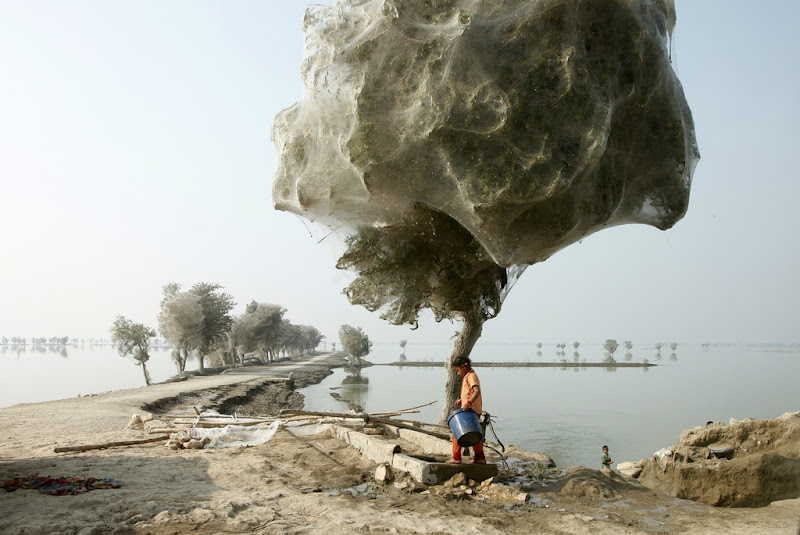
Image Credit: “Trees cocooned in spiders webs after flooding in Sindh, Pakistan” courtesy of flickr user DFID -
In Search of a New Security Narrative: National Conversation Series Launches at the Wilson Center
›The United States needs a new national security narrative, agreed a diverse panel of high-level discussants last week during a new Wilson Center initiative, “The National Conversation at the Woodrow Wilson Center.”
Hosted by new Wilson Center President and CEO Jane Harman and moderated by The New York Times’ Thomas Friedman, the inaugural event was based on a white paper by two active military officers writing under the pseudonym “Mr. Y” (echoing George Kennan’s “X” article). In A National Strategic Narrative, Captain Wayne Porter (USN) and Colonel Mark Mykleby (USMC) argue that the United States needs to move away from an outmoded 20th century model of containment, deterrence, and control towards a “strategy of sustainability.” [Video Below]
Anne-Marie Slaughter of Princeton University, who wrote the white paper’s preface, summarized it for the panel, which included Brent Scowcroft, national security adviser to President Ford and President H.W. Bush; Representative Keith Ellison (D-Minn.); Steve Clemons, founder of the American Strategy Program at the New America Foundation; and Robert Kagan, senior fellow for foreign policy at the Brookings Institution.Framing a 21st Century Vision
We can no longer expect to control events, but we can influence them, Slaughter said. “In an interconnected world, the United States should be the strongest competitor and the greatest source of credible influence – the nation that is most able to influence what happens in the international sphere – while standing for security, prosperity, and justice at home and abroad.”
“My generation has had our whole foreign policy world defined as national security,” said Slaughter, “but ‘national security’ only entered the national lexicon in the late 1940s; it was a way of combining defense and foreign affairs, in the context of a post-World War II rising Soviet Union.”
As opposed to a strategy document, their intention, write Porter and Mykleby, was to create a narrative through which to frame U.S. national policy decisions and discussions well into this century.
“America emerged from the Twentieth Century as the most powerful nation on earth,” the “Mr. Y” authors write. “But we failed to recognize that dominance, like fossil fuel, is not a sustainable source of energy.”It is time for America to re-focus our national interests and principles through a long lens on the global environment of tomorrow. It is time to move beyond a strategy of containment to a strategy of sustainment (sustainability); from an emphasis on power and control to an emphasis on strength and influence; from a defensive posture of exclusion, to a proactive posture of engagement. We must recognize that security means more than defense, and sustaining security requires adaptation and evolution, the leverage of converging interests and interdependencies. [italics original]
Prosperity and Security a Matter of Sustainability
The “Mr. Y” paper is similar in some respects to other strategic documents that have promoted a more holistic understanding of security, such as the State Department’s Quadrennial Diplomacy and Development Review, which was partially authored by Slaughter during her time in State’s Policy Planning Office. But there’s a markedly heavy focus on economics and moving beyond the “national security” framework in Porter and Mykleby’s white paper. They outline three “sustainable” investment priorities:
“These issues have come in and out of the security debates since the end of the Cold War, but they have not been incorporated well into a single national security narrative,” Geoff Dabelko, director of the Wilson Center’s Environmental Change and Security Program, told The New Security Beat. “This piece is a positive step toward achieving a coherent and inclusive national security narrative for the United States.”- Human capital: refocus on education, health, and social infrastructure;
- Sustainable security: use a more holistic, whole-of-government approach to security; essentially, expand the roles of civilian agencies and promote stability as much as ensuring defense; and,
- Natural resources: invest in long-range, sustainable management of natural resources, in the context of expanding global demand (via population growth and consumption).
To provide a “blueprint” for this transition, Porter and Mykleby call for the drafting of a “National Prosperity and Security Act” to replace the national security framework laid by the National Security Act of 1947 (NSA 47) and followed by subsequent NSAs.A New Geostrategic Model?
The panel unanimously praised the white paper’s intentions, if not its exact method of analysis and proposed solutions. All agreed that globalization and technology have helped create a more interconnected and complex world than current foreign policy and national security institutions are designed to deal with. Scowcroft called the 20th century “the epitome of the nation-state system” and said he expects an erosion of nation-state power, especially in light of integrated challenges like climate change and global health.
Kagan disagreed, saying he’s less convinced that the nation-state is fading away. “If anything, I would say since the 1990s, the nation-state has made a kind of comeback,” he said, adding that the paper lacks “a description of how the world works, in the sense of ‘do we still believe in a core realist point that power interaction among nation states is still important?’” In that sense, he said, “I’m not at all convinced we’ve left either the 20th century or the 19th century, in terms of some fundamental issues having to do with power.”
“I think there are three things that really are new,” said Slaughter. “The first [is the] super-empowered individual…the ability of individuals to do things that only states could.” We saw that with 9/11, with individuals attacking a nation, and we’re seeing that with communications as well, she said. “I can tell you, Twitter and the State Department’s reporting system, they’re pretty comparable and Twitter’s probably ahead, in terms of how much information you can get.”
Second, there is a “whole other dimension of power that simply did not exist before and that is how connected you are,” Slaughter said. “The person who is the most connected has the most power, because they’re the person who can mobilize, like Wael Ghonim in Egypt.”
Third, there are a greater number of responsible stakeholders. “What President Obama keeps telling other nations is ‘you want to be a great power? It’s not enough to have a big economy and a big army and a big territory, you have to take responsibility for enforcing the norms of a global order,’” Slaughter said. Qatar’s willingness to participate in the international community’s intervention in Libya, she said, was in part an example of a country responding to that challenge and stepping up into a role it had not previously played.
These new dimensions to power and security don’t entirely replace the old model but do make it more complex. “It’s on top of what was,” Slaughter said, and “we have to adapt to it.”
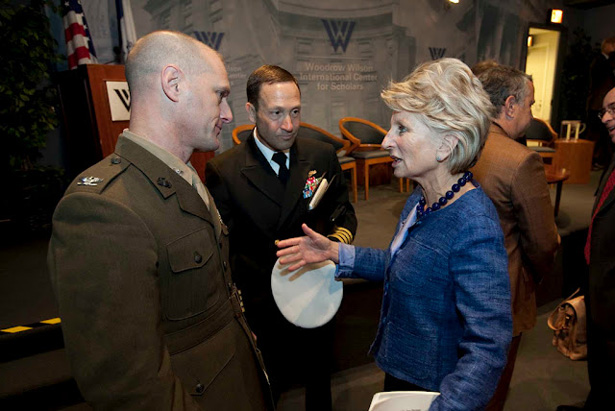
Photo Credit: Colonel Mark Mykleby (USMC), Captain Wayne Porter (USN), and Wilson Center President and CEO Jane Harman, courtesy of David Hawxhurst/Wilson Center. -
John Warburton, China Environment Series
UK Helping to Relieve Climate-Related Stress on China’s Agriculture
›The UK and China have been working together since 2001 to better understand how China is going to be impacted by climate change, particularly in the agriculture sector. But understanding must also lead to action, with adaptation needing to be integrated into the development process at both national and local levels. This work, which is ongoing, will increasingly provide a model for how to approach adaptation in other countries.
In my opinion, this work has also contributed to the realization among top-level Chinese officials that it is important to take global action on climate change as part of the international negotiation process; until very recently, most of the international engagement with China has focused on mitigation, with the result that the very real and urgent challenges that China faces in regards to its own adaptation needs have been sidelined.
Another Stressor for Chinese Agriculture
China’s Polices and Actions for Addressing Climate Change, issued in October 2008, state:The impacts of future climate change on agriculture and livestock industry will be mainly adverse. It is likely there will be a drop in the yield of three major crops — wheat, rice and corn; …enlarged scope of crop diseases and insect outbreaks; [and] increased desertification.
Even though assessing the likely impacts of climate change on crop yields is a complicated process, with some evidence showing that in some areas crops may benefit if agricultural technology can keep pace, the overall picture is grim for China.
Potential climate impacts are very worrying for a country which already faces so many other challenges within the agricultural sector, among them the facts that it has to feed nearly one quarter of the world’s population (1.3 billion people) with only seven percent of the world’s arable land; that it has only one-quarter of the world’s average per capita water distribution (one-tenth in large parts of northern China, which are heavily dependent upon agriculture); and that the agricultural land base is fast diminishing due to urbanization, industrialization, and the conversion of arable land to grasslands and forest.
Collaboration on Adaptation
Much of the evidence that supports the understanding of the likely adverse impacts on Chinese agriculture from climate change stems from collaborative work between the UK and China which started in 2001. A joint project, Impacts of Climate Change on Chinese Agriculture (ICCCA), has combined cutting-edge scientific research with practical development policy advice. Although national in scope, the project included pilot work to develop a stakeholder based approach to adaptation in the Ningxia region of northcentral China. ICCCA was successfully completed in December 2008. The UK-China collaboration is now continuing with a major new project which is going beyond agriculture and looking at additional socioeconomic sectors and geographic areas.
Continue reading in the China Environment Forum’s China Environment Series 11, from the Wilson Center. Other articles in the series can be found on CEF’s website.
John Warburton is a DFID senior environment adviser and is currently based in Beijing.
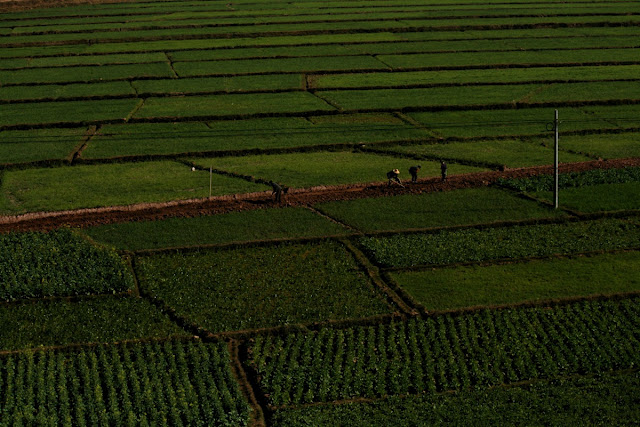
Photo Credit: “Field,” courtesy of flickr user totomaru. -
What “Lost” Cultures Can Contribute to Management of Our Planet
›“Climate change is not a technical problem for indigenous people – it’s a psychological and spiritual problem,” said Wade Davis, explorer-in-residence at National Geographic, at a recent Wilson Center event, the third in a series co-sponsored by George Mason University and the Environmental Change and Security Program. Indigenous people are “being driven out of existence,” as climate change alters landscapes and weather patterns that they have carefully adapted to over centuries, he said. These people are not “failed attempts at being modern…they are unique answers to the fundamental question, ‘what does it mean to be human and alive?’” he said. “It behooves us to pay attention to how they choose to live upon the earth.” [Video Below]