Showing posts from category Africa.
-
Senegal’s Burgeoning Cashew Industry Linked to Rebel Movement
›August 13, 2008 // By Sonia Schmanski Senegal’s southernmost region, Casamance, has been the site of outright or latent conflict for some 40 years. Even before Senegal gained independence, there were calls for independence from the region. Separatist agitation in the region was inflamed during the 1970s by an influx of unemployed migrants from Senegal’s drought-stricken northern regions, seeking a part of “the greatest [economic] potential in all of Senegal.” Beginning in 1983, calls for independence soon led to armed conflict between southern separatist groups and the Senegalese government.
The U.S. Agency for International Development (USAID) mission in Senegal worked to support a peaceful resolution to the conflict by bolstering infrastructure and providing jobs. One USAID-funded program, undertaken in partnership with EnterpriseWorks Worldwide in 2001, aimed to modernize Casamance’s cashew-processing industry to strengthen the region’s war-torn economy. While cashew exports can bring in significant revenue, the region lacked the infrastructure to produce high-quality nuts for export. Processed cashews can bring in seven to 10 times the price of raw nuts. Today, 90 percent of the 15,000 metric tons of cashews Senegal produces each year come from Casamance.
Sadly, violence in the Casamance region has welled up again in earnest. The peaceful conclusion that many had hoped for following the peace accord of 2004 failed to materialize, and instead, the Senegalese army and Movement for Democratic Forces of Casamance (MFDC) rebels both maintain a large presence in the region.
The USAID-funded expansion of cashew production in Casamance may be having an unintended, and profoundly negative, consequence, reports IRIN News: Skyrocketing cashew prices are “lining the pockets of armed rebels.” Cashews remain a central feature of this conflict in other ways, as well. Earlier this year, more than a dozen villagers attempting to harvest nuts were rewarded by having their ears cut off with machetes by rebels patrolling the area.
MFDC member Damien Manga disputes claims that rebel groups are financed by revenue from cashew exports. He says that while rebels do sell the nuts, the profits finance living expenses only, not weapons purchases. “We collect cashew nuts to sell like everyone else…Some say [selling] cashews…enables us to buy weapons. This is false…it is only our leaders who buy our weapons.” Instead, Manga places blame for violence around the cashew orchards squarely on the shoulders of the Senegalese military. Senegalese military spokesman Lieutenant Malamine Camare refutes this claim, saying that the army’s mission is “to ensure the safety of people and goods in this region. We never engage in profit-making activities, and we execute our mission by the rules.”
Because certain resources and activities are so frequently linked to conflict – diamonds and oil, for example – the role of agriculture is often ignored. As authors Alec Crawford and Oli Brown argue in a new publication discussed in this New Security Beat post, any resource can be exploited to further conflict. Earlier this year, ECSP hosted the “New Horizons at the Nexus of Conflict, Natural Resources, and Health” event series exploring the interaction between human health, natural resources, and conflict.
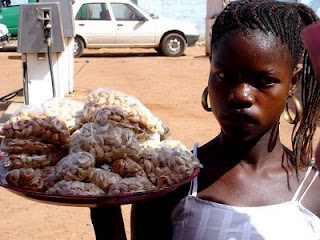
Photo: A cashew seller in the Gambia. Courtesy of Flickr user Javier D.
-
Fish Out of Water
›July 31, 2008 // By Daniel Gleick“If you want fast money and are willing to take the risk, that’s the only way to get it,” says Abdullah Dieng, a fisherman in Bissau, Guinea, in a new IRIN article, “Fishermen turn to trafficking as fish profits drop.” Fishermen in Guinea have a problem: No one is buying their fish. “The lack of decent roads into the interior of the country, combined with prohibitive fuel prices, makes it too difficult for fish-sellers to transport fish any further than Bissau, creating a saturated market,” reports IRIN. As an alternative, the fishermen are turning to illegal trade in drugs and humans. By smuggling, they can earn much more money.
“The UN Office on Drugs and Crime estimates several hundred kilograms of cocaine go through the country each week, while according to 2004 figures from the International Office of Migration, one million West and Central Africans head clandestinely to Europe every year,” reports IRIN.
Fisheries are collapsing all over the world, but especially in Africa. The New York Times article “Europe Takes Africa’s Fish, and Boatloads of Migrants Follow” reports that there is almost no regulation of Bissau’s fishery, like most fisheries along the African coast. “Creating the Enabling Environment for Effective Fisheries Enforcement,” an event in the Environmental Change and Security Program’s fisheries series, explored some of the challenges associated with fisheries management. One of the most basic problems is a lack of information. Vladimir Kacyznski, a marine scientist with the University of Washington, told the Times that “no one has comprehensively studied the nation’s coastal waters for at least 20 years.” As a result, both local and European fishers have mostly stripped the area of its fish.
The lack of oversight is largely due to a lack of attention, and thus a lack of money. IRIN reports that “The fishing ministry receives just 5 percent of the government’s paltry annual budget, despite fishing bringing in 40 percent of the country’s annual revenues, and most of this money can only cover staff salaries.” Without increased funding and attention, it is unlikely that a solution will emerge to the environmental and economic problems that force fishermen to turn to illegal and dangerous activities. As the source of their livelihoods disappears, they have fewer and fewer options. Said one consultant quoted in the Times story, “The sea is being emptied.” -
Al Jazeera Films the Evaporating Way of Life of Niger’s Tuareg Rebels
›July 29, 2008 // By Sonia SchmanskiThe land of Niger’s Tuareg Bedouin tribes—and thus the Tuareg way of life—is drying up. The steadily advancing Sahara desert is swallowing northern Niger at a rate of six kilometers per year, part of a centuries-old process recently accelerated by climate change and groundwater withdrawals by the nation’s booming uranium mining industry.
French nuclear giant Areva flies in workers rather than hiring locals to man the mines, and as a result, the Tuareg and other tribal groups have little or no opportunity to find employment. Cut out of the revenue stream, rebel fighters, made up of Tuaregs as well as members of other Bedouin tribes, are demanding a percentage (20-30 percent, by most accounts) of the revenue generated by the uranium mined on their land.
Defying a government ban on reporting on the conflict, Al Jazeera television reporter May Welsh interview the rebels in a five-part video series on the Tuareg. “They’re fighting a state that’s ignoring their problems,” she says. For example, a family suffering from a new and mysterious ailment claim they have been denied care by Areva’s medical offices. Welsh suggests their illness could be attributed to the radioactive water around Areva’s facilities.
Areva, for its part, rejects the notion that it is poisoning the people of northern Niger. In a document released in August 2007, the company reports that 60-70 percent of its private hospital patients are members of surrounding communities. Areva also states it gives preference to local sub-contractors in its exploration and procurement activities. But the yawning gulf between Areva’s position and the reality in northern Niger belies the company’s claims.
Conflict between rebel groups and the Nigerien army has separated families, displaced people, destroyed schools—and interfered with humanitarian missions. The government ordered the French NGO Medecins Sans Frontieres (MSF) to suspend its activity in Niger based on unsubstantiated suspicions that members of the organization were colluding with rebels. Welsh’s daring reports illuminate these and other dangers of life in Niger’s desert, a life that may soon become impossible. -
Environment, Population Key Security Concerns in Africa’s Central Albertine Rift
›July 28, 2008 // By Sonia SchmanskiIn the Central Albertine Rift, which runs from the northern end of Lake Albert to the southern end of Lake Tanganyika, “environmental factors are increasingly an underlying cause of instability, conflict and unrest,” says a new report from the Institute for Environmental Security, Charcoal in the Mist, which outlines environmental security issues and initiatives in the Albertine Rift region.
Part of the larger Great Rift Valley, the Central Albertine Rift encompasses portions of Uganda, Tanzania, Rwanda, Burundi, and the Democratic Republic of the Congo (DRC). The area is one of the world’s most important biodiversity hotspots, but is also a geopolitical hotspot, producing critical natural resources for a number of nations recently emerging from devastating civil wars. Lake Victoria, the birthplace of the Nile River, sits in this region, which means that the watchful eyes of its riparian states are trained at all times on the politics of the area. The Albertine Rift is also home to Africa’s Great Lakes, each of which straddles multiple nations and provides significant income to surrounding communities. Questions of access to these waters only heighten existing geopolitical tensions.
Charcoal in the Mist cites armed rebels, illegal mining, and a growing population’s increasing demands for food and energy as threats to regional environmental security. Virunga National Park, an internationally prized wilderness preserve in the DRC, has fallen victim to these pressures. Rampant poaching and illegal mining, as well as conflicts in the DRC and Rwanda, have left park authorities unable to protect the 7,800 square kilometer park. A timeline from National Geographic dramatically illustrates how violent conflict has disrupted conservation efforts in Virunga.
The “interconnectedness between natural resources, development and security” in the Central Albertine Rift region reinforces the need for innovative approaches to address these issues. For example, according to the report, population density around protected areas in this region is far higher than in the rest of sub-Saharan Africa, and the continually growing population already exceeds the capacity of local resources. The area’s population swelled with thousands of refugees fleeing the civil war in Rwanda in the 1990s, and simmering tensions continue to push people away from conflict zones and toward the relative calm of the Albertine Rift. Similarly, conflict stemming from the civil war in DRC, which lasted from 1998 until 2003, has beset North Kivu province. Rebel armies continue to clash in the region, restricting the ability of development organizations to work there and limiting the livelihoods of the local population.
The authors of Charcoal in the Mist call for more comprehensive mapping and monitoring of the Central Albertine Rift ecosystem in order to promote effective policies to address the region’s challenges. They also advocate for enhancing property rights to address fundamental conflicts over land, strengthening environmental law, dampening the illegal natural resource trade, and more aggressively protecting Virunga National Park. They believe that transboundary environmental cooperation has the potential to preserve both the ecological integrity and political stability of this important region.
-
Weekly Reading
›“Women are key to the development challenge,” says Strategies for Promoting Gender Equity in Developing Countries, but “gender mainstreaming has been associated with more failures than gains.” Detailing findings from an April 2007 conference co-sponsored by the Wilson Center and the Inter-American Foundation, the report calls for a redesigned approach operating on multiple fronts. Blogging about the report, About.com’s Linda Lowen dubs the gap between women and men in developing countries a “Grand Canyon-like divide” compared to the “crack in the sidewalk” faced by Western women.
A Council on Foreign Relations backgrounder on Angola—now Africa’s leading oil producer—tackles the familiar paradox of extreme poverty in resource-rich countries. Burdened by “an opaque financial system rife with corruption,” Angola’s leaky coffers are filling up with Chinese currency. As Angolan President Jose Eduardo dos Santos put it, “China needs natural resources, and Angola wants development.” FastCompany.com’s “Special Report: China In Africa” criticizes the overwhelming Chinese presence in Africa: “The sub-Sahara is now the scene of one of the most sweeping, bare-knuckled, and ingenious resource grabs the world has ever seen.”
In Scientific American’s “Facing the Freshwater Crisis,” Peter Rogers writes that the demands of increasing population, along with increasingly frequent droughts due to climate change, signal rough waters ahead, and calls for major infrastructure investments to prevent catastrophe. Closer to home, Circle of Blue reports on a new era of water scarcity in the United States, and director Jim Thebaut’s documentary “Running Dry: The American Southwest” takes a look at the hard-hit region.
Pastoralists are socially marginalized in many countries, making them highly vulnerable to climate change despite their well-developed ability to adapt to changing conditions, reports the International Institute for Environment and Development in “Browsing on fences: Pastoral land rights, livelihoods and adaptation to climate change.” The paper notes that the “high rate of development intervention failure” has worsened the situation, and calls for giving pastoralists “a wider range of resources, agro-ecological as well as socio-economic,” to protect them.
-
Three Years Later, “Wall of Trees” Project Launches
›July 24, 2008 // By Sonia SchmanskiDesertification is a serious problem for the land bordering—one might say being swallowed up by—the Sahara desert. But help is on the way for this huge swath of the continent. Three years after the idea was initially floated, the Great Green Wall project, which is intended to slow the Sahara’s southward march, is underway, after being formally approved at the Community of Sahel-Saharan States summit in Benin last month.
The first phase of the project will last for two years and will, with a $3 million budget, create a tract of trees 7,000 kilometers long and 15 kilometers wide. Planting will begin in September 2008 and will involve representatives and consultants from a number of affected countries, including Burkina Faso, Mali, Mauritania, Niger, Senegal, and Nigeria. The second planting phase will take place on the eastern part of the continent and will be undertaken in partnership with Sudan, Ethiopia, Eritrea, Chad, and Djibouti. This second phase has not been formalized yet, but it is expected that some arrangement will be reached through the Intergovernmental Authority on Development (IGAD) in the Horn of Africa.
Desertification and the droughts that often precede it have significant effects on life in the Sahel, the region bordering the Sahara. A 2007 UN Environment Programme report warns that “climate change and desertification threaten the livelihoods of millions of Sudanese living on the edge of the dry Sahara belt,” and the UN Convention to Combat Desertification reports that “[i]n many African countries, combating desertification and promoting development are virtually one and the same.”
Photo courtesy Flickr user Christing-O-. -
Defense, Development, Diplomacy Experts Debate DoD’s Role in Development
›July 18, 2008 // By Rachel Weisshaar“The U.S. military recognizes that the use of conventional military force is of limited use” in advancing U.S. national security, said Reuben Brigety II, director of the Sustainable Security Program at the Center for American Progress (CAP), at a July 18 launch of his report Humanity as a Weapon of War: Sustainable Security and the Role of the U.S. Military. The tragedy of 9/11, as well as the setbacks experienced in the wars in Afghanistan and Iraq, emphasized to the U.S. defense community that although combat operations remain critical to its mission, the military must also strive to “prevent conflict from emerging in the first place” through activities that stabilize societies, economies, and governments.
Brigety cited efforts by the Combined Joint Task Force for the Horn of Africa (CJTF-HOA), the nascent U.S. Africa Command (AFRICOM), and the U.S. Southern Command (SOUTHCOM) as examples of the U.S. military’s growing appreciation of how development assistance can help stabilize countries, build goodwill toward the United States, and increase U.S. understanding of local socio-political and economic conditions. In recent years, CJTF-HOA has dug wells, vaccinated livestock, and provided health services, while SOUTHCOM has a long track record of providing humanitarian assistance in Central and South America, particularly in the wake of natural disasters.
Although Brigety asserted that it is nothing “new for the military to be involved in addressing basic human needs,” he and his fellow presenters—Elisabeth Kvitashvili of the U.S. Agency for International Development (USAID), James Schear of the Institute for National Security Studies, and Stewart Patrick of the Council on Foreign Relations—agreed that the Department of Defense (DoD) has been undertaking an increasing share of the U.S. government’s development activities in recent years. As Brigety’s report notes, the “share of the U.S. government’s official development assistance, or ODA, spent by the Defense Department increased to 22 percent in 2005, the last year for which complete data is available, from 3.5 percent in 1998. Over the same time period, USAID’s share of ODA fell to less than 40 percent from 65 percent.”
Earlier this week, Secretary of Defense Robert Gates made waves when he said that “the United States military has become more involved in a range of activities that in the past were perceived to be the exclusive province of civilian agencies and organizations. This has led to concern among many organizations…about what’s seen as a creeping ‘militarization’ of some aspects of America’s foreign policy. This is not an entirely unreasonable sentiment.”
At the CAP launch, Patrick asserted that one reason why the DoD has become increasingly involved in development activities—in peaceful regions as well as violent ones—is the “massive budgetary asymmetry” between the DoD and the State Department and USAID. Gates made a similar point: “America’s civilian institutions of diplomacy and development have been chronically undermanned and underfunded for far too long—relative to what we spend on the military, and more important, relative to the responsibilities and challenges our nation has around the world.”
Kvitashvili agreed that USAID is underfunded and understaffed, but said the solution was not having the military take the lead in development activities. She argued that the military—which, unlike USAID, is not staffed by development professionals—tends to engage in “feel-good, short-term, one-off” projects that do not lead to sustainable gains for local populations. Instead, she welcomed a stepped-up supporting role for the military in development activities. -
Population, Health, Environment in Ethiopia: “Now I know my family is too big”
›July 16, 2008 // By Sonia SchmanskiIn “Life in Abundance,” an article from the latest issue of Sierra magazine, Paul Rauber gives us an inside look at family planning in Ethiopia, speaking with women in urban and rural environments to understand what government support of family planning has meant in practice. The government’s official embrace of family planning is a sharp and welcome shift from the previous dictatorship’s ban on mentioning it, but this endorsement, welcome as it is, doesn’t guarantee funding. Consequently, family planning programming, robust in urban areas, has yet to reach much of the vast rural expanse of Ethiopia. It is also heavily dependent on outside donors and NGOs for funding.
Thanks to one of the highest fertility rates in the world—5.4 children per woman—Ethiopia’s population has quintupled in the last 70 years. It now stands at 77 million, and is projected to double by 2050. Other indicators are equally discouraging: Rauber reports that average life expectancy is 48 years, that one in eight children dies before reaching five years of age, and that half of all children are undernourished.
One group trying to improve these statistics is Pathfinder International, whose integrated population-health-environment program in Ethiopia aims to “boost family planning, healthcare access, and environmental-restoration efforts through improving the lot of women and girls.” Rauber notes that Ethiopian women with at least some secondary education have one-third as many children as women with no or little education. Ethiopia, he says, is ripe for such integrated interventions; two-thirds of women want but lack access to family planning, and only one in 10 rural women uses any form of contraception. Pathfinder’s program, strongly backed by communities, has been successful in enrolling women in literacy classes, testing for HIV, planting mango and avocado trees, and curbing female genital mutilation.
For a look at another integrated PHE program in Ethiopia, see ECSP Director Geoff Dabelko’s photographs of the Berga Wetland Project, which includes conservation activities oriented around the White-Winged Flufftail bird; a small health facility offering basic maternal, children’s, and reproductive health services; and a community school.
Ethiopia has hosted several large PHE events in recent months, demonstrating the country’s enthusiasm for the approach. In November 2007, more than 200 members of the PHE community gathered in Addis Ababa for “Population, Health, and Environment: Integrated Development in East Africa,” a conference sponsored by the Population Reference Bureau and LEM Ethiopia. Rauber’s tour of Ethiopia, which also included substantial birdwatching, was jointly organized by the Sierra Club and the Audubon Society, both participants at the November meeting. Also emerging from this conference, which ECSP helped organize, was the East Africa Population-Health-Environment Network, a group working toward “an Eastern African region where men, women, and children are healthy, the environment is conserved, and livelihoods are secure.” In May of this year, Ethiopia launched its national chapter of the network, the Consortium for Integration of Population, Health, and Environment, in Ambo.
Photo: Health workers in Ethiopia’s Berga valley, where families average seven children. Now, thanks to the Ethiopian Wildlife and Natural History Society’s Berga Wetlands Project, hundreds of local women get contraceptives from health worker Gete Dida, allowing them to limit their family size – and giving the area’s wildlife a chance at survival. Reproduced from Sierraclub.org with permission of the Sierra Club. © 2008 Sierra Club. All rights reserved.