

Showing posts from category population.
-
Weekly Reading
›The authors of Asia’s Next Challenge: Securing the Region’s Water Future, a report by the Asia Society, argue that population growth, urbanization, and climate change are converging to make water an important security issue in Asia. The authors argue for including water in policy and development discussions, but warn against “securitizing” the issue.
China’s population is rapidly aging while the country is still developing and modernizing, explains China’s Long March to Retirement Reform: The Graying of the Middle Kingdom Revisited, a report by the Global Aging Initiative of the Center for Strategic and International Studies (CSIS). The report recommends steps to ensure that China’s aging citizens are not left without a safety net. Another report by CSIS’s Global Aging Initiative, Latin America’s Aging Challenge: Demographics and Retirement Policy in Brazil, Chile, and Mexico, argues that these countries have a rapidly narrowing window of opportunity to prepare to meet the needs of their aging populations.
According to a study published in the British Journal of Zoology, wild populations of major grazing animals—including giraffes, impala, and wildebeest—in Kenya’s Maasai Mara National Reserve decreased significantly from 1989-2003. “Researchers found the growing human population has diminished the wild animal population by usurping wildlife grazing territory for crop and livestock production to support their families,” reports the International Livestock Research Institute.
On April 22, Bill Butz of the Population Reference Bureau, Paul Ehrlich of Stanford University, and Hania Zlotnik of the UN Population Division discussed world population trends on the Diane Rehm Show. -
Weekly Reading
›“The Arctic could slide into a new era featuring jurisdictional conflicts, increasingly severe clashes over the extraction of natural resources, and the emergence of a new ‘great game’ among the global powers,” argue Paul Berkman and Oran Young, two researchers at the University of California, Santa Barbara, in Science. “However, the environment provides a physical and a conceptual framework to link government interests in the Arctic Ocean, as well as a template for addressing transboundary security risks cooperatively.” In the Washington Times, Paula Dobriansky, former U.S. undersecretary of state for democracy and global affairs, argues that the Antarctic Treaty offers lessons for dealing with competing territorial claims in the Arctic.
An article by Fred Pearce in Yale Environment 360, “Consumption Dwarfs Population As Main Environmental Threat,” has re-energized the debate over population’s contribution to climate change. For more, see Suzanne Petroni’s article “An Ethical Approach to Population and Climate Change” in ECSP Report 13.
Time interviews Laurel Neme, author of Animal Investigators: How the World’s First Wildlife Forensics Lab Is Solving Crimes and Saving Endangered Species, about the illegal wildlife trade. Neme will speak at the Wilson Center on May 20.
Slate’s William Saletan discusses the skewed sex ratio in China. For more on this topic, see Richard Cincotta’s review of Bare Branches: The Security Implications of Asia’s Surplus Male Population.
According to Rose George, author of The Big Necessity: The Unmentionable World of Human Waste and Why It Matters, “If you invest a dollar in sanitation, you save seven dollars in health-care costs.” Audio is available of a recent talk featuring George and ECSP Director Geoff Dabelko.
Time reports on Mexico’s water crisis. (See “Water Stories” for more on water and sanitation in Mexico.) It also features photo slideshows on the politics of water in Central Asia and the global water crisis.
In a paper published in Ecology (subscription required), Kevin Lafferty, a research ecologist for the United States Geological Survey at the University of California Santa Barbara, argues that climate change may not necessarily expand the range of disease vectors, as many scientists have argued. -
VIDEO: Leona D’Agnes on Population, Health, and Environment
›April 15, 2009 // By Wilson Center StaffIntegrated population-health-environment (PHE) programs “are very cost-effective ways” to develop “community capacity—to strengthen their know-how, and bring…in some additional appropriate technologies” to promote livelihoods, says Leona D’Agnes in this short expert analysis from the Environmental Change and Security Program.
“It doesn’t require a lot of money, but it does require capacity building and being able to motivate communities and help them to understand that it is not just the government that’s responsible for their development. Their own food security and environmental security rests with their abilities to manage their assets, their natural resources, to plan their families, and make sure their children finish school.”
In this expert analysis, D’Agnes, currently a consultant to CDM International on PHE and forestry in Nepal, discusses the linkages between population, health, and environment involved in her work as a technical adviser for PATH Foundation Philippines and its IPOPCORM project.
To learn more about population, health, and environment issues, please visit our PHE page. -
From Assessment to Intervention: Redefining UNEP’s Role in Conflict Resolution
›April 9, 2009 // By Will Rogers “Can we get beyond the point where environment and conflict always has to be a story of tragedy with no happy ending?” asked Achim Steiner at the March 24, 2009, launch of From Conflict to Peacebuilding: The Role of Natural Resources and the Environment, a new report from the UN Environment Programme (UNEP).
“I think we actually can provide a critical set of building blocks that would allow us to be not just lamenters on the sidelines,” but active problem-solvers, said Steiner, UNEP’s executive director. UNEP would like to put “green advisers, so to speak, with blue helmets” to examine peacebuilding “from an environmental, natural resource restoration point of view” and “minimize the potential for conflicts to escalate again,” said Steiner, who recently met with Alain Le Roy, UN undersecretary-general for peacekeeping operations, to discuss plans for embedding environmental advisers with UN peacekeeping troops.
Steiner was joined by Daniel Reifsnyder, deputy assistant secretary for environment at the U.S. State Department, and Andrew Morton, manager of UNEP’s Disasters and Conflicts Programme, to discuss the report’s findings.
Natural Resources and the Conflict Continuum
According to From Conflict to Peacebuilding:- Forty percent of intrastate conflicts within the past 60 years have been strongly linked to natural resources.
- Such conflicts are twice as likely to relapse within the first five years of peace.
- Less than a quarter of peace agreements for these conflicts address natural-resource issues.
Environmental factors can contribute to conflict and subvert peace in three main ways:
- The inequitable distribution of resource wealth, competition for scarce or valuable resources, and environmental degradation can contribute to the outbreak of conflict.
- Natural resources can used as “a financing vehicle for conflict—sustaining conflict well beyond the point where conflict has its origin, to actually having become part of an at-war economy, a conflict economy,” Steiner said.
- Unresolved environmental issues can subvert peace negotiations, especially when warring parties have a stake in lucrative resources. If we do not understand “how environment and natural resources can undermine very volatile peace agreements,” Steiner warned, we can “find ourselves back where we started off from.”
Lessons Learned and the Way Forward
Natural-resource conflicts have direct impacts—like deforestation and desertification—and indirect impacts—like the disruption of livelihoods—that are devastating to communities, Morton said. They also weaken a government’s capacity to manage its industry and infrastructure, like waste management and water purification, creating new environmental problems—and thus possible future conflict.
But the environment also offers opportunities, Morton emphasized. In Rwanda, for instance, “we have gorilla tourism going on within a few kilometers of what, essentially, was a war zone.”
UNEP recommends that peacekeepers:- Assess the natural-resource and environmental issues underlying conflicts.
- Monitor and address natural-resource use in conflict areas.
- Incorporate resource-sharing agreements into peace deals.
- When cooperation is not possible, use punitive measures to end resource exploitation.
U.S.-UNEP Cooperation on Environment, PeacebuildingAccording to Reifsnyder, the U.S. government frequently supports UNEP initiatives, such as the $1.8 million in U.S. funding for a UNEP reforestation and energy-efficiency program in an internally displaced persons camp in Darfur. This project grew out of the post-conflict environmental assessment that UNEP recently conducted in Sudan.
Reifsnyder praised UNEP’s focus: “UNEP is uniquely positioned to play a real catalytic role within the UN system, bringing together various parts of the UN system to try to focus on the importance of natural resources and the importance of the environment in peacebuilding initiatives,” he said.
Photos: From top to bottom, Achim Steiner, Andrew Morton, and Daniel Reifsnyder. Courtesy of Dave Hawxhurst and the Woodrow Wilson Center. -
VIDEO: Steven Sinding on ‘Making the Case for U.S. International Family Planning Assistance’
›April 8, 2009 // By Wilson Center Staff“If countries cash in on this window of opportunity” opened by falling birth rates, “it makes a big difference in their chance for development,” says Steven Sinding in this short expert analysis from the Environmental Change and Security Program. “While it is not a sufficient condition for economic growth, decreasing fertility is certainly a necessary condition for doing so.”
Sinding, a senior scholar at the Guttmacher Institute, discusses the recent report Making the Case for U.S. International Family Planning Assistance, which he co-authored, and argues that family-planning programs are central to addressing today’s social, economic, and environmental challenges.
To learn more, please see the complete video, as well as transcripts, PowerPoints, and a summary, from the March 17, 2009, Wilson Center launch of the report. -
Former USAID Population Directors Argue for Major Boost in Family Planning Funding
›April 7, 2009 // By Gib Clarke“We know how to do family planning, we know what it costs, and we know that it works,” said Joseph Speidel of the University of California, San Francisco, at the launch event for Making the Case for U.S. International Family Planning Assistance sponsored by the Wilson Center’s Environmental Change and Security Program on March 17, 2009. The key missing element, he said, is political will.
Speidel and his co-authors—all former directors of the U.S. Agency for International Development’s (USAID) Office of Population and Reproductive Health—argued that Congress should more than double spending on international family planning in the coming years for health, economic, and environmental reasons.
The Big Ask
Making the Case recommends that the USAID population budget be increased from $457 million in FY2008 to $1.2 billion in FY2010, growing further to $1.5 billion in FY2014. According to the speakers, this increase is necessary to:- Meet the “enormous pent-up and growing unmet need for family planning”;
- Stabilize population growth rates, especially in Africa; and
- Achieve the Millennium Development Goal of universal access to reproductive health services.
Duff Gillespie of the Johns Hopkins Bloomberg School of Public Health showed that U.S. funding for family planning has been stagnant in real dollars since the late 1960s, despite the fact that there are 200 million women with an unmet need for family planning. Without champions within USAID and the Obama administration, he said, the dollar amounts appropriated for family planning are unlikely to increase.
Speidel explained that growing populations, combined with stable or increasing rates of consumption, contribute to climate change. The current rate of population growth is unsustainable, given Earth’s finite natural resources. Changes in behavior and technology—such as eating less meat or using clean energy—could improve environmental outcomes.
Absolute numbers still matter, however: Although population growth rates have declined, the global population continues to grow. Addressing the nearly one-half of all pregnancies that are unplanned would bring great health and environmental benefits, said Speidel.According to Steven Sinding of the Guttmacher Institute, although most economists and demographers agree that economic growth leads to lower fertility, whether lower fertility reduces poverty is still a matter of much debate. But the “demographic dividend” generated by slowing population growth is a reality, he argued, and countries can benefit from it if their institutions are prepared to take advantage of it. For example, a USAID study found that one dollar invested in family planning in Zambia saved four dollars in other development areas.
A Broader Base of SupportRuth Levine of the Center for Global Development urged the authors to avoid “preaching to the choir.” One way to engage other constituencies interested in demographic issues is to broaden the scope of “population” to include not only family planning, but also migration, urbanization, and other key demographic issues.
In addition, convincing World Bank economists, especially the Bank’s next president, of the connections between declining fertility and poverty reduction should be a priority, said Levine, because developing countries put a lot of stock in the Bank’s advice.
By Gib Clarke
Edited by Rachel Weisshaar
Photos: From top to bottom, Joseph Speidel, Duff Gillespie, Steven Sinding, and Ruth Levine. Courtesy of Dave Hawxhurst and the Wilson Center. -
PODCAST – Forests for the Future: Family Planning in Nepal’s Terai Arc Landscape
›April 3, 2009 // By Wilson Center Staff“The Terai Arc Landscape has a very high population growth rate; people are very much dependent on the natural resources,” says Sabita Thapa in this podcast from the Environmental Change and Security Program.“We are especially working through the population, health, and environment project to address the issues of forest conversion, forest encroachment, and fuel extraction,” explains Thapa
. In this podcast, Thapa, now an environmental advisor with the United Nations Development Programme in the Solomon Islands, and Dhan Rai, senior project manager with World Wildlife Fund-Nepal, discuss WWF’s PHE program in Nepal’s Terai region.
To learn more about PHE in Nepal, read FOCUS Issue 18, “Forests for the Future: Family Planning in Nepal’s Terai Region.”
And for additional resources, please visit our PHE webpage.
Photo: Sabita Thapa. Courtesy of Meaghan Parker. -
VIDEO: Duff Gillespie on ‘Making the Case for U.S. International Family Planning Assistance’
›April 1, 2009 // By Wilson Center Staff“One dollar invested in family planning has a return on the investment of four dollars,” says Duff Gillespie in this expert analysis from the Environmental Change and Security Program.
“If you have a program that allows couples to avert having unwanted pregnancies, it also means there are less children to immunize – there are less schools that have to be built – there are less teachers that have to be trained.”
In this short video, Duff Gillespie, professor at the Johns Hopkins Bloomberg School of Public Health, discusses the recent report Making the Case for U.S. International Family Planning Assistance, and the need to increase funding for family planning around the world.
To learn more, please see a full summary and complete video of Duff Gillespie speaking recently at a March 17, 2009, Wilson Center launch of the report.
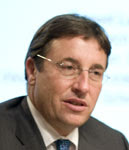 “Can we get beyond the point where environment and conflict always has to be a story of tragedy with no happy ending?” asked Achim Steiner at the March 24, 2009,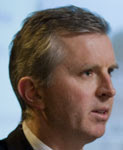
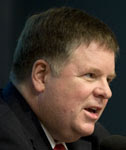 According to Reifsnyder, the U.S. government frequently supports UNEP initiatives, such as the $1.8 million in U.S. funding for a UNEP reforestation and energy-efficiency program in an internally displaced persons camp in Darfur. This project grew out of the
 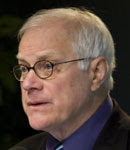 Duff Gillespie of the Johns Hopkins Bloomberg School of Public Health showed that U.S. funding for family planning has been stagnant in real dollars since the late 1960s, despite the fact that there are 200 million women with an unmet need for family planning. Without champions within USAID and the Obama administration, he said, the dollar amounts appropriated for family planning are unlikely to increase.
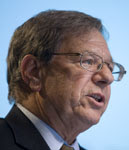 According to Steven Sinding of the Guttmacher Institute, although most economists and demographers agree that economic growth leads to lower fertility,
 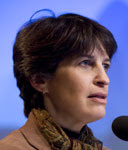 Ruth Levine of the Center for Global Development urged the authors to avoid “preaching to the choir.” One way to engage other constituencies interested in demographic issues is to broaden the scope of “population” to include not only family planning, but also
  .
. 

