Showing posts from category agriculture.
-
Tim Siegenbeek van Heukelom, State-of-Affairs
Food Security in Kenya’s Yala Swamp
›June 21, 2011 // By Wilson Center StaffThe original version of this article, by Tim Siegenbeek van Heukelom, appeared on State-of-Affairs.
In West Kenya on the Northeastern shore of Lake Victoria, the Yala swamp wetland is one of Kenya’s biodiversity hotspots. The Yala swamp also supports several communities that utilize the wetland’s natural resources to support their families and secure their livelihoods. Even more, many people recognize the swamp’s extraordinary potential as agricultural land to significantly boost Kenya’s food security. These are three widely diverse interests, which may seem to be difficult to reconcile. Yet, with proper management, sufficient investment and effective communication, a differentiated utilization of the Yala swamp can be realized through a system of multiple land use. This will be a difficult but certainly not unrealistic objective.
A Brief History
The most recent development of the Yala swamp was undertaken by Dominion Farms, a subsidiary of a privately held company from the United States investing in agricultural development. The reclamation and development of the swamp, however, is far from a new phenomenon.
The intention of the Kenyan government to transform parts of the Yala swamp into agricultural land for food production goes back as far as the early 1970s. Around that time, the Ministry of Foreign Affairs of the Netherlands was consulted extensively by the Kenyan government for technical assistance on reclamation of the swamp and the feasibility of agricultural production.
Throughout the 1980s numerous reports were commissioned by the Kenyan Ministry for Energy and Regional Development and the Lake Basin Development Authority to the Dutch Ministry of Foreign Affairs. Reports like the “Yala Integrated Development Plan” and the “Yala Swamp Reclamation and Development Project” focused in depth on the potential of the development of the swamp and made recommendations on practical matters, such as drainage and irrigation, soil analysis, agriculture, marketing, environmental aspects, employment opportunities, human settlement, management, and financial planning.
As a result, small-scale reclamation and development of the swamp land was undertaken throughout the 1980s and 1990s under the supervision of the Lake Basin Development Authority. The development of the swamp was partially successful, yet its scale was small and financial benefits were too marginal. Major investment was therefore required to extend the scale of the project.
Then, in 2003, an American investor expressed interest to make significant long-term investments into bringing parts of the swamp into agricultural production. Subsequently, a lease for 45 years was negotiated between Dominion Farms and the Siaya and Bondo County Councils to bring into agricultural production some 7,000 hectares of the Yala swamp. The whole Yala swamp wetland covers 17,500 hectares, which means that Dominion Farms is allowed to reclaim and develop roughly 40 percent of the swamp.
Protracted Conflict
Since the early days of the arrival of the foreign investor in 2004, there has been lingering tension and occasional flares of conflict between the communities surrounding the project site, third parties (i.e. government officials, politicians, NGOs, CBOs, environmentalists), and the investor.
The most commonly touted complaint is that Dominion Farms “grabbed” the communities’ land. While it is hard to trace back the exact procedures and individuals that were involved, there are clear contracts with the Siaya and Bondo County Councils that substantiate the transfer of land-use to Dominion Farms for a period of 45 years. Some claim, however, that the negotiation process for the lease was entrenched in bribery and corruption, yet no one has been able to show this author a single trace of evidence to substantiate these accusations. Similarly, there are complaints by local residents that they were never consulted in the negotiation process – where they should have been, as they rightly point out that the swamp is community trust land. However, the land is held in trust by the relevant county council for the community. The county council should therefore initiate consultations with the local communities and residents to get their approval to lease the land to third parties. So it appears that some of the resentment over the loss of parts of the swamp should not be directed at the foreign investor but rather target the local county council and their procedures.
Continue reading on State-of-Affairs. -
Keith Schneider, Circle of Blue
China’s Other Looming Choke Point: Food Production
›The original version of this article, by Keith Schneider, appeared on Circle of Blue.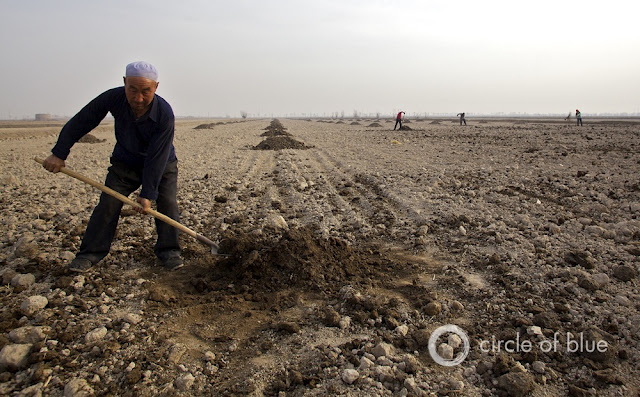
Even along the middle reaches of the Yellow River, which irrigates 402,000 hectares (993,000 acres) of farmland north of the Ningxia Hui Autonomous Region’s provincial capital, there is still no mistaking the smell of dry earth and diesel fuel, the abiding scents of a desert province that is also among China’s most efficient grain producers.
Ningxia farmers have relied on the Yellow River since 221 BCE, when Qin Dynasty engineers clawed narrow trenches from the sand, introducing some of the first instances of irrigated agriculture on earth. Despite persistent droughts, in each of the last five years irrigation has made it possible for annual harvests to increase by an average of 100,000 metric tons.
The 2010 harvest of 3.5 million metric tons was nearly double what it was in 1990. The 3.9 million people who live and work on Ningxia’s 1.2 million farms, most no larger than three-quarters of a hectare (1.6 acres), produce the highest yields of rice and corn in the nine-province Yellow River Basin, according to central government crop statistics.
In sum, the farm productivity of this small northern China region – about the same size as West Virginia and located 1,200 kilometers (745 miles) to the west of the Bohai Sea – reflects the major shifts in geography and cultivation practices over the last generation that have made China both self-sufficient in food production and the largest grain grower in the world.
Yet Chinese farm officials here and academic authorities in Beijing are becoming increasingly concerned that China does not have enough water, good land, and energy to sustain its agricultural prowess. As Circle of Blue and the Woodrow Wilson Center’s China Environment Forum have reported in the Choke Point: China series, momentous competing trends – rising energy demand, accelerating modernization, and diminishing freshwater resources – are putting the country’s energy production and security at risk.
The very same trends also threaten China’s farm productivity. Last year, the national farm sector and the coal sector combined used 85 percent of the 599 billion cubic meters (158 trillion gallons) of water used in China.
Continue reading on Circle of Blue.
Keith Schneider is the senior editor of Circle of Blue and was a New York Times national correspondent for over a decade, where he continues to report as a special writer on energy, real estate, business, and technology.
Photo Credit: Used with permission, courtesy of J. Carl Ganter/Circle of Blue. -
Michael Kugelman, Dawn
Aquaculture’s Promise for Food-Insecure Pakistan
›June 7, 2011 // By Wilson Center StaffThe original version of this article, by Michael Kugelman, appeared on Dawn.
“Give a man a fish and you feed him for a day,” the ancient Chinese philosopher Lao Tzu famously said. “Teach a man to fish and you feed him for a lifetime.”
For years, this adage has helped frame debates across a variety of disciplines. However, while globally influential, it is by no means universally applicable – as the sad realities of Sindh make painfully clear. In this parched, food-insecure region flush with fishermen and farmers, people have long known how to fish. The problem is that with water bodies shriveling up, there are increasingly fewer fish to catch. Many impoverished residents would be grateful for a single fish, given their struggles to secure a day’s worth of food.
Pakistan’s natural resource constraints know no provincial borders, yet they are notably severe in Sindh. Water tables are plummeting, with great volumes of Indus River flows diverted upstream to satiate agricultural and urban demand in Punjab.
Sindh’s water security is further threatened by population growth and global warming, and by the water-intensive, large-scale farming envisioned by foreign investors jockeying for agricultural land.
With surface water supplies threatened, users are increasingly tapping groundwater resources – yet according to the Pakistan Council of Research in Water Resources, a staggering 95 percent of the province’s shallow groundwater supplies are bacteriologically contaminated. This is unsurprising, given the technical deficiencies and inefficiency that characterize Sindh’s water treatment facilities.
In a province where so many livelihoods are tied to water availability and food production, water stress aggravates food insecurity and threatens economic well-being. A recent World Bank report concludes that Pakistan’s poorest spend at least 70 percent of their meager incomes on food – and undoubtedly many of them hail from Sindh. According to data from the Pakistan Agricultural Research Council, some of the province’s small farmers spend a whopping 87 percent of their incomes on food.
Continue reading on Dawn.
Michael Kugelman is a program associate for the Asia Program at the Woodrow Wilson Center.
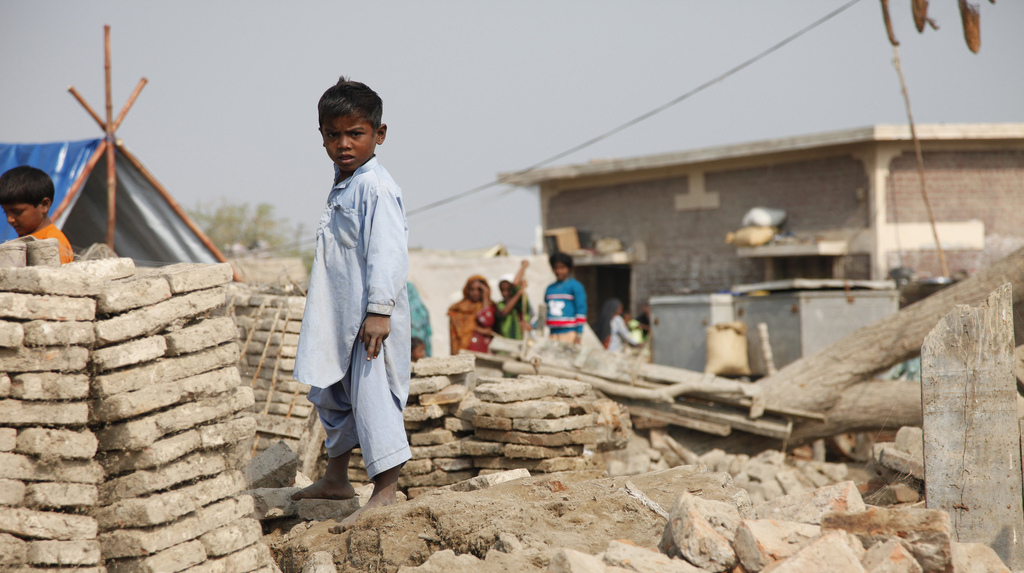
Photo Credit: A child stands amongst buildings destroyed by the floods in Sindh province, courtesy of flickr user DFID – UK Department for International Development. -
Measuring Ecosystem Vitality and Public Health With the Environmental Performance Index
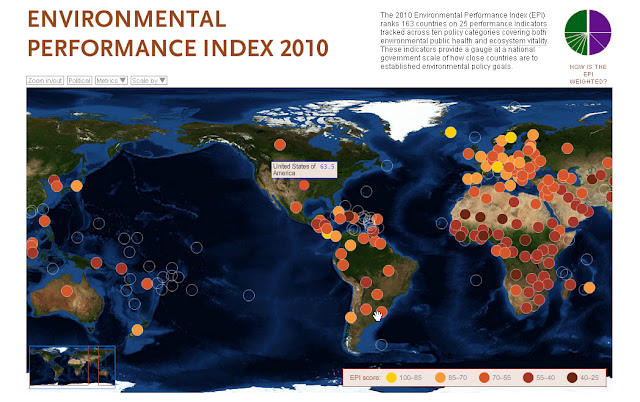
›The Environmental Performance Index (EPI) is a comparative analytic tool for policymakers created jointly by Yale and Columbia Universities in collaboration with the World Economic Forum and Joint Research Centre of the European Commission. The EPI was created in 2006 and is updated biannually. Data is drawn from 25 performance indicators that fall under 10 well-established policy categories, including the environmental burden of disease, the effects of water on human health, and agriculture. The indicators serve as a “gauge at a national government scale of how close countries are to established environmental [and health] policy goals,” write the authors.
The EPI draws data from a diverse array of sources, such as the World Health Organization, Food and Agriculture Organization, University of New Hampshire, and World Resources Institute. Users can view visualizations of the compiled data via an interactive map and the data is also available in the form of rankings charts, individual country profiles, and country group comparisons. The interactive map also allows users to isolate performance indicators or policy categories in order to compare an individual country’s performance with global trends. Furthermore, indicators may be scaled to visually reflect a country’s performance in relation to drivers of environmental performance, like gross domestic product, level of corruption, and government effectiveness.
This tool is particularly useful because users can effectively leverage points for policy change by identifying linkages between environmental policy and other issue areas, such as public health or sanitation. The EPI enables policymakers to visually conceptualize problematic regions, optimize investments in environmental protection, and identify best practices.
The index’s greatest weakness is its inability to track changes in performance over time. A pilot project was launched last year that tracks whether a country has progressed or deteriorated in an area of environmental performance, but the authors note that the project has “raised more questions than answers,” particularly concerning data availability and interpretation. Additionally, there are gaps in the data. Although these gaps signify a data quality weakness, they also support the continued calls for increased data collection by governments and other organizations to better inform environmental decision-making. -
Yemen Beyond the Headlines: Losing the Battle to Balance Water Supply and Population Growth
›Part three of the “Yemen Beyond the Headlines: Population, Health, Natural Resources, and Institutions” event, held at the Wilson Center on May 18.
Overlooked in most news coverage of Yemen’s crisis is the country’s struggle to manage its limited natural resources – particularly its rapidly depleting groundwater – in the face of soaring population growth. At the recent Wilson Center event, “Yemen: Beyond the Headlines,” Yemen’s ambassador to Germany, Mohammed Al-Eryani, and Daniel Egel of the RAND Corporation outlined Yemen’s shaky prospects for economic development without more sustainable agricultural practices and more efficient water management. [Video Below]
With a population of more than 24 million and a total fertility rate (TFR) of 5.5 – nearly double the average TFR for the region – Yemen’s population is projected to grow to 36.7 million by 2025 and jump further to 61.6 million by mid-century, according to the latest UN projections. While those figures may not seem large by global standards, given Yemen’s already limited stocks of arable land and groundwater, the country’s rapid rate of growth may quickly outpace its resources.
“Already in a Crisis”: The Groundwater Deficit
Yemen’s per capita water supply is falling fast in the face of booming population growth and agricultural consumption, said Al-Eryani, a water engineer who founded Yemen’s Ministry of Water and the Environment. While the commonly accepted threshold for water scarcity is 1700 cubic meters or less per capita, Yemen’s per capita renewable water availability is now in the neighborhood of 120 cubic meters, he said.
Meanwhile, water scarcity has been exacerbated by erratic precipitation that has hit rainfall-dependent farmers especially hard. In a country with no real rivers or perennial streams, rainfall harvesting has long enabled agricultural production, as evidenced by the country’s many intricately terraced hillsides – “the food baskets of Yemen,” said Al-Eryani.
Yemenis have coped with shifting precipitation patterns by drawing more groundwater for irrigation and other domestic uses. While drilling wells has provided some short-term relief, the practice is unsustainable in the long term, creating a “water deficit,” Al-Eryani said, that continues to grow each year.
In the populous Sanaa basin, home to the Yemeni capital, consumption outweighs the aquifer’s natural rate of recharge by a factor of five to one and groundwater levels have been plummeting at six meters per year, he said. With only minimal government regulation of drilling, the country’s groundwater situation is poised to worsen, one of the reasons Al-Eryani declared his country is “already in a crisis.”
Stalled Economic Development
Yemen’s stalled economic development is particularly pronounced outside of urban areas, “where the resources are,” said Daniel Egel, citing the country’s failure to build modern transportation infrastructure and develop other economic activities besides farming. He called for the international development community to focus on creating jobs in rural areas, particularly by increasing the financing available for non-agricultural businesses and by improving secondary roads. In addition, he warned development actors to be aware of how gender inequality and local social structures, such as tribes, affect development efforts.
Given the country’s dependence on agriculture, water scarcity poses a threat to Yemen’s food security and its economic development. Three out of every four Yemeni villages depend on rainfall for irrigation, Egel said, making them highly vulnerable to unexpected climate change-induced shifts in precipitation patterns. Water scarcity also weakens the financial stability of Yemeni households, with the cost of water “accounting for about 10 percent of income during the dry season,” he said.
Averting a “Domino Effect”
Al-Eryani asserted that water management policies will “have to be designed in piecemeal fashion,” as no one single action will avert a catastrophe. He suggested a number of steps to alleviate the country’s growing water crunch, including:- Focus on the rural population, which makes up 70 percent of the population, has the highest fertility rates, and are the most reliant on agriculture;
- Move development efforts outside of Sanaa to other regions of the country;
- Increase investment in desalination technology for coastal areas;
- Increase water conservation in the agricultural sector; and,
- Exploit fossil groundwater aquifers in Yemen’s sparsely populated eastern reaches.
“The battle to strike a sustainable balance between population growth and sustainable water supplies was lost many years ago,” Al-Eryani said. “But maybe we can still win the war if we can undertake some of these measures.”
See parts one and two of “Yemen Beyond the Headlines: Population, Health, Natural Resources, and Institutions” for more from this Wilson Center event.
Sources: UN Population Division, World Bank.
Photo Credit: “At the fountain,” courtesy of flickr user Alexbip. -
Mapping Population and Climate Change
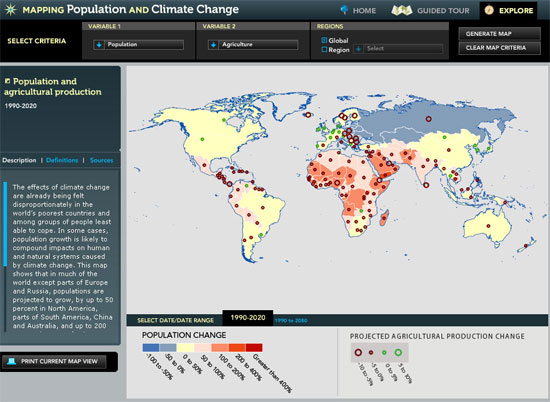
›Climate change, population growth, unmet family planning needs, water scarcity, and changes in agricultural production are among the global challenges confronting governments and ordinary citizens in the 21st century. With the interactive feature “Mapping Population and Climate Change” from Population Action International, users can generate maps using a variety of variables to see how these challenges relate over time.
Users can choose between variables such as water scarcity or stress, temperature change, soil moisture, population, agriculture, need for family planning, and resilience. Global or regional views are available, as well as different data ranges: contemporary, short-term projections (to the year 2035), and long-term projections (2090).In the example featured above, the variables of population change and agricultural production change were chosen for the time period 1990-2020. Unfortunately, no country-specific data is given, though descriptions in the side-bar offer some helpful explanations of the selected trends.
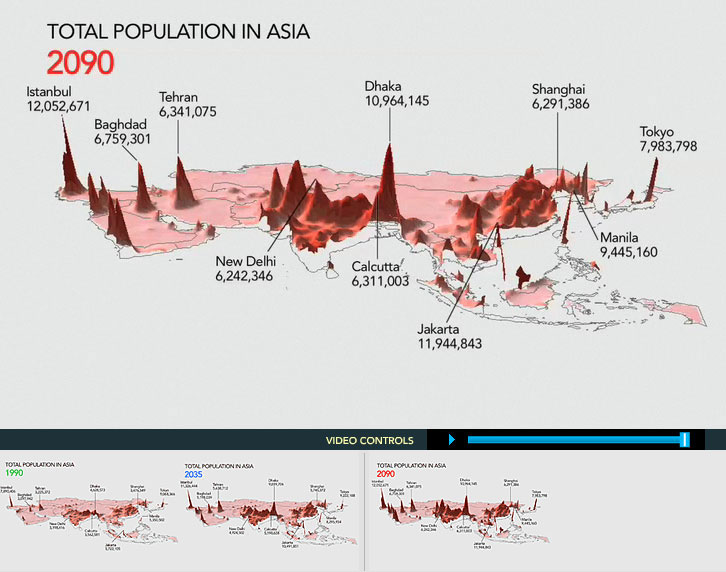
In addition, users can view three-dimensional maps of population growth in Africa and Asia for the years 1990, 2035, and 2090. These maps visually demonstrate the projected dramatic increases in population of these regions by the end of the century. According to the latest UN estimates, most of the world’s population growth will come from Africa and Asia due to persistently high fertility rates.
Image Credit: Population Action International. -
“The Second Front in the War on Terror”
USAID, Muslim Separatists, and Politics in the Southern Philippines
›For some years after the terrorist attacks of 9/11, the existence of violent Muslim separatists on the southern Philippine island of Mindanao gave U.S. officials significant cause for concern. In 2005, for example, the U.S. embassy charge d’affaires to the Philippines, Joseph Mussomeli, told reporters that “certain portions of Mindanao are so lawless, so porous…that you run the risk of it becoming like an Afghanistan situation. Mindanao is almost, forgive the poor religious pun, the new Mecca for terrorism.” During the Bush administration, officials referred to the region as a “second front” in the War on Terror: the region was once seen as a “new Afghanistan” that “threatened to become an epicenter of Al Qaeda.” [Video Below]
Nevertheless, as noted by Wilson Center Fellow Patricio Abinales at an Asia Program event on May 11, U.S. efforts to co-opt and pacify separatist guerrillas have proven remarkably successful in some areas of the islands. Some commentators have highlighted the role of the U.S. military in bringing a relative sense of security to troubled regions, noting that Mindanao presents a “future model for counterinsurgency.” However, Abinales’s research shows the military activities have had little effect, often because troops are stationed far from potential areas of conflict. Instead, it is the civilian side of the American presence that has dampened conflict in the war zones of the southern Philippines.
Abinales specifically explored the factors behind the success of the U.S. Agency for International Development’s (USAID) Growth with Equity in Mindanao (GEM) program in demobilizing and reintegrating 28,000 separatist guerrillas of the Moro National Liberation Front (MNLF), as well as the long-term political consequences of this accomplishment.
“Arms to Farms”
Usually, USAID programs are organized on the basis of grants for specific and limited projects. In contrast, GEM arose as a long-term umbrella organization that oversees the disbursement and management of American funding across a number of long-term projects. Coordinators are trained directly in Mindanao and are encouraged to “go native,” living in the area and becoming part of the community. GEM prioritizes cultural understanding, respect for community leaders, an appreciation of the important role that women play in local societies, and sensitivity to potential divisions within separatist groups and their security concerns vis-à-vis the Philippine government.
There has often been a general tendency for aid organizations to associate the demobilization of warring groups with disarmament. While Philippine officials on Mindanao have sometimes tried this approach, cash-for-guns amnesty schemes have opened up opportunities for corruption and have not been particularly effective. Understanding that one of the major concerns of guerrilla rebels is exploitation by corrupt government officials, GEM established an “Arms to Farms” scheme, whereby Muslim rebels are trained to engage in agriculture, but are not encouraged to put away their weapons. In this way, the program keeps potential guerrillas and Al Qaeda recruits busy with legitimate and peaceful economic activity, while it assuages their concerns about the threat from corrupt government officials, who may otherwise take the fruits of agricultural labor by force.
In fact, Abinales noted that one of the keys to GEM’s success is that the organization has never submitted to the official local authorities, and has largely been allowed a free reign by Manila to conduct its activities on Mindanao. It is precisely because the state has not been successful in delivering welfare regimes which provide stability to the area that GEM is seen as an alternate source of development and security in the region. Moreover, because of GEM’s activities, other American officials are allowed relatively free access, and are even welcomed into areas where the authority of the Philippine government holds no sway. Most of GEM’s activities are conducted with the MNLF, which has maintained its own official treaties and agreements with Manila since the 1970s. However, the American organization is beginning to enter the territory of the Moro Islamic Liberation Front, a splinter group of the MNLF that rejects relations with the national government outright, but one whose leaders are jealous of the development gains the MNLF has made under GEM.
Abinales was quick to point out that although GEM’s activities have been successful, they are tailor-made to specific circumstances. It is therefore difficult to present them as a generalized model that can be applied to other separatist conflicts. Nevertheless, Abinales’s work suggests that government agencies working on counterinsurgency efforts elsewhere might do well to examine the benefits of the flexible civilian approaches to conflict resolution formed with a deep understanding of the concerns of the specific communities involved.
Bryce Wakefield is program associate with the Asia Program at the Woodrow Wilson Center. -
How Does Organic Farming in the U.S. Affect Global Food Security?
›The feature story for last month’s Wilson Center newsletter, Centerpoint, was on the popular full-day conference “Rebuilding the U.S. Economy – One Heirloom Tomato at a Time,” hosted by the Program on America and the Global Economy in March. The conference focused on organic, local farming and the idea of creating “sustainable” food production that was healthier but also better for the economy than relying on imports from afar.
ECSP was asked to provide some international context for the discussion with a brief “Point of View.” I tried to paint a little bit of the big picture 21st century supply and demand story and give a sense of how today, globalization has helped linked everyone in this food security discussion:Dramatic events over the last year have shone a spotlight on the problem of global food security: massive fires in Russia, which reduced wheat supplies; famine and drought in Niger and Chad; and food price riots in the Middle East and elsewhere. These stresses come amid price spikes that echo the food crises of 2008 and reveal the linked nature of food security today and some of the fundamental challenges facing poor countries’ efforts to feed their growing populations.
What do you think: What’s the best way to inject the urgency that people looking at demographics and consumption rates around the world are feeling about global food security into a discussion about organic agriculture in the United States? Is there a tension between quality and quantity of food in the organic vs. agrobusiness debate that needs to be addressed in a global context? And what’s the role of policy in determining that balance?
In most countries, food insecurity is a symptom of poverty, poor governance, and/or poor infrastructure. For example, developed countries can often rebound from natural disasters relatively quickly. However, in drought-prone countries like Niger and Chad or flood victims like Pakistan and North Korea, such structural weaknesses leave them unable to bounce back as quickly from extreme events. This makes development efforts more difficult and can cause vulnerable countries to quickly become a burden on their neighbors or more prone to internal instability.
In the long term, reducing vulnerability in developing countries will be one of the most critical factors to ensuring global food security. But to meet the projected demand from increased consumption and continuing population growth, global yields must also increase.
The Green Revolution of the 1960-70s saved millions of lives by introducing heartier strains of rice and improving other staple crops in South and Southeast Asia, and most agree that a “Second Green Revolution” (whether or not it looks like the first) will likely be necessary. If so, the current tensions in the West over organic or sustainable practices versus agribusiness models will need to be reconciled in a way that can provide the most immediate help for the world’s hungry.
An important requirement, however, is that in a more resource-constrained world, these yields must be increased without destroying our future capacity. How we go about this, whether through traditional industry, organic techniques, or a mixture of both, will be one of the defining challenges of the 21st century.