-
Carl Haub, Behind the Numbers
Rwanda’s 2010 Demographic and Health Survey Shows Remarkable Drop in Fertility and Child Mortality
›October 18, 2011 // By Wilson Center StaffThe original version of this article, by Carl Haub, appeared on PRB’s Behind the Numbers blog.
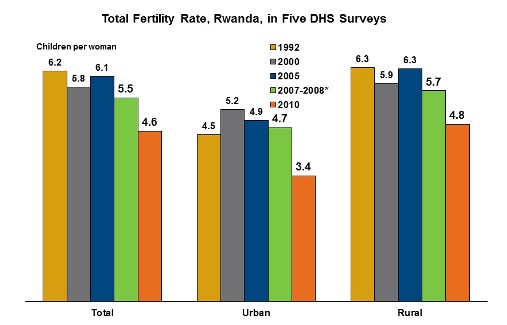
The Rwanda 2010 Demographic Health Survey is the latest in a regular series of DHS surveys that began in 1992, although hostilities had delayed the next survey until 2000. The 2010 survey interviewed 13,671 women ages 15 to 49 and 6,329 men ages 15 to 59 from September 2010 to March 2011. The total fertility rate (TFR – the average number of children would bear in her lifetime if the birth rate of a particular year were to remain constant) obtained in the survey was 4.6 for the three-year period preceding the survey. For urban women, the TFR was 3.4 and for rural women, who were 85 percent of the sample, 4.8.
Rwanda’s TFR saw its fastest decline in the 2010 DHS. From the 2007-08 Interim DHS to the 2010 survey, the TFR fell by 1.1 children nationwide – by 1.3 in urban areas and 0.9 in rural areas in a period of only four and a half years. This is sharpest drop in a sub-Saharan TFR I can ever remember seeing. As an indicator of future fertility plans, 56.2 percent of women with three living children said that they not wish to have any more children as did 76 percent of those with four living children. It is clear that the large family size of eight children per woman is truly a thing of the past.
In the survey, 51.5 percent of currently married women said that they were using some form of family planning, 45.1 percent a modern method. Injectables were by far the most frequently used, as such “spacing” methods are in much of Africa, with 23.1 percent of women saying that they used them. That method increased from 15.2 percent in the 2007-08 survey. The next two methods were implants (6.3 percent) and the pill (7.1 percent).
Continue reading on Behind the Numbers.
Image Credit: Arranged by Population Reference Bureau; data from the National Institute of Statistics of Rwanda, Ministry of Finance and Economic Planning, Ministry of Health Rwanda, MEASURE DHS, ICF Macro, Demographic and Health Survey 2010, Preliminary Report. -
Minority Youth Bulges and the Future of Intrastate Conflict
›October 13, 2011 // By Richard CincottaFrom a demographic perspective, the global distribution of intrastate conflicts is not what it used to be. During the latter half of the 20th century, the states with the most youthful populations (median age of 25.0 years or less) were consistently the most at risk of being engaged in civil or ethnoreligious conflict (circumstances where either ethnic or religious factors, or both, come into play). However, this tight relationship has loosened over the past decade, with the propensity of conflict rising significantly for countries with intermediate age structures (median age 25.1 to 35.0 years) and actually dipping for those with youthful age structures (see Figure 1 below).
-
Strengthening the Voices of Women Champions for Family Planning and Reproductive Health
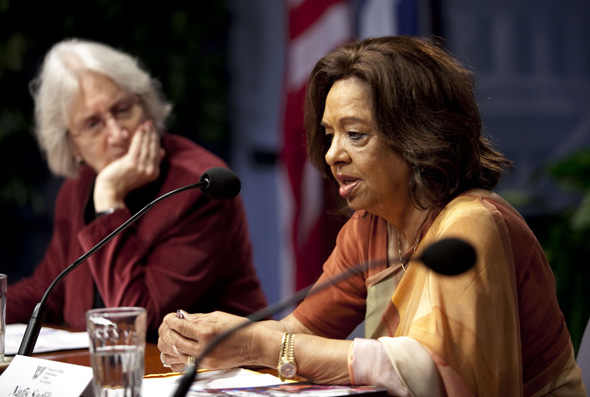
›“The health, security, and well-being of families depend importantly on the health of women,” said Carol Peasley, president and CEO of the Centre for Development and Population Activities (CEDPA). “When women have the ability to voluntarily space and limit the number of children they have, maternal and newborn child deaths decrease, as do abortions and abortion-related injuries,” she continued.
Peasley was joined by three panelists on September 28 at the Wilson Center: Dr. Nafis Sadik, special advisor to the UN Secretary General; Tigist Kassa Milko, health communications program coordinator for Panos Ethiopia; and Rosemary Ardayfio, a reporter for the Ghanaian paper, The Daily Graphic.
Ardayfio and Milko both recently participated in a CEDPA-led workshop, which is designed to create effective women champions for family planning and reproductive health.
“The voices of women champions may in fact be the best way to influence policymakers and just average citizens around the world,” said Peasley.
Women’s Rights Essential for Development of All
According to Sadik, women have gained some autonomy over their reproductive health:- Maternal mortality around the world is down by 40 percent compared to 1990 levels;
- Family planning reaches over 65 percent of women who need and want it;
- Many developing countries will achieve parity in girls’ and boys’ education by 2015; and
- Women are increasingly prominent in national and international leadership.
- Women’s literacy rates are still much lower than men’s;
- Pregnancy and childbirth still pose major health risks for women;
- Maternal mortality is the single biggest differential between developed and developing countries;
- We are far from reaching the Millennium Development Goal of reducing maternal mortality by 75 percent; and
- The current unmet demand for family planning (215 million women) is projected to rise by 40 percent by 2050 as the reproductive age population grows.
Local Champions for Local Needs
Although Tigist Kassa Milko and Rosemary Ardayfio come from two African countries hundreds of miles apart, their struggles are eerily similar.
In Ethiopia, the more than 1.5 million women who live in pastoral or nomadic areas shoulder many responsibilities, including walking long distances to fetch food and water for their families. The well-being of these women and their families is further strained by the challenges of climate change and limited health service provision.
To help overcome these obstacles, a number of micro-credit associations now offer female pastoralists alternative livelihood options. Panos Ethiopia also provides “reproductive health, family planning, gender-based violence forums” and “trainings on life skills and saving” to those who come for loans, said Milko.
But “when it’s a choice between walking to get water and walking to get contraceptives, water will win,” said Milko, so it is essential to focus on integrating ways to improve livelihoods, health, and ecosystems – also known as population, health, and environment (PHE) programs.
In Ghana, women also grapple with competing issues of development, poverty, healthcare, and cultural barriers. According to Ardayfio, 35 out of every 100 Ghanaian women want to space or limit births but are not using modern family planning methods. As a journalist, she acknowledged that there are many myths about reproductive health that need to be dispelled. The newspaper she writes for, The Daily Graphic, publishes three articles on women’s health each week.
“The stories of women dying from pregnancy-related causes should continue to be told in a compelling manner until our government makes good on the many international commitments it has signed to,” said Ardayfio. “Our decision-makers should be told again and again that it’s time to scale up family planning.”
Event Resources:
Sources: CEDPA, Guttmacher Institute, Population Reference Bureau, UNESCO, UNICEF, USAID.
Photo Credit: Dave Hawxhurst/Wilson Center. -
El Niño, Conflict, and Environmental Determinism: Assessing Climate’s Links to Instability
›October 5, 2011 // By Schuyler Null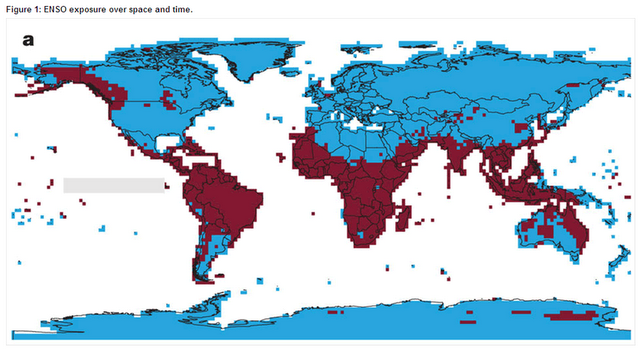
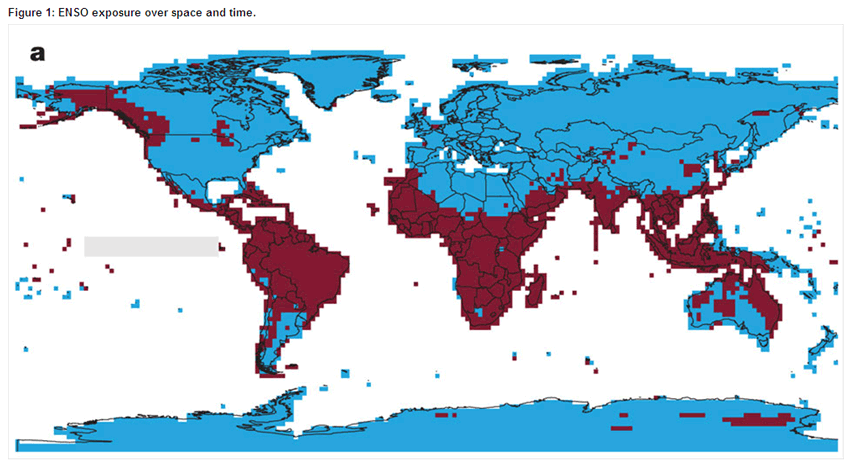
A recent Nature article on climate’s impact on conflict has generated controversy in the environmental security community for its bold conclusions about links between the global El Niño/La Niña cycle and the probability of intrastate conflict.
-
Remembrance: Wangari Maathai, Nobel Peace Prize Winner, Linked Environment and Conflict
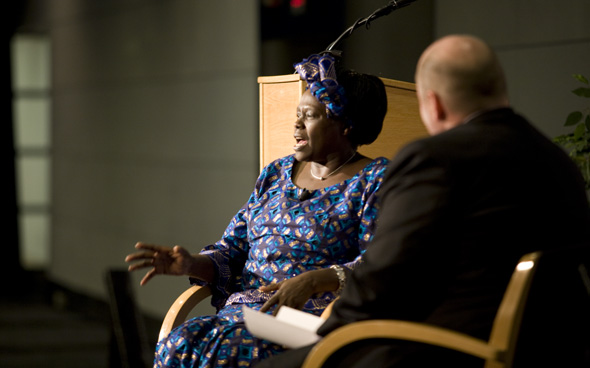
›September 26, 2011 // By Schuyler NullSad news today as Wangari Maathai, the first African woman and the first environmentalist to win the Nobel Peace Prize, has passed away in Nairobi. The Green Belt Movement, which Maathai founded in 1977, has planted over 30 million trees and advocates for what Maathai called the three essential components of a stable society: sustainable environmental management, democratic governance, and a culture of peace. [Video Below]
“Almost every conflict in Africa you can point at has something to do with competition over resources in an environment,” said Maathai during her visit to the Wilson Center in 2009:Unless you deal with the cause, you are wasting your time. You can use all the money you want for all the years you want; you will not solve the problem, because you are dealing with a symptom. So we need to go outside that box and deal with development in a holistic way.
Maathai’s message was molded from her experiences in Kenya and across sub-Saharan Africa in general. She was not shy about condemning African leaders and advocating for women in the political space. In ECSP Report 12, she wrote, “I come from a continent that has known many conflicts for a long time. Many of them are glaringly due to bad governance, unwillingness to share resources more equitably, selfishness, and a failure to promote cultures of peace.”
Importantly, though, Maathai advocated for addressing these issues in concert, not separately. She said at the Wilson Center:I can’t say, ‘Let us deal with governance this time, and don’t worry about the resources.’ Or, ‘Don’t worry about peace today, or conflicts that are going on; let us worry about management of resources.’ I saw that it was very, very important to use the tree-planting as an entry point.
A Message to the World
Some raised questions when Maathai won the Nobel Peace Prize in 2004 – the first awarded to someone from the environmental field – but the recognition was more than deserved, wrote Environmental Change and Security Program (ECSP) Director Geoff Dabelko on Grist:Maathai is on the front lines of the struggle over natural resources that fuels conflicts across the world. While there is no dramatic footage of tanks rumbling across borders or airplanes flying into buildings, the everyday fight for survival of those who depend directly on natural resources – forests, water, minerals – for their livelihoods is at the heart of the battle for peace and human security.
Maathai explained in Report 12 that she thought her winning of the prize was intended as a message to the world to “rethink peace and security.”
…
Elevating such a strong Southern voice – and one whose elephant’s skin bears the scars of the fight for peace – is a noble choice.
The Nobel Committee “wanted to challenge the world to discover the close linkage between good governance, sustainable management of resources, and peace,” she wrote. “In managing our resources, we need to realize that they are limited and need to be managed more sustainably, responsibly, and accountably.”
Sources: Grist, The New York Times.
Photo Credit: David Hawxhurst/Wilson Center. -
Carl Haub, Yale Environment 360
What If Experts Are Wrong On World Population Growth?
›September 22, 2011 // By Wilson Center StaffThe original version of this article, by Carl Haub, appeared on Yale Environment 360.
In a mere half-century, the number of people on the planet has soared from 3 billion to 7 billion, placing us squarely in the midst of the most rapid expansion of world population in our 50,000-year history – and placing ever-growing pressure on the Earth and its resources.
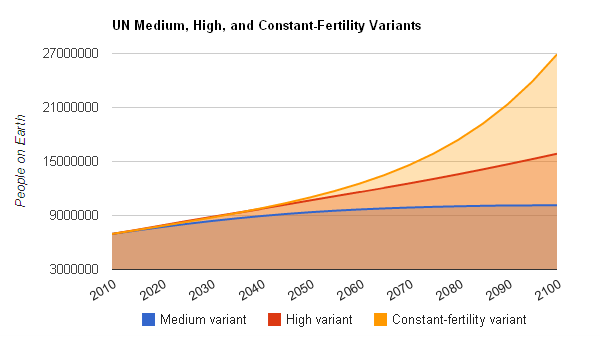
But that is the past. What of the future? Leading demographers, including those at the United Nations and the U.S. Census Bureau, are projecting that world population will peak at 9.5 billion to 10 billion later this century and then gradually decline as poorer countries develop. But what if those projections are too optimistic? What if population continues to soar, as it has in recent decades, and the world becomes home to 12 billion or even 16 billion people by 2100, as a high-end UN estimate has projected? Such an outcome would clearly have enormous social and environmental implications, including placing enormous stress on the world’s food and water resources, spurring further loss of wild lands and biodiversity, and hastening the degradation of the natural systems that support life on Earth.
It is customary in the popular media and in many journal articles to cite a projected population figure as if it were a given, a figure so certain that it could virtually be used for long-range planning purposes. But we must carefully examine the assumptions behind such projections. And forecasts that population is going to level off or decline this century have been based on the assumption that the developing world will necessarily follow the path of the industrialized world. That is far from a sure bet.
Continue reading on Yale Environment 360.
Image Credit: Data from UN Population Division, chart arranged by Schuyler Null. -
Loren Landau: We Need to Move Beyond Traditional Views of Migration
›Addressing the role of subnational actors, from local governments to mining companies, is increasingly critical to understanding migration, said Loren Landau, director of the African Center for Migration and Society at the University of the Witwatersrand, in an interview with ECSP. These actors frequently exert more influence than national governments over human resources because they control the “space in which people live, the space in which they produce,” Landau said.
Migration is most frequently seen as an aberration or a temporary coping mechanism, but this conception is outdated. According to Landau, “especially as rural livelihoods become less viable, movement will be the norm.”
Local and global actors must recognize that “people are moving, and they are moving to a whole range of new places,” he said. These new places will need attention and resources, but we will need to move beyond traditional views of migration in order to respond to the challenge. -
Babatunde Osotimehin Answers Seven Questions on Population
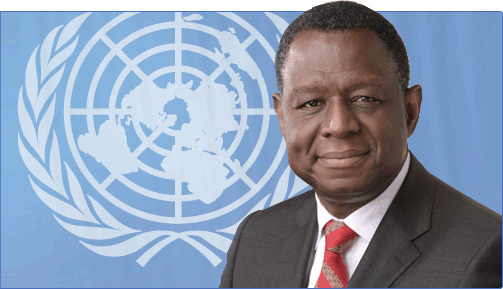
›PSI’s Impact magazine has an interview up with UNFPA Executive Director Babatunde Osotimehin asking him seven questions about population. It’s not likely this will be the last seven-something-themed story as we approach October and the expected seven billion mark for global population, but Karl Hofmann, president and CEO of PSI, asks some good questions, including on the prospect of harnessing the “demographic dividend” and about the barriers facing more integrated development efforts – a critical topic in population, health, and environment (PHE) circles.
On the demographic dividend:Karl Hofmann: Demography can be a key to progress with the right policy environment in place, but it can also be a burden when we don’t have the right framework in place to take advantage of growing populations. Some have described this as the demographic dividend – growing populations as a potent driver of economic growth and development. Give us your perspective on that.
And on integrated development:
Babatunde Osotimehin: I spoke at the 17th African Union Summit this year and one of my messages was that we have the opportunity right now to take advantage of the demographic dividend of young people. It’s important for African governments to understand that they have a youthful population. Most of Africa is under the age of 35. If 85 percent of the African population is under 35, the implication is that you have to have education, social services, housing, all of that, tailored to meet the needs of this population.
Beyond that, given what we’ve seen with the Arab spring uprising and others in many parts of the developing world, young people who are out of work want education and economic opportunities. We want to appeal to member states to provide skills appropriate to development and also ensure that we have continuing conversations with young people about their reproductive health and rights so they can make the choices that will ensure they plan for their families.KH: There are lots of conversations going on in global health circles these days around the synergy of integration. From your perspective, what are the barriers to this integration?
Read the full interview on Impact.
BO: I think it’s bipolar. Some countries are satisfied with vertical programs. Others are resistant to changing their system at the request of a donor. One argument for integration is that you can have the one-stop shop situation where one, two, three trained providers can deliver services at the same time. These include integration of HIV counseling, testing and treatment with family planning, with health education for non-communicable diseases, with immunization for children or with maternity services.
When you look at the components of an integrated system, it is very easy to sell. In terms of investment, it makes sense for the governments to build and put this together. The supervision becomes a lot easier, and the training of health workers would then capture all of the skill sets that would be required. Some countries, like India, Ethiopia and Nigeria have started this kind of integration.
Sources: PSI.
Image Credit: Adapted from UNFPA.
Showing posts from category Africa.