-
Climate Finance as a Tool for Global Stability
May 11, 2026 By Madelyn MacMurray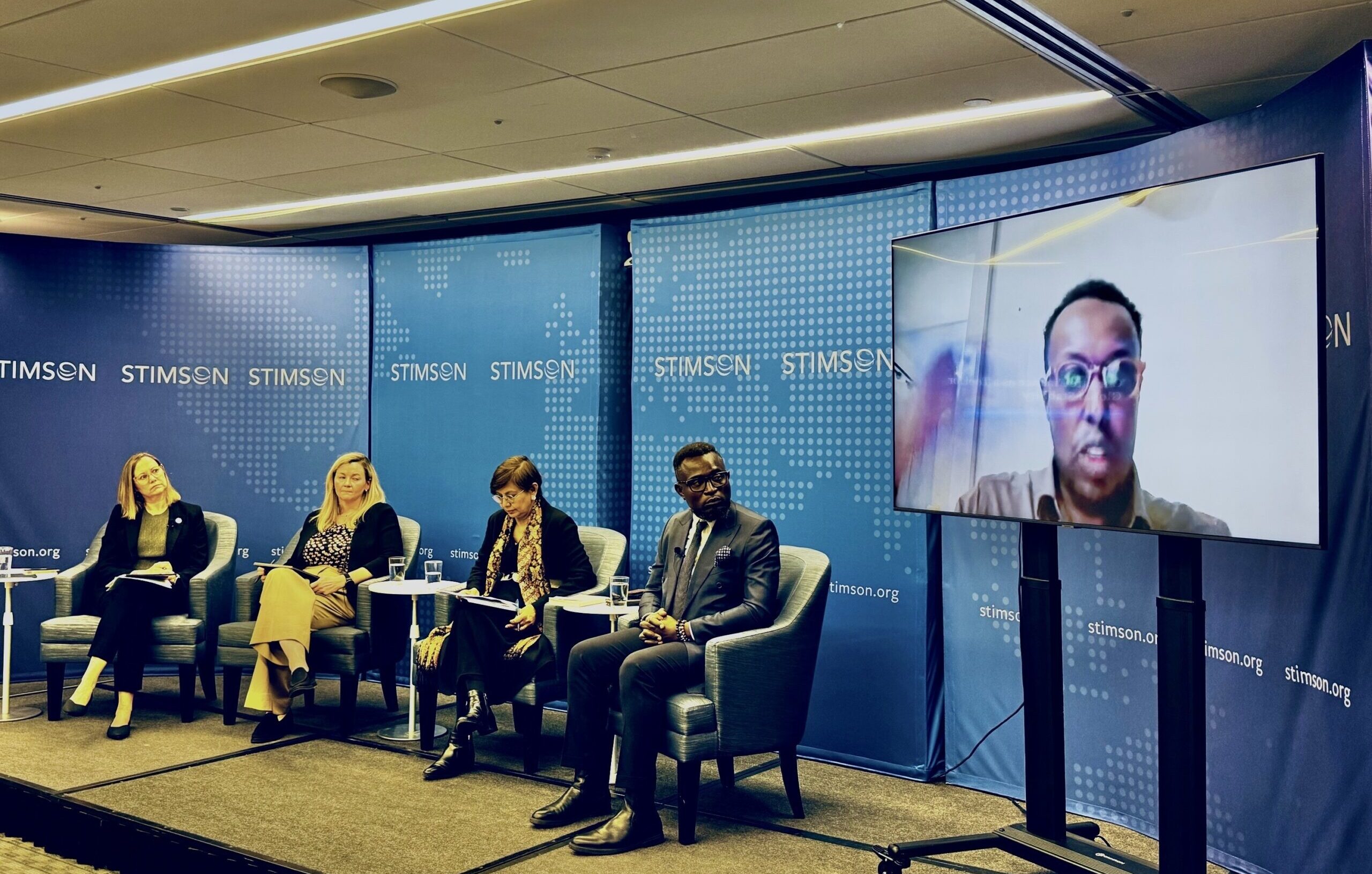
The relationship between climate vulnerability and political instability is clear. Twenty-two of the 30 countries ranked as the most vulnerable to climate change in 2025 also were categorized as fragile and/or conflict affected. Within this contexts, the need for solutions that address the intersection of climate risks and instability is increasingly dire.
A recent Stimson Center event hosted with the Green Climate Fund (GCF)—Climate Finance as a Tool for Global Stability—examined how early climate investments in climate adaptation, food systems, and water security can reduce the risk of conflict and displacement.
“The current system is not delivering for countries that are really struggling with the climate, especially countries such as Somalia, where you have so much of a compounding crisis,” said Abdihakim Ainte, Director of Food Security and Climate Change for the Office of the Prime Minister in the Federal Government of Somalia.
Speakers at the event offered their views of how things have broken down – in addition to ways to ensure that climate finance addresses interconnected ecological, governance, and livelihood issues that can stymie progress on ameliorating or preventing climate impacts.
Why the Current System Falls Short
The 2025 UNEP Adaptation Gap report observes that developing countries will need between $310 and $365 billion per year in adaptation finance by 2035. Yet international public flows reached just $26 billion in 2023.
For fragile and conflict-affected countries, the current climate finance architecture falls short in several key respects. Ainte noted that a largely top-down global approach to countries like Somalia means that proposals are designed by external experts, rather than drawing upon local knowledge and solutions. It is a system that, therefore, disproportionately advantages countries with strong institutions. He stated that any reform of global financial architecture should “be based on realities and solutions that exist in host countries such as Somalia.”
Ainte also raised concerns that the architecture is also oriented toward short-term humanitarian responses rather than the long-term development investments communities need. It was an argument echoed by Tara Clerkin, Climate Resilience Global Practice Lead at the International Rescue Committee (IRC): “We all know now many, many humanitarian and development projects where after the grant period, the intervention stops.”
Clerkin noted that in this environment, standard development practices routed through government institutions or market systems break down. As a result, projects risk faltering once the grant period ends. She added that operationalizing lasting policies in these environments involves assessing what the right financing and scaling structure is based on understanding what affected communities need to grow their businesses and feed into local markets.
What Transformational Adaptation Finance Looks Like
Kavita Sinha, Special Advisor to the Global Climate Fund’s Executive Director, pointed to his organization’s commitment to closing this gap. When GCF approved $2.2 billion in climate adaptation finance in 2025 (its largest single-year total ever), approximately $705 million was directed toward conflict-affected countries spanning 18 fragile states.
In Somalia, the GCF’s efforts already are showing promise. Anite said that his nation secured its first major climate financing portfolio through the GCF in December 2024, totaling roughly $100 million. This landmark funding supports Somalia’s National Transformation Plan (NTP)—a 10-year roadmap designed to move the country away from humanitarian dependence toward resilience-based development.
“The dilemma [in operationalizing the NTP] is not simply a choice between investing in long-term and short-term solutions, but it’s also about prioritizing and sequencing your solutions,” said Ainte. Building systems and institutions capable of delivering at the frontlines is the first priority. Energizing the private sector so that it becomes a genuine partner in crisis response, rather than a bystander, follows.
“You’ve got to have institutions and partnerships that can prepare and predict tomorrow,” said Ainte, “but can also provide solutions and assistance at speed, and at-scale.”
As a key partner for the GCF and the Federal Government of Somalia, the IRC is working to help sequence investments in long-term resilience alongside meeting acute needs by co-creating projects with community members, policymakers, and the private sector. Clerkin says that mapping negative feedback loops with communities to understand behavioral barriers to project implementation and continuity is central to this approach.
In designing a carbon market system in Somalia, for example, the IRC is working with the Ministry of Environmental Climate Change to understand what the operationalization of voluntary carbon markets looks like. Clerkin says that this task is supplemented by working with community members to understand how community-based carbon projects can benefit them.
In order to address acute risks in Somalia, IRC layers a shock response mechanism into projects to better address immediate community needs in the aftermath of a climate or conflict shock. Clerkin pointed to IRC’s public forecasts program, which directs cash payments where specific hazards are forecasted in Somalia, as one such measure. The program has directed $2 million to 8,000 households over the last year.
“We’re pairing that with information about what action can those households take based off of their livelihoods, based off of what they do, that is going to best protect their families,” said Clerkin. “They had the ability to take action to protect their households.”
Sinha stated that integrated partnerships and monitoring systems are essential to making these programs effective. End-to-end assessments of a project’s theory of change are built into GCF’s model, incorporating independent redress mechanisms to maintain accountability, transparency, and elasticity in project implementation, as illustrated by IRC’s multidimensional approach as just one of GCF’s civil society partners.
“To build partnerships of people who are interested in the community as a whole and bring solutions which are integrated—not a silo of climate here and stability there and development here—that’s the role GCF is playing,” said Sinha.
Moving Beyond Donor Dependency
Throughout the discussion, panelists highlighted an inherent tension in the funding landscape: how to balance meeting acute humanitarian needs with building the long-term resilience that can eventually reduce that need.
Clerkin observed that with 70% of global humanitarian need concentrated in a subset of climate- and conflict-affected states, the honest near-term goal of international finance may not be bending the curve dramatically but rather preventing the convergence from getting worse. Despite progress made in recent years, this imbalance is confirmation that the climate finance system as it is currently designed cannot fully address the specific and chronic challenges facing fragile and conflict-affected states.
David Akana, director of programs at Mongabay Africa, observed that in the conflict-affected North Kiva province of the Democratic Republic of Congo, the economy is fed by hydropower generated in Virunga National Park and funded by the European Union. This development is bringing hope to this UNESCO World Heritage Site, even with a significant part of Goma under the control of rebel March 23 Movement (M23) paramilitary group.
NGOs are now looking at models that address the nexus between renewable energy, agricultural production, and poverty reduction, and exploring how they can experiment with them in new places. But Akana added that how to meaningfully scale these projects under the present donor-led finance architecture is less than certain.
Akana also observed that the current political moment’s shifting foreign aid landscapes and growing pressure on external finance may be precisely the right time to rethink who owns the solutions.
Homegrown approaches are not just preferable for scaling successful environmental peacebuilding initiatives; they are more likely to endure. Communities and countries driving their own development can build investments that last, rather than projects that end when the grant period expires.
“Local startup ecosystems, people who are closest to the problems, are also the most innovative in finding solutions for them,” said Sinha.
“When they build it, they will take ownership,” agreed Akana. “They will defend it at all costs.”
Panelists at the event agreed that a set of principles should shape future climate finance. Co-creating adaptation solutions with communities should be preferred to designing solutions for them. Short-term relief should be sequenced with long-term institution-building. The private sector should be activated as a genuine partner. And, at bottom, this essentials work should be monitored with an eye to adaptation—and a willingness to acknowledge when something hasn’t worked.
As Sinha put it: “Do the right things, design the right elements, find the right partners, get the money to the ground, and then monitor closely.”
Madelyn MacMurray is a Research Assistant in the Stimson Center’s Environmental Security Program.
Sources: UN Environment Programme; The World Bank
Photo Credits: Photo courtesy of the Stimson Center.
 A Publication of the Stimson Center.