According to the latest projections, the global population will hit the
seven billion mark later this year and perhaps nine billion by 2050. Yet, while the global population is growing, it is also aging, due to falling fertility rates and longer life expectancies. By 2050 the number of people aged 60 and over will
reach two billion. At an
event at the Wilson Center on April 1,
Andrew Mason of the University of Hawaii at Manoa and the East-West Center and
Ronald Lee of the University of California, Berkeley, discussed their research on the economic effects of an aging world with discussant
Dalmer Hoskins of the Social Security Administration.
[Video Below]
Changing Age Structures and Economic Lifecycles
There are three phases of age transition, Mason explained: during the first phase, high fertility rates and declining infant and child mortality rates increase the share of children in the population. In the second phase, the proportion of the working age population (those aged 15-64) increases, potentially providing a boost to production and consumption, and in the third phase, the elderly proportion increases due to lower fertility rates, decreasing production and increasing the burden on state support systems.
From 2010-2015, 85 countries are projected to witness the largest absolute increase in history of their populations aged 60 and over. This increase in elder populations is significant, Mason said, because it may mean slower economic growth.
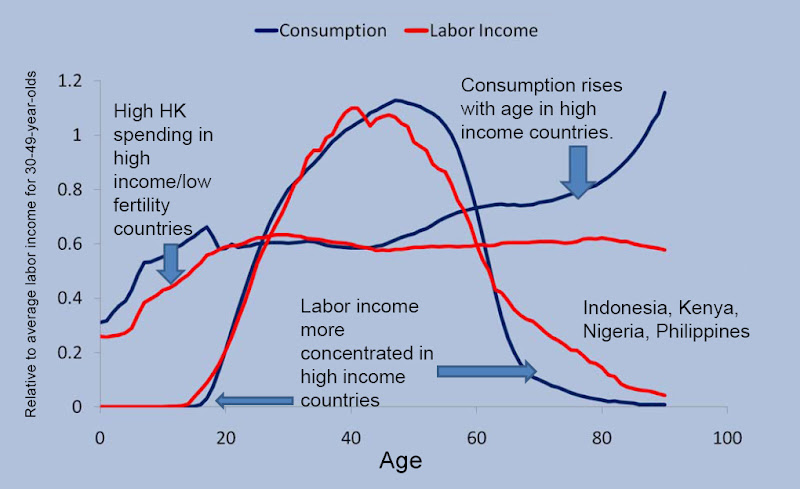
Based on data collected through National Transfer Accounts, Mason and Lee’s economic lifecycle tracks the labor income and consumption rates of a population at a given age. In high income countries, consumption increases around the teen years as a result of investments in education, then dips slightly, and, finally, sharply rises around the age of 80 due to high health care expenditures. The consumption rate remains relatively flat in low income countries, with consumption differing the most in the older ages.
The support ratio measures the number of workers relative to the number of consumers, while taking into account age-specific variances in number of hours worked and level of consumption. Mason explained that China, after four decades of rapid growth, has reached the peak of its support ratio, with many workers relative to the number of consumers. However, China is rapidly aging, like much of Northeast Asia, and also because of its one-child policy. The resulting decline in its support ratio will likely limit its economic growth; however, Mason cautioned that it would be “rash” to say that its growth will bottom out completely.
The United States has an age structure that is “quite a bit more favorable” than other industrial countries, Mason said. Higher fertility, lower life expectancy, and a higher rate of immigration mean that aging is coming more slowly to the United States than other developed countries.
The Second Demographic Dividend: An Investment Opportunity
During the first demographic dividend, the labor force grows more rapidly than the dependent population, thus allowing more resources to be spent on economic growth. But what happens after that? As populations age, there is a “semi-automatic” increase in investment in human, physical, or financial capital, Lee explained; for example, as fertility falls, the amount invested per child increases. This second demographic dividend, said Lee, can help somewhat offset the decline in support ratio that comes in the third phase of the age transition – aging.
One response to the increased costs of an aging population, said Lee, is to reduce consumption in proportion to the decline in the support ratio. Another option would be adding more hours to the work day or pushing the retirement age back. In the United States, Lee said that to offset the declining support ratio entirely by postponing retirement would require postponement by eight years up to 2050, and 10 years by 2085.
Brazil, Lee said, is the “world champion” of pension generosity, where pensions make up 12 percent of the GDP. The United States, by contrast, relies on asset income from physical or financial investments for about two-thirds of its retirement income. Brazil’s challenge, when it begins to feel the effects of aging (it is still relatively young), will therefore be much greater than in the United States.
A “New Lens” on Aging
Aging, Hoskins said, is not the “catastrophe” that it has been portrayed to be in the media. Supporting an aging population is “something we can plan for and handle,” he said. It is possible “to do the right thing to make sure citizens have a decent life.” The problems come when a country waits too long or does not plan at all, such as in Nigeria and the Philippines where, Hoskins said, they have very underdeveloped social protection systems and the elderly have little to no income. Mason and Lee’s analysis of the work/consumption ratio, said Hoskins, offers a “new lens” into how the world will deal with aging.
Sources: Los Angeles Times, National Transfer Accounts, UNFPA, World Bank.
Image Credits: “Elderly couple – Meiji-jingu,” courtesy of flickr user Tom Spender. Chart courtesy of Ronald Lee and Andrew Mason, National Transfer Accounts.


 A Publication of the Stimson Center.