-
Taking a Livelihoods Approach to Understanding Environmental Security
February 17, 2012 By Kate Diamond
Since the concept of “environmental security” first gained traction in the early 1990s, research on the issue has been overwhelmingly focused on how environmental change impacts state security. That has been to the detriment of policymakers trying to preempt instability and conflict, according to the University of Toronto’s Tom Deligiannis in his article, “The Evolution of Environment-Conflict Research: Toward a Livelihood Framework,” published in February’s Global Environmental Politics.
Rather than focus on how environmental change affects security on a state level, Deligiannis argues, researchers should instead turn to “development practitioners, population-environment researchers, and climate change adaptation researchers,” whom he credits with bringing household-livelihood analysis into the mainstream. By taking a livelihoods approach to environmental security, Deligiannis bridges the gap between environment-conflict research and human security research, elevating the individual dimension of environmental security in ways that state-based analysis overlooks. Through a livelihoods framework, scholars and policymakers can build adaptation and mitigation strategies that address climate-driven instability at its roots – in the households and communities whose resilience forms the first line of defense against instability transitioning into conflict.
From Household Scarcity to Small-Scale Conflict
Deligiannis expands on the link that earlier scholars (Thomas Homer-Dixon, notably) have found between environmental scarcity and conflict, arguing that other household factors – such as access to productive livelihoods – can change the course of how scarcity and conflict interact. He references previous research by the International Union for the Conservation of Nature that shows access to natural resources “underpins all livelihoods” and work by Lief Ohlsson that shows that when it comes to whether or not conflict erupts in developing countries, “it is the processes that lead to the rapid loss of rural dwellers’ livelihoods or their inability to attain or maintain adequate livelihoods that prove key.”
According to Deligiannis, state-level environment-conflict analyses miss this link between scarcity, livelihoods, and conflict because the state is often removed from the immediate impacts of scarcity and nascent conflict. “Scarcities initially affect individuals, families, and communities, personally and directly, before being translated into broader state or societal effects,” Deligiannis writes. Similarly, conflict can fester at a sub-state level for years before becoming a direct threat to state stability. Small-scale conflicts “may only kill or injure handfuls of people,” but over time (and they do tend to “occur over many years,” he writes), “their local impacts may undermine the fabric of society, alter migration patterns, and affect social and ethnic group solidarity and cohesion in certain areas of states.”
Even as he emphasizes the scarcity-livelihood-conflict link, Deligiannis makes it clear that a precise path from scarcity to conflict is difficult to map out. The path can be straightforward, with scarcities provoking a security dilemma between communities trying to secure access to dwindling resources which, quoting earlier work done by Colin Kahl, “can set off an action-reaction spiral that leaves all parties worse off and less secure.” Alternatively, a community might adapt successfully to one scarcity, only to provoke “unanticipated negative social effects” that ignite conflict far afield – either “geographically or temporally” – from the community initially impacted.
This scenario is already playing out in the Sahel, where changes in underlying environmental trends have made it difficult for the traditional coping mechanisms of both pastoralists and farmers to co-exist. To reduce this risk of unintended consequences, Deligiannis argues it’s important to prioritize low-risk strategies and offer vulnerable communities access to more and varied types of coping and adaptation mechanisms.
Go Local
Exactly how this “livelihood diversification” recommendation translates into policy, however, remains underdeveloped. To help “the poorest households, with the least access to natural resources such as land,” for example, Deligiannis recommends that policymakers “support policies and infrastructure services that build upon and enhance diversity, such as technology distribution, co-operation services, etc.”
The message to researchers is clearer: “Ultimately, environment-conflict research should do more than diagnose how and why environmental and demographic change contributes to conflict,” he writes. “It should offer scholars and policymakers insights into what interventions would be most effective at mitigating the negative social effects of scarcities.” To do that, Deligiannis argues that more work should focus on the specific, local-level systems of the most vulnerable, as opposed to state-level analysis. “Such an approach will also lead to a better appreciation of the many previously-ignored local violent conflicts that have their roots in human environmental change interactions,” he concludes.
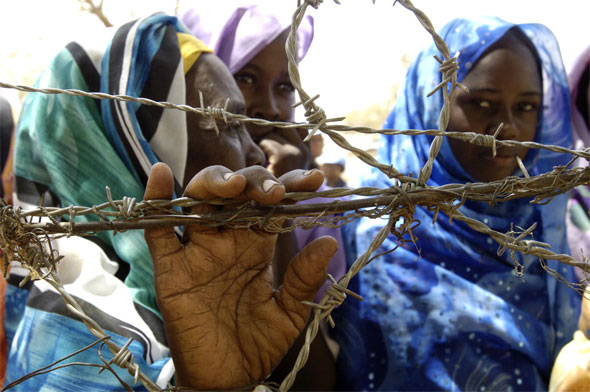
Photo Credit: “Displaced Sudanese, El Fasher,” courtesy of United Nations Photo.
 A Publication of the Stimson Center.