-
P.H. Liotta, Salve Regina University
The Real Population Bomb: Megacities, Global Security, and the Map of the Future (Book Preview)
February 8, 2012 By Wilson Center Staff
 There was a time when the city was the dominant political identity. Centuries and even millennia ago, the most advanced societies in the Mediterranean, the Near East, and South America revolved around cities that were either states in themselves or were the locus of power for larger empires and kingdoms. The time of the city is coming again, though now in a considerably less benign way.
From the introduction to The Real Population Bomb:There was a time when the city was the dominant political identity. Centuries and even millennia ago, the most advanced societies in the Mediterranean, the Near East, and South America revolved around cities that were either states in themselves or were the locus of power for larger empires and kingdoms. The time of the city is coming again, though now in a considerably less benign way.
With the rise of massive urban centers in Africa and Asia, cities that will matter most in the twenty-first century are located in less-developed, struggling states. A number of these huge megalopolises – whether Lagos or Karachi, Dhaka or Kinshasa – reside in states often unable or simply unwilling to manage the challenges that their vast and growing urban populations pose. There are no signs that their governments will prove more capable in the future. These swarming, massive urban monsters will only continue to grow and should be of great concern to the rest of the world.
This book is about where and how geopolitics will play out in the twenty-first century. Cumulatively it represents two decades of work from authors with seemingly dissimilar backgrounds: one is a poet, novelist, and translator; the other is a security analyst and expert in disaster response and management who has worked for two presidential administrations. Both were colleagues at the U.S. Naval War College in the early 2000s.
We have traveled widely and conducted fieldwork in places as disparate as the Altiplano of Bolivia; Caracas, Venezuela; Guayaquil, Ecuador; the autonomous Altai Republic in deep Siberia; and the massive slums of Egypt, India, Kenya, South Africa, and Brazil. What we share from this experience is the recognition that the world has changed before our eyes. Terms such as the “developed” and “developing” world – phrases that were always dangerous and loaded with false value – no longer have the relevance they seem to have had once. Concepts such as “first world” and “third world” are stubborn relics of Cold War thinking – just as our “mental maps” are grounded in the often difficult but known past. We must change our ways of seeing the world.
Traditionally there have been two general approaches to understanding societies and states. One is the humanitarian or ecological perspective in which the focus is on society – how people live and are affected by war, pollution, and economic globalization. The other is a realist perspective in which the focus is on the economic, political, and military relations among major powers such as the European Union, the United States, China, and Russia.
What these traditional approaches underemphasize is the overlap and natural alignment between them. To understand the map of the future, we need to critically appreciate how astonishing population growth in cities – particularly fast-growing megalopolises in weak or failing states in Africa, the Middle East, and Asia – is impacting ecology and ecosystems, human security, and the national security of Western states, as well as allies and trading partners.
For both better and worse, globalization and urban population growth have changed political and economic dynamics in ways that previous conceptions of how the world works cannot do justice. In this book we examine how developments below the nation-state level – at the municipal level – affect how we must see the world of the future. While this work is anything but a travelogue, we do visit some of the most alarming locations on the earth. Often these places have been viewed in impressionistic terms, as distant locations where “others” live – with whom “we” have little interaction. But we are far more connected than we think; whether Nigeria or Pakistan, Bangladesh or Egypt, their future is also ours. The odds seem stacked against those who live there. In the dense, overgrown neighborhoods and shantytowns of Lagos, Kinshasa, Cairo, Karachi, Lahore, or Dhaka, government authorities have failed to provide infrastructure and public services. We need urgent, collective, and innovative actions to help critical megacities weather the gathering storm.
But there is hope and strength. Though time is running short, solutions are still possible. In the end, this book is about the power and resilience of the human spirit.
P. H. Liotta’s latest book is The Real Population Bomb: Megacities, Global Security, and the Map of the Future, with James F. Miskel. As a member of the United Nations Intergovernmental Panel on Climate Change UN’s IPCC, he shared the 2007 Nobel Peace Prize.
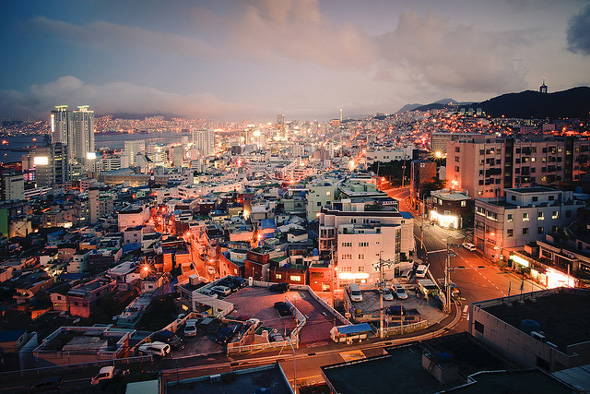
Photo Credit: “Urban View: the Republic of Korea’s Second Largest City,” courtesy of United Nations Photo.

 A Publication of the Stimson Center.