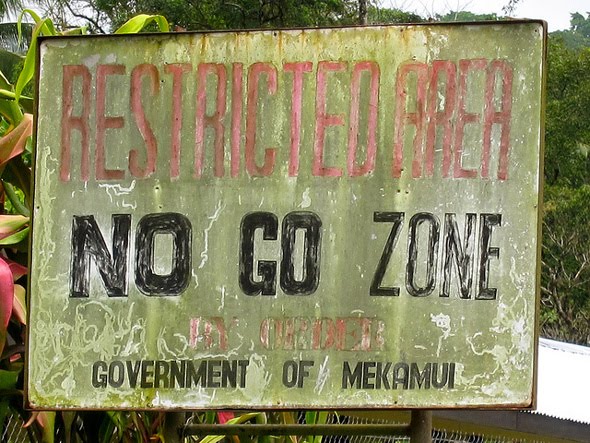
Demographic security is fast becoming a central concept in discussions about the relationship between youth and violence, and, although quantitative work has been the normal mode of research in the field, recent evidence from Papua New Guinea’s autonomous region of
Bougainville shows the value of understanding local-level nuance.
Policies to support youth in post-conflict situations are important for building peace, particularly given the “youth bulge” thesis that suggests that large cohorts of marginalized young people are contributing to a demographic “arc of instability” across the developing world. However, the statistical evidence showing correlations between youth bulges and an increased risk of instability has been criticized for failing to account for the agency of youth themselves. For instance, Marc Sommers points out that there is “scant information on how and why most marginalized African youth resist engagement in violence even when it would seem to provide immediate benefits.” This lack of detailed, evidence-based knowledge can frustrate efforts to develop effective youth policies, particularly in post-conflict settings, where the risk of the persistence or even return of violence, is arguably increased by the presence of youth bulges.
Bougainville’s “Crisis Generation”
Hoping to address this lack of knowledge about how and why young people engage in peace or violence in post-conflict settings, I recently spent several weeks in Bougainville. My aim was to study how young men make lives for themselves in the social circumstances that exist nine years on from a civil war that lasted more than a decade and claimed more lives than any Pacific conflict since World War II. The qualitative evidence I collected on these pathways informed analysis in an article co-authored with Jon Barnett in the Journal of Political Geography, “Localising Peace: The Young Men of Bougainville’s ‘Crisis Generation’” (subscription required).
With a 2010 median age of just 20.4 years (projected to remain less than 25 until at least 2030) and more than 60 percent of its population less than 30 years old, Papua New Guinea is among the world’s youngest states, according to UN population data. Despite a wealth of natural resources, the state faces severe challenges to providing education, jobs, and security for a young population whose growth has for many years severely outpaced the capacity of its formal institutions. Papua New Guinea, and the region of Bougainville within it, is a state where demographic strains are reasonably expected to continue to pose risks to an already fragile state.
Bougainville’s 18-to-30-year olds, known among their peers and elders as the “crisis generation,” are those with living memory of the violence but who were too young to have fought on either side. They continue to face challenges with trauma, accessing education and work, achieving social standing, and escaping from histories of violence. These sometimes impede their capacity to participate meaningfully in local society and can lead them towards sporadic acts of violence.
Understanding the Pathways to Violence
For many young men in Bougainville, achieving critical social measures of success – such as amassing the wealth required for marriage – has become nearly impossible due to high unemployment and restricted access to education. Marriage matters, since land rights in Bougainvillean societies are generally derived matrilineally, and therefore young men who are unable to marry tend to lack secure access to land.
Education is a critical institution for young men in Bougainville. Unfortunately, the formal sector that might employ young men upon completing secondary education is very small, and therefore much of the time and money spent pursuing that education is wasted. The education system itself lacks the resources to meet the needs of all those who seek secondary education. To cope with the demand, youth are asked to sit for exams in grade 8 and again in grade 10, a practice which creates high failure rates and whittles down the student cohort from several thousand at primary level to only a few hundred at the completion of secondary schooling (few of whom then receive meaningful employment). For many, this failure to obtain a return on years of school fees places significant strain on the relationships between youth and their familial and social networks.
Some adapt to these challenges by “upgrading” their poor education through distance learning or by seeking out vocational training as a way to obtain skills relevant for rural life. But some are seen as wedged between a set of unworkable options: “Many of them are existing in a vacuum,” said one civil society leader. “They see things outside but they cannot grab them and they cannot ground themselves.”
As a result, many turn to homebrew alcohol and marijuana and a select few seek social standing by adopting displays and acts of violence that imitate the personas of former rebels. Of these choices, the first attracts the stigma of “lazy,” and the second, “dangerous.” In both cases, these stigmas risk overshadowing the legitimate challenges facing young men by distilling the complexity of the world into a simple morality crisis that itself creates divides both between and within generations.
Building Policy Prescriptions
Unfortunately, the sorts of life and trauma counseling services capable of engaging these young men remain under-supported. As one youth worker claimed of the youth who have no memory of life before the war, “They don’t know how it was before the Crisis. They think things have always been this way; that this is normal.”
In a more southern district, one young man explained of his more notorious peers, “It’s these guys roaming around, mixing with ladies and drinking, they cannot reason so they use the gun, the knife – offensive weapons. And when they are sober they regret. These people spoil the peace process here in Bougainville.”
Providing viable alternatives to these lifestyles is crucial and can only be achieved by asking young men themselves about their world, about the challenges they face, and about the strategies they take to maneuver through them. By understanding the social, cultural, and geographical specifics of a local context, this form of analysis provides a valuable starting point for determining and evaluating policy interventions that statistics alone cannot provide.
In Bougainville’s case, an expansion of vocational training and the provision of trauma counseling, regardless of whether a person was a combatant or not, are two desperately needed interventions that have the potential to increase the capacity of young men to achieve success through peaceful means.
Sources: Conciliation Resources, The Sydney Morning Herald, UN Population Division.
Photo Credit: “Mekamui/Panguna” and crossing from Buka to Bougainville, courtesy of flickr user madlemurs.


 A Publication of the Stimson Center.