Late last year,
Afghanistan’s first-ever nationally representative survey of demographic and health issues was published, providing estimates of indicators that had previously been modeled or inferred from smaller samples. My
first post on the survey focused on the methodology and results, which found that Afghanistan is not as much of a demographic outlier as many observers had assumed. But perhaps the most surprising finding is how the results compare to those of Afghanistan’s neighbor, Pakistan.
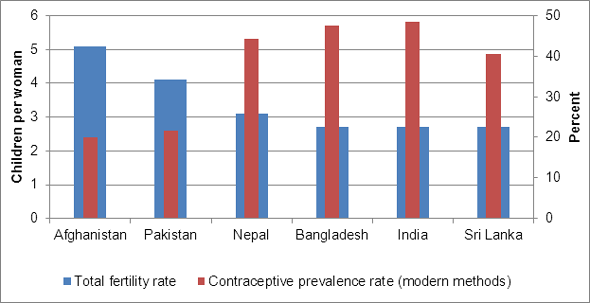
The political future of each country depends largely on the other and, with Afghanistan making progress on reproductive health issues that remain stalled in Pakistan, their demographic trajectories are heading toward closer synchronization as well. In one key measure – use of contraception among married women – Afghanistan is almost identical to Pakistan. The modern contraceptive prevalence rate is 19.9 percent, slightly lower than the rate of 21.7 percent in Pakistan.
While Pakistan faces its own serious political instability, it is widely regarded as more developed than its neighbor. Afghanistan is included in the UN’s grouping of least developed countries, and Pakistan is not. Pakistan’s GDP per capita is almost twice as high. On the surface, this should suggest lower fertility. There is a general negative relationship between economic development and fertility, though demographers are quick to point out its complexities, and David Shapiro and colleagues have found that countries with larger increases in GDP actually experience slower fertility declines.
Pakistan’s fertility rate of 4.1 children per woman is in fact 20 percent lower than Afghanistan’s, but the similarities in contraceptive use, which is one of the direct determinants of fertility, suggest that this gap could be shrinking. If Afghanistan’s median age at marriage (18 compared to 20 in Pakistan) was higher and more women were educated (76 percent of women have never been to school compared to 65 percent in Pakistan), the two fertility rates might be closer.
Pakistan’s Entrenched Challenge
Why are these indicators closer than might be expected? Relative to the other countries in South Asia, Pakistan has had considerably less success in promoting family planning use. Bangladesh has a per capita income about half that of India and one-quarter that of Sri Lanka, yet the three countries’ fertility rates are identical. Nepal has the lowest income in the region – even slightly below Afghanistan – yet more than 40 percent of married women use modern contraception and fertility is three children per woman. And then there is Pakistan. Despite a per capita income 90 percent that of India, only 22 percent of married women use modern contraception and fertility remains persistently high at over four children per woman.
The weaknesses of Pakistan’s family planning program have been well-documented. Government commitment has been lacking and cultural expectations and gender inequities are a powerful force to promote large family size. The country’s most recent DHS report cited disengagement with the program among local agencies, low levels of outreach into communities, and weak health sector support as likely causes for the stagnation of contraceptive use. In summer 2011, the Pakistani government abolished the federal Ministry of Health and empowered provincial governments with all responsibilities for health services. This transfer of authority could pay dividends by increasing local ownership of health care, but some in and outside Pakistan have raised concerns about the loss of regulatory oversight and information sharing entailed in total decentralization.
Compared to the Afghanistan survey, the most recent Pakistan Demographic and Health Survey provides more detail on women’s motivations and preferences regarding fertility and family planning. Overall, 55 percent of married women in Pakistan have a “demand” for family planning; that is, they wish to avoid pregnancy or report that their most recent pregnancy or birth was mistimed or unwanted. More than half of these women are using family planning, while the remaining 25 percent of married women have an “unmet need.”
Unintended pregnancies and births play a major role in shaping Pakistan’s demographic trajectory. The DHS survey finds that 24 percent of births occur earlier than women would like or were not wanted at all. If unwanted births were prevented, Pakistan’s fertility rate would be 3.1 children per woman rather than 4.1. Yet 30 percent of married women are using no contraceptive method and do not intend to in the future. The most common reasons for not intending to use family planning are that fertility is “up to God” and that the woman or her husband is opposed to it.
Linked Destinies
Just as Afghanistan and Pakistan’s political circumstances have become more entwined, their demographic paths are more closely in parallel than we might have expected. For Afghanistan, given the myriad challenges in the socioeconomic, political, cultural, and geographic environments, this is good news; for Pakistan, where efforts to meet family planning needs have fallen short of capacity, it is not. While Afghanistan is doing better than expected, Pakistan should be doing better.
Regardless, both countries are at an important juncture. With very young age structures and the attendant pressures on employment and government stability, each government must reduce unmet need for family planning or face mounting difficulties to providing for their populations in the future. In addition to rolling out health services, turning the share of women without education from a majority into zero would be an excellent way to start.
Elizabeth Leahy Madsen is a consultant on political demography for the Wilson Center’s Environmental Change and Security Program and senior technical advisor at Futures Group.
Sources: Afghanistan Ministry of Public Health, Bongaarts (2008, 1978), Cincotta (2009), Embassy of Afghanistan, Haub (2009), International Monetary Fund, MEASURE DHS, Nishtar (2011), Population Action International, Savedoff (2011), Shapiro et al. (2011), UN-OHRLLS, UN Population Division, U.S. Census Bureau, The Washington Post.
Image Credit: Chart arranged by Elizabeth Leahy Madsen, data from MEASURE DHS.


 A Publication of the Stimson Center.