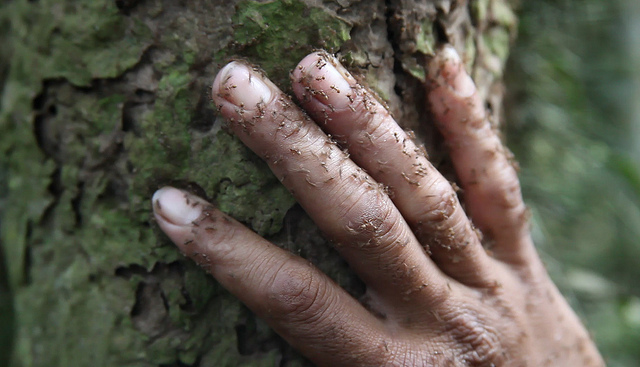
In the far west of the Brazilian Amazon reside some of the last indigenous tribes on Earth untouched by modern society. In 2002, writer and photographer Scott Wallace, on assignment for National Geographic magazine, undertook a three month journey through the Javari Valley Indigenous Land on an expedition to map and protect the territory of the flecheiros, or Arrow People, named for the poison-tipped arrows they use. Wallace turned the chronicles of his adventure into a book while in residence as a Public Policy Scholar at the Wilson Center.
On November 21, Wallace returned to the Center to present his finished book, The Unconquered: In Search of the Amazon’s Last Uncontacted Tribes.
Over the past 40 years, Brazil’s policies towards indigenous tribes have changed dramatically, said Wallace – from initially wanting to “civilize” tribes through contact, to a modern hands-off approach. He explained that globalization and demand for rubber in the twentieth century meant more contact with indigenous tribes and, ultimately, more upheaval. As a result, many tribes took up hostile attitudes towards outsiders and retreated as far into the wilderness as possible.
Today, the Brazilian Department of Isolated Indians is attempting to map out the extent of uncontacted peoples’ lands in order to better protect them from intrusion. Over the last eight years since the book was written, the official number of uncontacted tribes has increased from 17 to 26. Javari Valley alone hosts eight distinct ethnic groups, making it the largest concentration of uncontacted tribes in the world.
The leader of Wallace’s expedition, Sydney Possuelo, is an explorer who was formerly the head of the Department of Isolated Indians and once one of Brazil’s most famous sertanistas (“agents of contact”). Possuelo is now a champion of the vision that we should no longer contact tribes, said Wallace, but only “identify them and get legal protection for [their] lands and erect control posts to keep intruders out.”
Old Tensions, New Threats
Although Wallace holds up Brazil as one of the countries with the most enlightened policies for native Indians in the Americas, he said there is cause for concern as intrusions continue. As Wallace notes on his blog, isolated Indians are known to travel extensively by foot during the dry season, appearing along the riverbanks as they search for turtle eggs buried in nests along the sandy beaches of the western Amazon. Mounting pressure from logging crews, wildcat gold prospectors, and seismic teams exploring for oil and gas are flushing these isolated indigenes out of the forests.
During their trek to map the flecheiros, Wallace’s group ran into an illegal gold mining operation, and, although they managed to take the dredge to the local authorities, Wallace said he fears corruption may have stymied justice.
Rights-Based Conservation
On the positive side, Wallace pointed out that by protecting indigenous tribes, the government is also protecting tens of thousands of acres of virgin rainforest in what is a mutually beneficial intersection of conservation and human rights. “Indians are the rightful owners of the land and the most efficacious guardians of the rainforest,” he said.
While there are many obstacles threatening the survival of uncontacted tribes, Wallace said that the situation is not hopeless and that conservation through protecting indigenous-rights in Brazil is a good starting point. “When there is a commitment to do something and resources are made available,” he said, “what seems like inevitable development, like the overrunning of forests, can be stopped.”
Event ResourcesPhoto Credit: “Brazil Amazon adventure,” courtesy of jonrawlinson.


 A Publication of the Stimson Center.