Monthly archive for September 2011. Show all posts
-
SXSW Eco Panel: Three Great Ideas That Won’t Be On the Rio+20 Agenda
›By Schuyler Null // Friday, September 30, 2011
South by Southwest (SXSW) – the popular music, film, and alternative showcase – is moving into the green space with its first ever “eco” conference, kicking off next week, October 4, with more than 50 panels on “solutions for a sustainable world.” There’s one in particular though you should tune into: “Three Great Ideas that Won’t Be On the Rio Agenda,” featuring Geoff Dabelko, director of the Wilson Center’s Environmental Change and Security Program; Roger-Mark De Souza, vice president of research and director of the climate program at Population Action International; and Aimee Christensen, CEO of Christensen Global Strategies.MORE
The panel will feature discussion on three issues that will likely not be on the table at the Rio+20 UN Conference on Sustainable Development next year: integrated population, health, and environment development programs, climate adaptation as a path to peacebuilding, and how to get the private sector better involved in helping cope with climate change.
If you’re traveling down to Austin, “Three Great Ideas” is scheduled for Thursday, October 6 at 10am CST; if not, stay tuned for webcast information! -
Friday Podcasts:
Aaron Wolf on Water Management, Agriculture, and Population Growth in the Middle East
›By Russell Sticklor // Friday, September 30, 2011
In terms of groundwater depletion, “Yemen and Gaza are probably the two places worst off in the Middle East,” Aaron Wolf told ECSP in a recent interview. Wolf, a water expert and geography professor at Oregon State University, said population growth across the broader Middle East region has led to intensified groundwater pumping in recent years. This trend has raised the prospects for water-related conflict down the road, as countries drain their groundwater stocks faster than the aquifers can recharge. Potentially complicating matters further, said Wolf, is that most aquifers in the Middle East cross international boundaries.MORE
Despite the region’s history of water tensions, Wolf said the unprecedented level of demographic change currently being experienced across the Middle East is not necessarily a recipe for future confrontations over the resource, in part thanks to the existence of water-sharing agreements in the area. Nevertheless, mounting demand will likely force water-users across the region – especially within the agriculture sector – to change the ways they utilize the resource.
Accounting for 80 to 90 percent of total water usage in some Middle Eastern countries, agricultural operations have already been forced to adjust to the evolving water-access situation. While moving from flood irrigation to drip irrigation represents one policy option if sufficient funds are available, Wolf said doing away with local food production “is a path that a lot of countries are going to have to take” to ensure a relatively stable water supply for their populations’ drinking, cooking, and cleaning needs.
Wolf added that one frequently discussed but not entirely realistic option for addressing the region’s water-supply concerns involves desalination. To date, widespread deployment of the technology has been hampered by high costs and substantial energy requirements, although that hasn’t stopped a few countries in the region – among them the United Arab Emirates, Saudi Arabia, and Israel – from becoming partially reliant on converted fresh water.
Wolf maintained that desalination’s hefty price tag means the technology is useful only for urban population centers near the coast. Moving converted sea water further inland remains a non-starter, he said, because transporting it requires an enormous amount of energy (a cubic meter of water weighs a metric ton).
For the same reasons, Wolf asserted, using desalinated water for agriculture doesn’t seem to be in the cards any time soon. “Right now a cubic meter of desalinated water costs about 40 cents, and you can’t use that for agriculture unless it drops down to about 8 cents a cubic meter,” Wolf said. “So until you can irrigate with desalinated water, it really doesn’t go a long way towards mitigating the larger water crisis.”
The “Pop Audio” series is also available as podcasts on iTunes.
Sources: American University, International Food Policy Research Institute, World Bank. -
Dot-Mom / From the Wilson Center:
Women Leaders Urge Stronger Advocacy on Health and Public Policy
›By ECSP Staff // Thursday, September 29, 2011The original version of this article appeared on the Pan American Health Organization website.
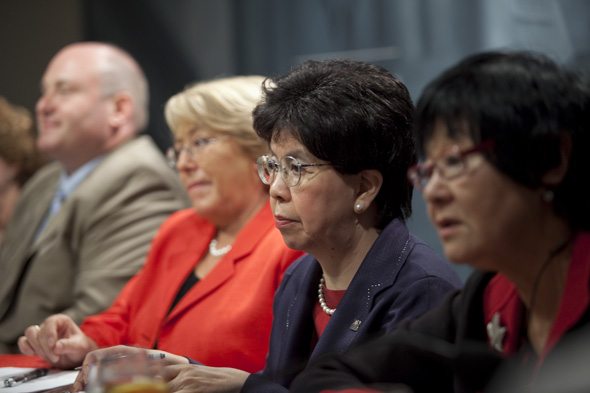
Women have made major strides toward greater equality in Latin America and the Caribbean, but stronger advocacy and leadership are needed to address problems they continue to face in health and other areas, said a group of top women health leaders at an event held at the Woodrow Wilson Center in Washington, D.C. on September 27.MORE
The event was part of a series of activities surrounding the 51st Directing Council meeting of the Pan American Health Organization/World Health Organization (PAHO/WHO), which is being held this week.
Dr. Michelle Bachelet, Executive Director of UN Women, noted that Millennium Development Goal (MDG) five, reduce maternal mortality, “is the one MDG that has advanced the least in our region and around the world.” She said it is now widely accepted that investing in women is not only an issue of human rights, it is also “the intelligent thing to do economically, politically, and socially. So why doesn’t it happen?” She said making it happen is the major leadership challenge facing women in health and public policy today. “We have to empower women to make the strongest case possible that investing in women is the best thing governments can do, and we have to help ministers of health make this same case with their governments.”
WHO Director-General Dr. Margaret Chan said that high levels of maternal mortality reflect “a failure of governments.” “We know how to prevent women from dying while giving birth. It’s a lack of political commitment, policies, and investments in the right areas. We need to get these issues out into the public, and we need to work with men who are enlightened to accomplish this,” she said.
Rocío García Gaytán, President of the Inter-American Commission of Women, said maternal mortality continues to be a major problem in the hemisphere despite the fact that it is almost completely preventable. She said that contrary to common belief, most maternal deaths take place in hospitals and are the result of a lack of proper training of medical personnel. “This problem should not exist in the second decade of this millennium,” she said.
PAHO Director Dr. Mirta Roses urged women to develop a leadership style that will effectively advocate for women’s top concerns, particularly social, economic, and political progress.
“What is different when women lead?” Roses asked. “We need to support each other and identify what we should do that is different from male models. We must all work together – UN Women, the Council of Women World Leaders – to define feminine leadership and promote it.”
Canada’s Minister of International Cooperation, Beverly Oda, said progress on public policies for women “took many years” to develop in Canada. Today, gender reviews of legislation are now mandatory for legislation, and promotion of gender equality is an integral part of Canadian technical cooperation programs.
Vice-Minister of Health Dr. Silva Palma de Ruiz of Guatemala described a number of initiatives in her country that have been successful in improving women’s health and status. They include joint efforts involving the health ministry, the public prosecutor’s office, the national human rights ombudsman, and civil society organizations to reduce sexual violence by empowering women to report violence and by more aggressive prosecution of perpetrators. PAHO/WHO has supported these efforts with technical assistance in developing guides for care of victims of sexual violence. Other efforts include a new family planning law and education of men and women as well as healthcare workers about women’s rights to use contraception.
Minister of Health Ann Peters of Grenada said that women of the Caribbean “are very vocal” and have had considerable success advocating for women’s health. In her own country, this has helped produce a highly effective comprehensive mother-child health program that includes strong community health services with well-trained midwives and good referral systems, breastfeeding-friendly hospitals, and universal voluntary testing of pregnant women for HIV. Thanks to these programs, Grenada has “no mother-to-child transmission of HIV and virtually no maternal mortality.”
Minister of Health Marcella Liburd of Saint Kitts and Nevis noted the importance of addressing the social determinants of women’s health. For example, in her country as elsewhere, the majority of people living in poverty are women. “We need to consider other aspects of women’s well-being,” she said, “including financial, social, and mental health.”
Paraguay’s Minister of Health, Dr. Esperanza Martinez, said it was important to address women’s concerns in an integral way. She described a new platform for discussing policies that affect women involving different government ministries, not just health. “Women need to participate as policymakers and also to influence policies from the outside,” she said.
Dr. Carmen Barroso, Western Hemisphere Director for the International Planned Parenthood Federation, said, “Civil society is ready to partner with ministries of health to advocate for more resources, legislation, and promotion of women’s sexual and reproductive rights.”
The event was organized by the Council on Women World Leaders, PAHO/WHO, the Wilson Center’s Environmental Change and Security Program, Global Health Initiative, and Latin America Program.
Event ResourcesPhoto Credit: David Hawxhurst/Wilson Center. -
Ethiopia’s 2011 Demographic and Health Survey: Remarkable Fertility Decline, Continued Rural Health Challenges
›Carl Haub, Behind the Numbers
By ECSP Staff // Wednesday, September 28, 2011The original version of this article, by Carl Haub, appeared on the Population Reference Bureau’s Behind the Numbers blog.
Continuing my recent practice of posting a quick summary of results from new demographic surveys in developing countries, here is another new Demographic and Health Survey (DHS) preliminary report, this time from a sub-Saharan African country. This will help readers of this blog to stay right up-to-date with the latest developments.MORE
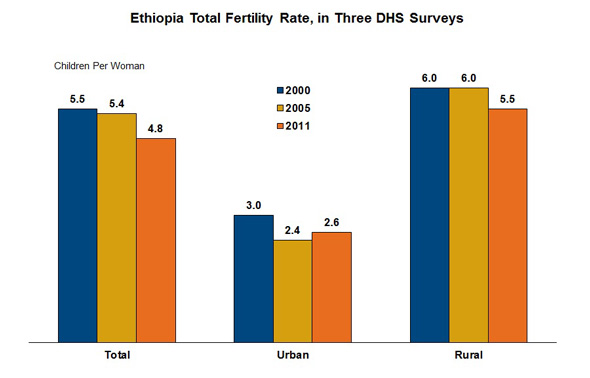
The Ethiopia 2011 DHS interviewed 16,515 women ages 15 to 49 and 14,110 men ages 15 to 59 from September 2010 to June 2011. The total fertility rate (TFR – the average number of children would bear in her lifetime if the birth rate of a particular year were to remain constant) obtained in the survey was 4.8 for the three-year period preceding the survey. For urban women, the TFR was 2.6 and for rural women, who were a little over 75 percent of the sample, 5.5. There appears to have been an acceleration of TFR decline from the 2005 to the 2011 survey compared with the 2000 DHS, which had a three-year TFR of 5.5. In 1990, a government survey had shown the TFR as 6.4. The desire to continue or cease childbearing provides one insight into possible future fertility trends. Of the women with five living children, 55.8 percent said that they did not wish to have any more children; among women with six or more living children, 68.6 percent said that they also wished to ceased childbearing.
Continue reading on Behind the Numbers.
Image Credit: Population Reference Bureau; data courtesy of Ethiopian Central Statistics Agency (CSA) and ICF Macro, Ethiopia Demographic and Health Survey (EDHS) 2011, Preliminary Report. -
From the Wilson Center:
Digging Deeper: Water, Women, and Conflict
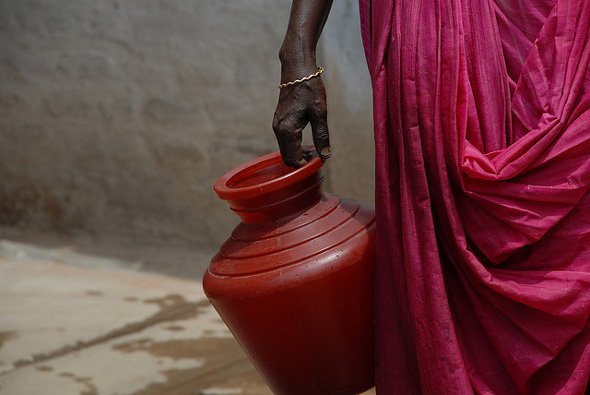
›By Theresa Polk // Tuesday, September 27, 2011It’s not just “carrying water from a water point, but it’s discharging responsibilities that a woman has for using and managing water which may make her vulnerable to violence and bring her into risky areas,” said Dennis Warner, senior technical advisor for water and sanitation at Catholic Relief Services (CRS), at the Wilson Center on August 29.
“It’s really like peeling an onion, quite frankly. All of these issues are embedded within one another,” said Sandra Ruckstuhl, a senior social scientist at Group W Inc. Ruckstuhl and Warner were joined by Carla Koppell, USAID’s senior coordinator for gender equality and women’s empowerment to talk about the relationship between gender, access to water, and violent conflict.MORE
Women: Water Users and Managers
The water for washing clothing, bathing, and general household use is often found in remote locations that may also be insecure. Women, who are primarily responsible for these activities, are therefore vulnerable to violence, including rape and kidnapping. This violence has far-reaching health, social, emotional, and economic impacts on the women themselves, but also has cascading effects on their households and communities.
Warner noted that the design of water systems frequently prioritizes technical efficiency and cost savings but fails to anticipate the vulnerability of women and children or other social considerations. “We need to institutionalize this knowledge on the protection of women in all development sectors, but especially in water, because water is such an obvious and leading edge of development that is subject to so many of these problems,” he said.
In planning water points, therefore, CRS attempts to both improve access and enhance protection of women and children. In Darfur, for example, by providing separate and more secure water points for pastoral and agricultural groups, they reduced both the risk to women and tension between groups.
Incorporating Social Factors
There is no linear progression from conflict to water access to gender dimensions that could lead to clear-cut interventions, said Sandra Ruckstahl; these issues “are nested within one another.” Citing case studies from India, the West Bank, and Gaza, she explored several factors that can impede water access in conflict situations, including the level of violence, state neglect, the role of non-state actors, and failure to build and/or maintain infrastructure. She also pointed to positive linkages, such as the case of Bosnia and Herzegovina, where an informal water management arrangement during the conflict created a foundation for post-conflict reconstruction.
Ruckstuhl indicated that access to water is “defined not just by physical and environmental factors, but also by social factors.” Therefore, interventions should be based on disaggregated data that analyzes the behaviors, priorities, and concerns of different user groups within a conflict area. Furthermore, practitioners should consider secondary impacts, including “other development implications, in terms of productive time for education or to contribute to the local economy.”
Gender Is Core Issue, Not a Sideline
“Too often when we are talking about issues related to women, or gender dimensions, within any development or conflict context, people think about it as a sideline,” said Carla Koppell. She emphasized the centrality of women to the conversation, both because they are profoundly vulnerable and because their vulnerability has a “ripple effect on the entire well-being of communities.”
According to Koppell, interventions should take into consideration the different roles of women and men, and how those roles evolve in conflict situations. She warned against viewing women solely as passive victims and emphasized the importance of leveraging women’s roles as leaders within their families and communities in the search for solutions.
“[W]hat we need to remember when we are talking about the nexus between water, conflict, and women, and I would say both women and gender issues as well, is that if we do a better job at building this into all of the interventions we’re working in…we will see better development results,” Koppell said. “I think we should all feel like this is quite core to our agenda…we should feel like it is a collective endeavor that we want to move forward together.”
Event ResourcesPhoto Credit: “Woman holding water vessel,” courtesy of flickr user waterdotorg. -
Remembrance: Wangari Maathai, Nobel Peace Prize Winner, Linked Environment and Conflict
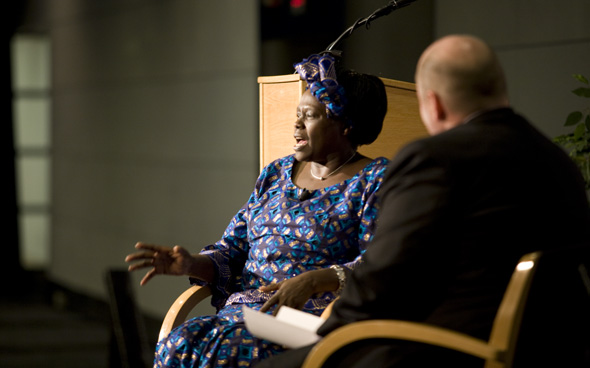
›By Schuyler Null // Monday, September 26, 2011Sad news today as Wangari Maathai, the first African woman and the first environmentalist to win the Nobel Peace Prize, has passed away in Nairobi. The Green Belt Movement, which Maathai founded in 1977, has planted over 30 million trees and advocates for what Maathai called the three essential components of a stable society: sustainable environmental management, democratic governance, and a culture of peace. [Video Below]
MORE
“Almost every conflict in Africa you can point at has something to do with competition over resources in an environment,” said Maathai during her visit to the Wilson Center in 2009:Unless you deal with the cause, you are wasting your time. You can use all the money you want for all the years you want; you will not solve the problem, because you are dealing with a symptom. So we need to go outside that box and deal with development in a holistic way.
Maathai’s message was molded from her experiences in Kenya and across sub-Saharan Africa in general. She was not shy about condemning African leaders and advocating for women in the political space. In ECSP Report 12, she wrote, “I come from a continent that has known many conflicts for a long time. Many of them are glaringly due to bad governance, unwillingness to share resources more equitably, selfishness, and a failure to promote cultures of peace.”
Importantly, though, Maathai advocated for addressing these issues in concert, not separately. She said at the Wilson Center:I can’t say, ‘Let us deal with governance this time, and don’t worry about the resources.’ Or, ‘Don’t worry about peace today, or conflicts that are going on; let us worry about management of resources.’ I saw that it was very, very important to use the tree-planting as an entry point.
A Message to the World
Some raised questions when Maathai won the Nobel Peace Prize in 2004 – the first awarded to someone from the environmental field – but the recognition was more than deserved, wrote Environmental Change and Security Program (ECSP) Director Geoff Dabelko on Grist:Maathai is on the front lines of the struggle over natural resources that fuels conflicts across the world. While there is no dramatic footage of tanks rumbling across borders or airplanes flying into buildings, the everyday fight for survival of those who depend directly on natural resources – forests, water, minerals – for their livelihoods is at the heart of the battle for peace and human security.
Maathai explained in Report 12 that she thought her winning of the prize was intended as a message to the world to “rethink peace and security.”
…
Elevating such a strong Southern voice – and one whose elephant’s skin bears the scars of the fight for peace – is a noble choice.
The Nobel Committee “wanted to challenge the world to discover the close linkage between good governance, sustainable management of resources, and peace,” she wrote. “In managing our resources, we need to realize that they are limited and need to be managed more sustainably, responsibly, and accountably.”
Sources: Grist, The New York Times.
Photo Credit: David Hawxhurst/Wilson Center. -
Reproductive Health’s Connection to Global Problems
›John Donnelly, Global Post
By ECSP Staff // Monday, September 26, 2011
The original version of this article, by John Donnelly, appeared on Global Post.
At a forum at the Rubin Art Museum earlier this week, a group of global leaders, including two top U.S. officials, talked about how reproductive health issues for women were wrongly cast as only a women’s issue.MORE
Instead, they said reproductive health was intimately connected to the world’s population boom, climate change, water and sanitation crises, economic downturns, educational rates, and development overall. And greater reproductive health rights would trigger a brighter future for the 600 million young women in the developing world, including the 10 million girls who are married before they reach the age 18, said the panelists, members of the Global Leaders Council for Reproductive Health of Aspen Global Health and Development.
And yet, reproductive health and family planning is generally not a focus on the world stage. In fact, the topic is often avoided.
“If you can help young women feel empowered, where they themselves want to delay pregnancy, they can become the actors in their own lives,” Maria Otero, U.S. Under Secretary of State for Democracy and Global Affairs said at the Rubin Museum of Art. “What this Council allows us to do is think about the issue of reproductive health, one that is interconnected to all other issues” related to development.
Continue reading on Global Post.
Image Credit: “Age at 1st marriage (women),” courtesy of ChartsBin; data courtesy of Gapminder. -
Eye On:
Gates and Winnefeld: Development a Fundamental Part of National Security
›By Kate Diamond // Friday, September 23, 2011
“As we’ve learned in Iraq and Afghanistan, reconstruction, development, and governance are crucial to any long-term success – it is a lesson we forget at our peril,” said Former Secretary of Defense Robert Gates in a video address commemorating the U.S. Agency for International Development’s 50th anniversary this fall. Gates was joined by Admiral James Winnefeld, Jr., the vice chairman of the Joint Chiefs of Staff, in a post on USAID’s Impact blog to reinforce the importance of development and USAID in particular to U.S. national security.MORE
USAID was created on November 3, 1961 as part of a total overhaul of U.S. foreign assistance by President Kennedy. From the start, President Kennedy understood that the agency would play a role not just in development abroad but in improving U.S. security as well.
The agency is marking its 50th anniversary in an environment where development and security are seen as perhaps more linked than ever.
Winnefeld described the work that USAID and the military do as going hand-in-hand, saying that “together, we play a critical role in America’s effort to stabilize countries and build responsive local governance.”
In country after country, Winnefeld said, “USAID’s development efforts are critical to our objective of creating peace and security around the world.” He added that “instability in any corner of today’s highly interconnected world can impact everyone. Development efforts prevent conflicts from occurring by helping countries become more stable and less prone to extremism.”
“For 50 years,” Gates said, “USAID has embodied our nation’s compassion, generosity, and commitment to advance our ideals and interests around the globe. It’s a commitment demonstrated every time this agency works hand-in-hand with communities worldwide to cure a child, build a road, or train a judge.”
“By improving global stability,” Winnefeld concluded, “USAID helps keep America safe.”
Sources: USAID.
Video Credit: USaidVideo. -

What If Experts Are Wrong On World Population Growth?
›Carl Haub, Yale Environment 360
By ECSP Staff // Thursday, September 22, 2011The original version of this article, by Carl Haub, appeared on Yale Environment 360.
In a mere half-century, the number of people on the planet has soared from 3 billion to 7 billion, placing us squarely in the midst of the most rapid expansion of world population in our 50,000-year history – and placing ever-growing pressure on the Earth and its resources.MORE
But that is the past. What of the future? Leading demographers, including those at the United Nations and the U.S. Census Bureau, are projecting that world population will peak at 9.5 billion to 10 billion later this century and then gradually decline as poorer countries develop. But what if those projections are too optimistic? What if population continues to soar, as it has in recent decades, and the world becomes home to 12 billion or even 16 billion people by 2100, as a high-end UN estimate has projected? Such an outcome would clearly have enormous social and environmental implications, including placing enormous stress on the world’s food and water resources, spurring further loss of wild lands and biodiversity, and hastening the degradation of the natural systems that support life on Earth.
It is customary in the popular media and in many journal articles to cite a projected population figure as if it were a given, a figure so certain that it could virtually be used for long-range planning purposes. But we must carefully examine the assumptions behind such projections. And forecasts that population is going to level off or decline this century have been based on the assumption that the developing world will necessarily follow the path of the industrialized world. That is far from a sure bet.
Continue reading on Yale Environment 360.
Image Credit: Data from UN Population Division, chart arranged by Schuyler Null. -
Reading Radar:
Broadening Development’s Impact: From Sustainability to Governance and Security
›By Kate Diamond // Thursday, September 22, 2011John Drexhage and Deborah Murphy’s UN background paper, “Sustainable Development: From Brundtland to Rio 2012,” looks at how “sustainable development” has evolved since the 1987 Brundtland Report first brought the concept to the forefront of the international community’s attention. Drexage and Murphy write that climate change has become a “de facto proxy” for sustainable development and they offer various recommendations for how policymakers and institutions can better integrate social and economic issues into a sustainable development framework. Considering that “increasing consumption, combined with population growth, mean that humanity’s demands on the planet have more than doubled over the past 45 years,” the authors conclude that “the opportunity is ripe” to bring “real systemic change” to how the world thinks about – and acts on – sustainable development.MORE
The World Bank’s World Development Report 2011 makes an argument for “bringing security and development together to put down roots deep enough to break the cycles of fragility and conflict.” The report gives an overview of the “interconnections among security, governance, and development” and offers recommendations on how understanding and addressing them can end cycles of violence. Just as Drexhage and Murphy point to population changes as a challenge for sustainable development, the World Bank notes that growing urbanization has “increased the potential for crime, social tension, communal violence, and political instability” locally while a threefold increase in refugees and internally displaced persons over the past 30 years has put strains on regional relations around the world. Though the report acknowledges that there’s no quick fix to any of these problems, the conclusion underlining the report’s findings is that “strengthening legitimate institutions and governance to provide citizen security, justice, and jobs is crucial to break cycles of violence.” -
From the Wilson Center:
Perfect Storm? Population Pressures, Natural Resource Constraints, and Climate Change in Bangladesh
›By Michael Kugelman // Wednesday, September 21, 2011Few nations are more at risk from climate change’s destructive effects than Bangladesh, a low-lying, lower-riparian, populous, impoverished, and natural disaster-prone nation. The UN Intergovernmental Panel on Climate Change estimates that by 2050, sea levels in Bangladesh will have risen by two to three feet, obliterating a fifth of the country’s landmass and displacing at least 20 million people. On September 19, the Wilson Center’s Asia Program, with assistance from ECSP and the Comparative Urban Studies Project, hosted a conference that examined Bangladesh’s imperiled environmental security.
MORE
Climate Change and Population
The first panel focused on manifestations, drivers, and risks. Ali Riaz addressed the threat of climate refugees. Environmental stress, he said, may produce two possible responses: fight (civil conflict or external aggression) or flight (migration). In Bangladesh, the latter is the more likely outcome. Coastal communities, overwhelmed by rising sea levels and flooding, could migrate to Bangladesh’s urban areas or into neighboring India. Both scenarios pose challenges for the state, which already struggles to provide services to its urban masses and has shaky relations with New Delhi.
Mohamed Khalequzzaman examined Bangladesh’s geological vulnerability in the context of climate change. In a deltaic nation like Bangladesh, he explained, sedimentation levels must keep up with rates of sea level rise to prevent the nation from drowning. However, sediment levels now fall below 5 millimeters (mm) per year – short of the 6.5 mm Khalequzzaman calculates are necessary to keep pace with projected sea level rises. He lamented the nation’s tendency to construct large dams and embankments in the Bengal Delta, which “isolate coastal ecosystems from natural sedimentation,” he said, and result in lower land elevations relative to rising sea levels.
Adnan Morshed declared that Bangladesh’s geographic center – not its southern, flood-prone coastal regions – constitutes the nation’s chief climate change threat. Here, Dhaka’s urbanization is “destroying” Bangladesh’s environment, he said. Impelled by immense population growth (2,200 people enter Dhaka each day) and the need for land, people are occupying “vital wetlands” and rivers on the city’s eastern and western peripheries. “Manhattan-style” urban grid patterns now dominate wetlands and several rivers have become converted into land. Exacerbating this urbanization-driven environmental stress are highly polluting wetlands-based brickfields (necessary to satisfy Dhaka’s construction needs) and city vehicular gas emissions.
Adaptation Responses
The second panel considered possible responses to Bangladesh’s environmental security challenges. Roger-Mark De Souza trumpeted the imperative of more gender-inclusive policies. Environmental insecurity affects women and girls disproportionately, he said. When Bangladesh is stricken by floods, females must work harder to secure drinking water and to tend to the ill; they must often take off from school; and they face a heightened risk of sexual exploitation – due, in great part, to the lack of separate facilities for women in cyclone shelters. He reported that such conditions have often led to early forced marriages after cyclones.
Shamarukh Mohiuddin discussed possible U.S. responses. On the whole, American funding for global climate change adaptation programs has lagged and initiatives that are funded often focus more on short-term mitigation (such as emissions reductions) rather than adaptation. She recommended that Washington’s Bangladesh-based adaptation efforts be better coordinated with those of other donors.
Mohiuddin also suggested that to convey a greater sense of urgency, Bangladesh’s climate change threats should be more explicitly linked to national security – and particularly to how America’s strategic ally, India, would be affected by climate refugees fleeing Bangladesh.Philip J. DeCosse highlighted Bangladeshi government success stories in the famed Sundarbans – one of the world’s largest mangrove forests. Officials have banned commercial harvesting in some areas of the forests and shut down a highly polluting paper mill. He also praised civil society and the media for bringing attention to the Sundarban’s environmental vulnerability. As a result of efforts such as these, the Sundarbans are “coming back,” he said, with mangrove species growing anew. Thanks to a range of actors – from the forestry department to civil society – these forests are also now being “governed more than managed,” said DeCosse.
The Sundarbans – click to view larger map.
DeCosse’s fellow panelists identified additional hopeful signs. Morshed shared a photograph of a green, pristine park in Dhaka. De Souza underscored how family planning programs have worked in Bangladesh in the past, with fertility rates declining considerably in recent years, and several speakers spotlighted efforts by civil society and the media to bring greater attention to Bangladesh’s environmental security imperatives.
Nonetheless, major challenges remain, and panelists offered a panoply of recommendations. Khalequzzaman called for a major geological study of soil loss and siltation. De Souza implored Bangladesh to ensure that women’s roles and family planning considerations are featured in climate change negotiations and adaptation policies. Morshed advocated for imposing urban growth boundaries and enhancing public transport in cities. And several speakers spoke of the need to pursue more effective natural-resource-sharing arrangements with India. Ultimately, in the words of De Souza, it may not be possible to eliminate Bangladesh’s “perfect storm” – but much can be done to calm it.
Event ResourcesMichael Kugelman is a program associate with the Wilson Center’s Asia Program.
Sources: UN.
Photo/Image Credit: “Precarious Living, Dhaka,” courtesy of flickr user Michael Foley Photography; “Impact of Sea Level Rise in Bangladesh,” courtesy of UNEP; and the Sundarbans courtesy of Google Maps. -
Eye On:
Loren Landau: We Need to Move Beyond Traditional Views of Migration
›By Theresa Polk // Tuesday, September 20, 2011
Addressing the role of subnational actors, from local governments to mining companies, is increasingly critical to understanding migration, said Loren Landau, director of the African Center for Migration and Society at the University of the Witwatersrand, in an interview with ECSP. These actors frequently exert more influence than national governments over human resources because they control the “space in which people live, the space in which they produce,” Landau said.MORE
Migration is most frequently seen as an aberration or a temporary coping mechanism, but this conception is outdated. According to Landau, “especially as rural livelihoods become less viable, movement will be the norm.”
Local and global actors must recognize that “people are moving, and they are moving to a whole range of new places,” he said. These new places will need attention and resources, but we will need to move beyond traditional views of migration in order to respond to the challenge. -
On the Beat:
Babatunde Osotimehin Answers Seven Questions on Population
›By Schuyler Null // Monday, September 19, 2011PSI’s Impact magazine has an interview up with UNFPA Executive Director Babatunde Osotimehin asking him seven questions about population. It’s not likely this will be the last seven-something-themed story as we approach October and the expected seven billion mark for global population, but Karl Hofmann, president and CEO of PSI, asks some good questions, including on the prospect of harnessing the “demographic dividend” and about the barriers facing more integrated development efforts – a critical topic in population, health, and environment (PHE) circles.
MORE
On the demographic dividend:Karl Hofmann: Demography can be a key to progress with the right policy environment in place, but it can also be a burden when we don’t have the right framework in place to take advantage of growing populations. Some have described this as the demographic dividend – growing populations as a potent driver of economic growth and development. Give us your perspective on that.
And on integrated development:
Babatunde Osotimehin: I spoke at the 17th African Union Summit this year and one of my messages was that we have the opportunity right now to take advantage of the demographic dividend of young people. It’s important for African governments to understand that they have a youthful population. Most of Africa is under the age of 35. If 85 percent of the African population is under 35, the implication is that you have to have education, social services, housing, all of that, tailored to meet the needs of this population.
Beyond that, given what we’ve seen with the Arab spring uprising and others in many parts of the developing world, young people who are out of work want education and economic opportunities. We want to appeal to member states to provide skills appropriate to development and also ensure that we have continuing conversations with young people about their reproductive health and rights so they can make the choices that will ensure they plan for their families.KH: There are lots of conversations going on in global health circles these days around the synergy of integration. From your perspective, what are the barriers to this integration?
Read the full interview on Impact.
BO: I think it’s bipolar. Some countries are satisfied with vertical programs. Others are resistant to changing their system at the request of a donor. One argument for integration is that you can have the one-stop shop situation where one, two, three trained providers can deliver services at the same time. These include integration of HIV counseling, testing and treatment with family planning, with health education for non-communicable diseases, with immunization for children or with maternity services.
When you look at the components of an integrated system, it is very easy to sell. In terms of investment, it makes sense for the governments to build and put this together. The supervision becomes a lot easier, and the training of health workers would then capture all of the skill sets that would be required. Some countries, like India, Ethiopia and Nigeria have started this kind of integration.
Sources: PSI.
Image Credit: Adapted from UNFPA. -
On the Beat:
Food Security and Conflict Done Badly…
›Edward Carr, Open the Echo Chamber
By ECSP Staff // Friday, September 16, 2011The original version of this article, by Edward Carr, appeared on Open the Echo Chamber.
Over at the Guardian, Damian Carrington has a blog post arguing that “Food is the ultimate security need.” He bases this argument on a map produced by risk analysts Maplecroft, which sounds quite rigorous:MOREThe Maplecroft index [represented on the map], reviewed last year by the World Food Programme, uses 12 types of data to derive a measure of food risk that is based on the UN FAO’s concept. That covers the availability, access and stability of food supplies, as well as the nutritional and health status of populations.
I’m going to leave aside the question of whether we can or should be linking food security to conflict – Marc Bellemare is covering this issue in his research and has a nice short post up that you should be reading. He also has a link to a longer technical paper where he interrogates this relationship…I am still wading through it, as it involves a somewhat frightening amount of math, but if you are statistically inclined, check it out.
Instead, I would like to quickly raise some questions about this index and the map that results. First, the construction of the index itself is opaque (I assume because it is seen as a proprietary product), so I have no idea what is actually in there. Given the character of the map, though, it looks like it was constructed from national-level data. If it was, it is not particularly useful – food insecurity is not only about the amount of food, but access to that food and entitlement to get access to the food, and these are things that tend to be determined locally. You cannot aggregate entitlement at the national level and get a meaningful understanding of food insecurity – and certainly not actionable information.
Continue reading on Open the Echo Chamber.
Image Credit: “Estimated food security conditions, 3rd Quarter 2011 (August-September 2011),” courtesy of the Famine Early Warning Systems Network (FEWS NET) and USAID. -
Eye On:
Development or Security: Which Comes First?
›By Kate Diamond // Friday, September 16, 2011
“Let’s take an area of conflict of great concern to us: Afghanistan. One of the very concrete questions is, do you invest your development efforts predominantly in the relatively secure parts of Afghanistan, which gives you more security gains in terms of holding them, or in the relatively insecure parts, where you’re most concerned with winning against the Taliban and the battle seems most in the balance?” With that question, Richard Danzig, the chairman of the board for the Center for a New American Security (CNAS), got to the heart of the issues being debated at a recent panel on development assistance and national security. MORE
The discussion, hosted on September 5 by the Aspen Institute in conjunction with the Brookings Blum Roundtable on Global Poverty, brought together Rajiv Shah, the administrator of the U.S. Agency for International Development; Susan Schwab, professor at the University of Maryland and former U.S. trade representative; Sylvia Mathews Burwell, president of the Bill and Melinda Gates Foundation’s Global Development Program; and CNAS’ Danzig. Most of the hour-long discussion was spent debating whether assistance could be successful in insecure situations (like Afghanistan), or if a place has to have some kind of stability before assistance can really take root and successfully spur development.
Short vs. Long term
Administrator Shah, not surprisingly, made the argument that development assistance is valuable in either instance. That said, he also strongly cautioned against overpromising what aid in a place like Afghanistan can accomplish, saying that “one big mistake we’ve made is to oversell what any civilian agency can do in an environment where there’s an active military campaign.” He pointed out that “it not only raises the cost of doing the work…but it also puts people at real risk.”
Danzig took a more aggressive tone, saying that “in the great majority of cases I think it is misleading and distortive to argue for development on the grounds that it will predominantly enhance security.” He argued that more often than not, security should be a prerequisite for development: “You need to distinguish cart and horse here…in most instances…the security needs to precede the development.”
Shah and Danzig, who dominated the panel, were more in sync about what development assistance can accomplish in longer-term scenarios, when security and stability are assured. Shah in particular spoke forcefully about development assistance over time, stressing that “in the long view, in the medium term, the development priorities are national security priorities.”
Enabling Success
However, Shah did warn that aid could fall short of our goals if it not carried out in a reliable way. “Stability and predictability of finance is the single thing that’s most highly correlated with good outcomes,” he said. When our aid to a country comes and goes unreliably, flowing one year and stopping abruptly the next, it’s much harder to have the kind of positive impact we want it to have, he explained.
“Through the years, where these questions have been debated back and forth, there has been one constant,” said moderator Jessica Tuchman Mathews, president of the Carnegie Endowment for International Peace. “We have always multiplied the objectives vastly beyond the resources – always.”
Video Credit: Aspen Institute.
Subscribe to: Posts (Atom)