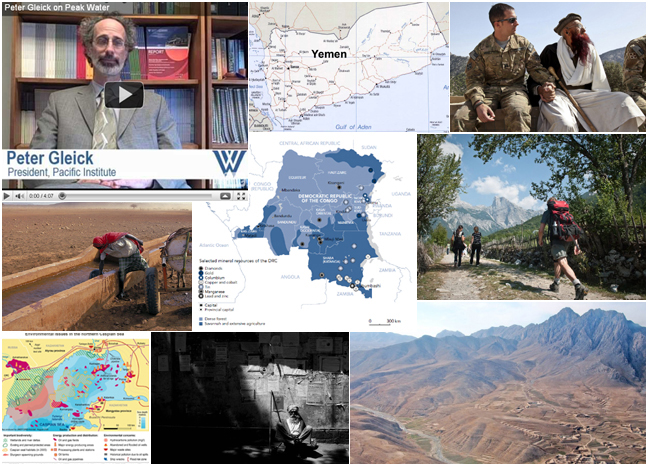
The New Security Beat’s 2010
top ten (measured by unique pageviews) included guest contributions from Marc Levy, Todd Walters, and the UK’s Royal Society, a post by West Point Cadet Marie Hokenson, a video feature with Peter Gleick, and posts on global enviro-security hot spots Afghanistan, India, the Democratic Republic of the Congo, and Yemen:
1. Watch: Peter Gleick on Peak Water
“The concept of ‘peak water’ is very analogous to peak oil…we’re using fossil groundwater. That is, we’re pumping groundwater faster than nature naturally recharges it,” says Peter Gleick in this short expert analysis from the Environmental Change and Security Program. Gleick, president and co-founder of the Pacific Institute and author of the newest edition of The World’s Water, explains the new concept of peak water.
2. Copper in Afghanistan: Chinese Investment at Aynak
Will new investments by the Metallurgical Corporation of China (MCC) in the Aynak copper mine break Afghanistan out of its poverty trap? Will future revenues from the subsoil assets in Logar Province bring peace and stability to the ongoing conflict?
3. DRC’s Conflict Minerals: Can U.S. Law Impact the Violence?
Apple CEO Steve Jobs, in a personal email posted by Wired, recently tried to explain to a concerned iPhone customer the complexity of ensuring Apple’s devices do not use conflict minerals like those helping to fund the civil war in the Democratic Republic of Congo. However much one might be tempted to pile on Apple at the moment, Mr. Jobs is on to something with regard to the conflict minerals trade – expressing outrage and raising awareness of the problem is one thing but actually implementing an effective solution is quite another.
4. India’s Maoists: South Asia’s “Other” Insurgency
The Indian government’s battle with Maoist and tribal rebels – which affects 22 of India’s 35 states and territories, according to Foreign Policy and in 2009 killed more people than any year since 1971 – has been largely ignored in the West. That should change, as South Asia’s “other” insurgency, fomenting in the world’s largest democracy and a key U.S. partner, offers valuable lessons about the role of resource management and stable development in preventing conflict.
5. On the Beat: Climate-Security Linkages Lost in Translation
A recent news story summarizing some interesting research by Halvard Buhaug carried the headline “Civil war in Africa has no link to climate change.” This is unfortunate because there’s nothing in Buhaug’s results, which were published in the Proceedings of the National Academy of Sciences, to support that conclusion.
6. Guest Contributor Todd Walters: Imagine There’s No Countries: Conservation Beyond Borders in the Balkans
International peace parks have captured the imagination of visionaries like Nelson Mandela, who called them a “concept that can be embraced by all.” Such parks—also known as transboundary protected areas—span national boundaries, testifying to the peaceful collaborative relationship between neighboring countries and to the co-existence of humans and nature.
7. Restrepo: Inside Afghanistan’s Korengal Valley
Restrepo, the riveting new documentary film from Tim Hetherington and Sebastian Junger, follows a platoon of U.S. soldiers deployed in the dangerous Korengal Valley of Afghanistan. As a cadet at West Point majoring in human geography, I was fascinated to watch the ways the soldiers confronted and adapted to the challenges posed by the local culture of the remote Afghan community surrounding their outpost.
8. UK Royal Society: Call for Submissions: “People and the Planet” Study To Examine Population, Environment, Development Links
In the years that followed the Iranian revolution, when Ayatollah Khomeini returned from exile to Tehran and the country went to war against Iraq, the women of Iran were called upon to provide the next generation of soldiers. Following the war the country’s fertility rate fell from an average of over seven children per woman to around 1.7 children per woman – one of the fastest falls in fertility rates recorded over the last 25 years.
9. Demographics, Depleted Resources, and Al Qaeda Inflame Tensions in Yemen
A second spectacular Al Qaeda attack on Yemeni government security buildings in less than a month is a worrisome sign that the terrorist group may be trying to take advantage of a country splitting at the seams. U.S. officials are concerned that Yemen, like neighboring Somalia, may become a failed state due to a myriad of challenges, including a separatist movement in the south, tensions over government corruption charges, competition for dwindling natural resources, and one of the fastest growing populations in the world.
10. Eye on Environmental Security: Visualizing Natural Resources, Population, and Conflict
Environmental problems that amplify regional security issues are often multifaceted, especially across national boundaries. Obtaining a comprehensive understanding of the natural resource, energy, and security issues facing a region is not fast or easy.
Photo Credit: Collage from individual posts (left to right, top to bottom): Peter Gleick courtesy of ECSP’s Youtube channel; “Yemen pol 2002,” via Wikimedia Commons courtesy of the U.S. Federal Government; “Mutual support,” courtesy of flickr user The U.S. Army; “KE139S11 World Bank,” courtesy of flickr user World Bank Photo Collection; “Mineral and Forests of the DRC” from ECSP Report 12, courtesy of Philippe Rekacewicz, Le Monde diplomatique, Paris, and Environment and Security Institute, The Hague, January 2003; IPPE/Cory Wilson; “Environmental Issues in the Northern Caspian Sea,” courtesy of the Environment & Security Initiative; “Wandering Aesthetic” courtesy of flickr user Wen-Yan King; and “River and Mountains of Logar,” courtesy of flickr user AfghanistanMatters.

 A Publication of the Stimson Center.