In a report sponsored by the
Stanley Foundation and the
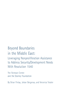
Stimson Center, authors Brian Finlay, Johan Bergenas, and Veronica Tessler discuss the implications of what a growing population and dwindling water supply will have on the people and governments of the Middle East. In the report, titled “
Beyond Boundaries in the Middle East: Leveraging Nonproliferation Assistance to Address Security/Development Needs with Resolution 1540,” the authors point out that while the Middle East has six percent of the world’s population, it has only 0.7 percent of the world’s fresh water resources. This supply is expected to be halved in the coming decades due to “rapid population growth and increased standards of living in urban areas.” To make up for this shortfall, governments are turning to nuclear-powered desalination technology, which poses risks to the nonproliferation movement and the safety and stability of the region.
(Editor’s note: for more on water as a strategic resource in the Middle East, see CSIS’ latest report.)
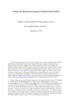
A recent study by Richard Nielsen, Michael Findley, Zachary Davis, Tara Candland, and Daniel Nielson from Bringham Young University examines the relationship of severe decreases in foreign aid to inciting violence among rebels in recipient countries. The study, “Foreign Aid Shocks as a Cause of Violent Armed Conflict”, examines aid shocks in 139 countries from 1981-2005. The authors find that when a donor country cuts off or suddenly limits aid due to economic or political reasons, this volatility upsets the status quo and gives strength to rebel groups who play upon the government’s inability to deliver adequate resources to the population. Instead of a sudden or sharp withdrawal in aid, Nielsen et al conclude that “if donors decide to remove aid, they should do so gradually over time because sudden large decreases in aid could be deadly.”

 A recent study by Richard Nielsen, Michael Findley, Zachary Davis, Tara Candland, and Daniel Nielson from Bringham Young University examines the relationship of severe decreases in foreign aid to inciting violence among rebels in recipient countries. The study, “Foreign Aid Shocks as a Cause of Violent Armed Conflict”, examines aid shocks in 139 countries from 1981-2005. The authors find that when a donor country cuts off or suddenly limits aid due to economic or political reasons, this volatility upsets the status quo and gives strength to rebel groups who play upon the government’s inability to deliver adequate resources to the population. Instead of a sudden or sharp withdrawal in aid, Nielsen et al conclude that “if donors decide to remove aid, they should do so gradually over time because sudden large decreases in aid could be deadly.”
 A Publication of the Stimson Center.