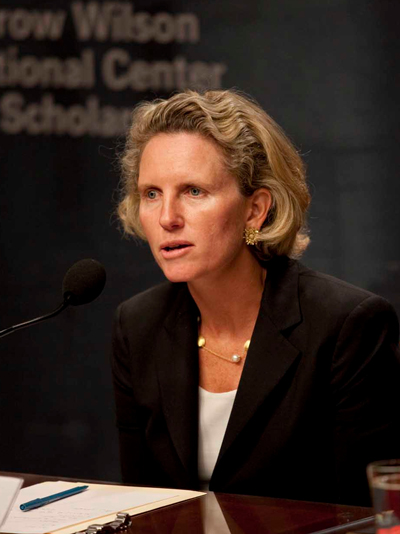
Isobel Coleman, senior fellow for U.S. foreign policy at the Council on Foreign Relations, said she believes
demographic changes are intensifying the notion that women’s empowerment is key to the growth and prosperity of the economies of Arab and Muslim-majority countries.
Coleman, author of the book
Paradise Beneath Her Feet: How Women Are Transforming the Middle East,
spoke at the Wilson Center in October, with Haleh Esfandiari moderating.
In addition to the Middle East’s demographics, Coleman also discussed how women in these traditional societies face challenges expanding their roles because women’s rights are often seen in a negative light. Coleman noted that things are changing, however, because women in the Muslim world are turning towards an Islamic discourse, which allows them to expand their rights within society’s religious framework. With this tactical shift and gradual gains in education, Coleman explained how women are slowly yet steadily transforming their societies.
Coleman began her talk by focusing on the demographic changes in the region, noting that 50 percent of the Arab world’s population is under the age of 22. Furthermore, education was once the exclusive preserve of men in many Arab and Muslim states (in some cases, only decades ago). Today, however, women often constitute the majority of those enrolled in these countries’ educational institutions: Females outnumber males in Jordan’s secondary schools and constitute 70 percent of all university students in Iran. While the levels of educational attainment and achievement among women are increasing, normative and legal restrictions on their socioeconomic mobility remain. Coleman indicated that this contradictory scenario has led to greater opposition to impediments to women’s equality.
Coleman went on to address the tactics being used by the latest generation of reform-minded women in the Muslim world. She said today’s reformist women are more cognizant of the religious conservatism in their societies and are taking on religion in a way earlier feminists did not. By making feminist arguments from an Islamic perspective they avoid being “slandered” by conservatives and traditionalists as pro-Western or anti-Islamic. Coleman noted that some women adopt such a stance out of deep religious conviction, while others do it in the name of expediency. She indicated this new strategy of compromise has given more women influence in social affairs and led to significant engagement with governments.
With the advent of new social media and technology, women have become more visible and able to express their opinions about previously taboo gender-related issues. Female journalists and bloggers are more stridently supporting feminist discourses. Coleman mentioned Sweet Talk, the Arabic language equivalent of the American television show, The View, on which the female co-hosts have addressed topics such as polygamy, rape, incest, and the Saudi prohibition on women driving.
According to Coleman, these factors of change – demographic transitions, the role of media, and an awareness of growing extremism in society – are contributing to women making strides in the region and a “wearing away” of gender inequality in the Muslim world. Given the gains women have made so far, Coleman said she is “cautiously optimistic” for the future.
Luke Hagberg is an intern with the Middle East Program at the Wilson Center; Haleh Esfandiari is the director of the Middle East Program.
Photo Credit: Yemeni women in computer class, courtesy of flickr user World Bank Photo Collection, and David Hawxhurt/Wilson Center.


 A Publication of the Stimson Center.