 Q:
Q: Foreign assistance has had major achievements over the past 50 years. What are some examples?
SEWELL: There have been many but off the top of my head I can think of three. First, the Green Revolution where the combined efforts of American aid and private foundations revolutionized agriculture in Asia. As a result, many more people lived a much longer time. Second, the efforts put into improving education, particularly of women and girls. The third is population growth. When I started working on development, the best predictions said that global population would rise to over 20 billion at the end of the 20th century. Now we know it will not go much above 9 billion and perhaps lower. That wouldn’t have happened without American leadership and funding.
Q: What are the major failures of foreign assistance?
SEWELL: Failures have occurred either because countries were not committed to development, or because aid agencies designed ineffective programs. But most major failures came about because aid was provided for political reasons— for Cold War purposes in Southeast Asia or the Middle East, not for economic and social development. And we should remember that promoting development is a risky business. If there were no failures, development agencies were being too cautious.
But the more important failures are at the strategic level. Assistance really is only effective when governments and leaders want to speed economic growth, improve health and education, and address poverty. When the government isn’t committed to development, a lot of aid is wasted.
That’s why the choice of countries is so important. Korea is one example. Korean leaders knew how to use foreign aid effectively to build agriculture and industry. Part of that assistance funded investments in health and education. We all know the result.
Egypt, on the other hand, also has received large amounts of American assistance since 1979. But its growth rates are low and they still have one of the highest rates of adult illiteracy in the world.
Perhaps the largest failure has been in Africa. Except for a small number of countries, Africa lags far behind other regions. The blame lies not just with African leaders but also with aid donors who have continued to provide assistance in ways that hinder development.
Q: In what ways can global poverty be reduced quickly in the next three to four years?
SEWELL: In the short term, it won’t happen. The global financial crisis makes that a certainty.
The best estimates are that up to 90 million people will fall back into poverty because they will have lost jobs and livelihoods. The most important thing the U.S. can do in the near term is to continue to lead the reform of the international financial systems that are essential to restarting global economic growth, particularly in the developing world.
Q: That’s the way to reduce poverty?
SEWELL: In the short term, yes. But the U.S. can target aid to build poor peoples’ capacities and can make a great difference. That means aid for education, especially women, and to enable poor people to improve their health. And jobs are critical.
I think the right goal is to empower people to move into the middle class.
That means helping to provide technical assistance and in making low-cost credits for both farmers and small scale entrepreneurs. They will be the generators of jobs that enable men and women to move out of poverty.
Q: Why do you say in one of your papers that economic growth alone will not eliminate poverty?
SEWELL: Because it’s true. Growth does not automatically diminish poverty; it has to be complemented by government actions to share the gains from growth by investing in better health and education. For this you also need a competent state. That’s how the East Asian countries managed to develop so successfully. On the other hand, many Latin American countries have grown at decent rates but have lousy income distribution. But now countries like Brazil are starting to change. For instance, the Brazilian government now pays mothers to keep their children in school where they can get education and health care.
Q: USAID has restrictions that inhibit advertising. How can the public and Congress be informed about the successes and importance of development assistance?
SEWELL: USAID has been very timid about educating the public and Congress. I am not even sure that the earlier successful programs of development education exist anymore. Some steps are easy.
USAID staff knows a lot about development. Why not send them out to talk to public groups around the country? USAID staff doesn’t even participate actively in the yeasty dialogue on development that goes on in the Washington policy community and they should be encouraged to do so. Other changes may require funding and perhaps legislation and the administration should work with the Congress to get them.
Informing the public is particularly important now when there are two major processes underway to modernize U.S. development programs and Congress is rewriting the development assistance legislation.
Q: Since China and Vietnam have both developed without democracy, how important is it to push for democracy and good governance? Are they really necessary?
SEWELL: We need to separate democracy and governance. Very few of the successful developing countries have started out as democracies; India is the big exception. On the other hand, all of the successful countries have had effective governments to do what governments should do: provide security and public goods like health and education, establish the rule of law, and encourage entrepreneurship.
We need to face the fact that no outsider, including the U.S., can “democratize” a country. But it can play an important role in helping to improve governance in committed poor countries. And one of the important parts of successful development is what a Harvard economist calls “conflict mediating institutions” that allow people to deal with the inevitable conflicts that arise within successful development.
Q: You have said that we need to make markets work. How can we help poor people begin to trade when Europe, Japan, and the United States either block imports or subsidize exports?
SEWELL: If you are serious about development, you have to give high priority to trade policy. Unfortunately, USAID seems to have very little voice in trade decisions.
The U.S. needs to focus its development trade policy on the poorest countries. The highest priority should be dropping the remaining subsidies for U.S. production of highly subsidized agricultural products like cotton that can be produced very competitively in very poor countries.
But many of these countries have difficulty selling goods in the U.S., not only because of subsidies, but also because they are not equipped to export. Transport costs are high as are the costs of meeting U.S. health and quality standards, and knowledge of marketing in America is scarce.
Here’s where USAID can play an important complementary role. U.S. companies are already providing technical assistance, some with USAID support. But USAID can expand its trade capacity building programs and focus them on the poorer countries.
Q: What about microcredit?
SEWELL: Microcredit is a very important innovation, especially for empowering poor people, particularly poor women. It’s part of the solution to ending poverty.
But there are other needs. In most poor countries, there are large groups of poor entrepreneurs who are not poor enough to get microcredit but who can’t get commercial banks to lend to them. These are people who produce products for sale— handbags, for instance—that employ 10 to 20 people, but they need capital and advice in order to grow. In the U.S., small businessmen used to borrow money from local banks.That’s how America grew. But similar institutions don’t exist in many poor countries.
Q: We are involved in so many different programs—20 or 30 different federal agencies do some sort of foreign assistance— why not just invest in education and health and let each country figure out what their own development plan should be?
SEWELL: A very good idea. I have long advocated that the U.S. should focus its programs on a few major development issues but I would go beyond just health and education. I add climate change and dealing with global health threats. We dodged the bullet on SARS [severe acute respiratory syndrome] and avian flu but we may not be so lucky in the future. And strengthening governance and strengthening weak states is essential.
The real need now is for some mechanism that oversees and coordinates the multiplicity of agencies that have programs and expertise on these critical issues. Let’s hope that emerges from the current administration’s reviews of development policy
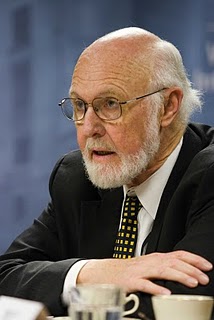
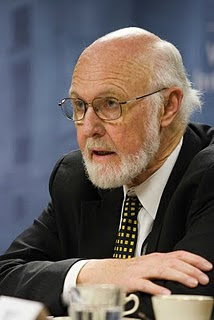
John Sewell a senior scholar at the Woodrow Wilson International Center for Scholars, was interviewed by FrontLines Editorial Director Ben Barber. Originally published in USAID FrontLines, April 2010.
Topics:
Africa,
Asia,
climate change,
development,
family planning,
foreign policy,
funding,
gender,
global health,
population,
poverty

 A Publication of the Stimson Center.