

Monthly archive for July 2009. Show all posts
-
Senate, Pentagon Focus on Climate-Security Challenges
›July 31, 2009 // By Brian Klein “Climate change may well be a predominant national security challenge of the 21st century, posing a range of threats to U.S. and international security,” said Sharon Burke, vice president for Natural Security at the Center for a New American Security (CNAS). Her remarks at a July 21 Senate Foreign Relations Committee hearing on climate change and security—along with those of two retired vice admirals and former Senator John Warner—amplified the growing chorus of national security experts and military personnel urging Congress to act promptly to address the security implications of climate change.
Vice Admiral Lee Gunn, USN (Ret.), called climate change “a clear and present danger to the United States of America,” while Burke cited a 2007 report from the Center for Naval Analysis that defined climate change as a “threat multiplier.”
Security Link Could Push Senate Climate Bill
Senator John Kerry, chair of the Senate Foreign Relations Committee, scheduled last week’s hearing on climate’s security links in a bid to bolster support for congressional action on climate change, which is currently stalled in the Senate. “Just as 9/11 taught us the painful lesson that oceans could not protect us from terror, today we are deluding ourselves if we believe that climate change will stop at our borders,” he said.
Former Senator John Warner echoed this sentiment, noting that the hearing was an opportunity to “educate the American public on these potential risks to our national security posed by global climate change.”
“Leading military, intelligence, and security experts have publically spoken out that if left unchecked, global warming could increase instability and lead to conflict in already fragile regions of the world. If we ignore these facts, we do so at the peril of our national security and increase the risk to those in uniform who serve our nation,” stated Warner, who recently launched the Pew Project on National Security, Energy, and Climate with the Pew Environment Group.
Pentagon Looks to Reduce Reliance on Oil and Drive Innovation
Burke explained that the phenomenon will not only pose “direct threats to the lives and property of Americans” from wildfires, droughts, flooding, severe storms, the spread of diseases, and mass migrations, but will also have “direct effects on the military,” including problems with infrastructure and the supply chain.
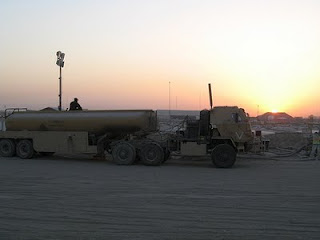
As a massive consumer of energy—110 million barrels of oil and 3.8 billion kilowatts of electricity in 2006 alone—the Pentagon has recognized its vulnerability to disruptions in fossil fuel supplies, as well as its potential to develop alternative technologies. As ClimateWire’s Jessica Leber writes in the New York Times: “The long logistics ‘tail’ that follows troops into the war zone—moving fuel, water and supplies in and waste out—risks lives and diverts major resources from fighting.”
According to Leber, two-thirds of the tonnage in Iraq convoys was fuel and water. To mitigate such vulnerability in the future—not to mention in arid, mountainous Afghanistan—DoD has begun testing ways to turn waste into energy, distribute power through “microgrids,” develop jet fuel from algae, desalinate water using little energy, and purify wastewater on a small scale.
“While the military by itself won’t make a market for plug-in vehicles or algae-based jet fuel,” notes Leber in an earlier ClimateWire article, “its investment power can bump emerging climate-friendly technologies onto a larger commercial stage.”
At the hearing, Burke warned against the possible knock-on effects of switching dependence from fossil fuel to other resources like lithium for lithium-ion batteries in electric cars.
The Military Must Manage Uncertainty
Vice Admiral Dennis McGinn, USN (Ret.), a member of the CNA’s Military Advisory Board, dismissed the argument that climate data and projections are too uncertain to form a solid basis for action. “As military professionals,” he told the Senate committee, “we were trained to make decisions in situations defined by ambiguous information and little concrete knowledge of the enemy intent. We based our decisions on trends, experience, and judgment, because waiting for 100% certainty during a crisis can be disastrous, especially one with the huge national security consequences of climate change.”
“The future has a way of humbling those who try to predict it too precisely,” Kerry said at the hearing. “But we do know, from scientists and security experts, that the threat is very real. If we fail to connect the dots—if we fail to take action—the simple, indisputable reality is that we will find ourselves living not only in a ravaged environment, but also in a more dangerous world.”
Photo: A convoy of the U.S. Army’s 515th Transportation Division moves fuel around Baghdad, Iraq. Courtesy Flickr user heraldpost. -
Weekly Reading
›A Population Reference Bureau (PRB) policy brief considers several methods of integrating population, health, and environment initiatives in Uganda, citing the Ruhiira Millennium Village Project and the Conservation Through Public Health program as successful examples. Also new from PRB: Farzaneh (Nazy) Roudi explains that Iran’s “youth bulge, along with changes in women’s fertility and reproductive health, provide a backdrop for understanding Iran’s current political instability.”
In “Military vs. Climate Security: Mapping the Shift From the Bush Years to the Obama Era,” Miriam Pemberton of the Institute for Policy Studies compares U.S. government spending on climate change and military, arguing for dedicating more resources to climate security.
A new report from Global Witness reveals that all main warring parties in the eastern Democratic Republic of the Congo—including rebel groups and members of the Congolese national army—are heavily involved in the mineral trade in North and South Kivu provinces.
In the Spring 2009 edition of The New Atlantis, Kendra Okonski asks if water is a human right, while Travis Kavulla looks at “Aids Relief and Moral Myopia” in Africa, arguing that the Western public-health lobby “must realize that HIV has a social dimension that must be addressed.” -
Who Does Development? Civil-Military Relations (Part I)
›USAID convened a study group to determine the future civil-military relationship between USAID and the Department of Defense. Two members of the study group, Dr. Frederick Burkle and Dr. Gene Bonventre, offer their thoughts.In the first decade of the new millennium, the relationship between the Department of Defense and civilian governmental agencies and NGOs has been a rollercoaster ride. At the high point of civil-military cooperation—the response to the Kurdish refugee crisis after the first Iraq war—the U.S. military provided security, access, and logistics, while USAID and NGOs provided direct assistance and expert advice to the 800-pound uniformed gorilla.
-
Who Does Development? Civil-Military Relations (Part II)
›USAID convened a study group to determine the future civil-military relationship between USAID and the Department of Defense. Two members of the study group, Dr. Frederick Burkle, Jr., and Dr. Eugene Bonventre, offer their thoughts.
The success of all interventions and relief efforts in conflict and post-conflict situations is dependent on politics and political action. For the United States, political action translates into military action. During my career, I’ve been involved in five conflict situations with the U.S. military, and each one made a different claim and set different restrictions for intervening with “aid.”
In the 1990s, after several frustrating years of failures, many in government believed that humanitarian assistance without political solutions achieved nothing. In good Wilsonian fashion, they saw political action—and the military interventions that followed—as a means to project, influence, and spread U.S. values. As such, the military became the security and protection tool of political humanitarianism, especially among those who considered that the convergence of humanitarian actors with the military ensured that the duty to provide assistance and the right to receive it was guaranteed.
The Kurdish crisis after the Persian Gulf War was instrumental for many reasons. One, it was the first time the Security Council did not veto a resolution to protect vulnerable populations within a sovereign state. Two, it was considered in most circles to be a success, because the coalition led by the U.S. military was considered by the humanitarian community to have been an ally in the struggle to provide security and assistance. The military presence allowed the humanitarians to work in an austere environment and to save lives.
What happened afterwards is a different story. Influenced by the post-9/11 global war on terrorism, increasingly insecure conflict environments, and the unilateral approach to conflict management, the military began to provide direct assistance to the population themselves. Liberties were taken: NGOs were recruited as “force multipliers,” “a second front,” or “part of our combat team.” The traditional leaders of humanitarian assistance and disaster relief, the Red Cross and the UN’s Office for Coordination of Humanitarian Affairs, were ignored. A “partnership” of the U.S. military-political command, the World Bank, corporate contractors, and like-minded NGOs dominated the scene.
In the last four months I’ve been confronted by two retired generals. One strongly insisted that the military must “stay within their lane” or risk destroying the military and supporting the perception of a U.S. politico-military “empire.” The other strongly insisted that the only entity in the world that could do humanitarian assistance and disaster relief is the U.S. military
So who should be leading these efforts for the United States? USAID, which was decimated in the 1980s, has never come back. The more than 12,000 USAID professionals during the 1960s-70s now number only 2,000. Reestablishing USAID’s place in development and relief will take much money, time, and expertise.
In the meantime, the only show in town, DoD, grows even larger and stronger. Gates’ statement that more civilians are needed in Afghanistan and Pakistan was actually a request for more “civilians” to be coordinated by the military.
It is not unusual to find those who think that the politico-military “relief and reconstruction complex” is impossible to change, especially when they are favored by Congress over USAID and State to solve these problems. But if “outcome indicators” rather that the current DoD-dominated “achievement indicators” were used to measure success, they would tell a totally different story.
In the last few years, the argument that such efforts are essential to “winning the hearts and minds” of a population has come out of nowhere. This claim is not grounded in accepted measures that monitor and evaluate such success. Yet the defense budgets that are heavily supported by Congress are based on achievement indicators alone.
President Obama does not come to the table with a strong and substantive knowledge or experience with the nuances of foreign assistance and the critical importance of the traditional humanitarian community. He is currently hearing only voices from the military and industry on this issue. We owe it to both the humanitarian community and the military to ensure that evaluation of their effectiveness is transparent, accountable, and evidence-based.
Current USAID leadership, short of a named Administrator, must speak up. The opportunity to reestablish USAID’s role in development and humanitarian assistance may never come this way again.
Dr. Frederick M. Burkle, Jr., is a professor and senior fellow with the Harvard Humanitarian Initiative, Harvard University; a senior public policy scholar at the Woodrow Wilson Center; and a retired Navy Reserve Captain and combat decorated for service with the U.S. Marines. -
Weekly Reading
›“The natural resources are being depleted at an alarming rate, as population pressures mount in the Arab countries,” says the 2009 Arab Human Development Report, which was published this week by the UN Development Programme. A launch event in Washington, DC, features New York Times columnist Tom Friedman and Wilson Center scholar Robin Wright.
A special issue of IHDP Update focuses on “Human Security in an Era of Global Change,” a synthesis report tied to the recent GECHS conference. Articles by GECHS members, including Karen O’Brien and Alexander Lopez, address water and sanitation, the global financial crisis, poverty, and transborder environmental governance in Latin America.
An op-ed by Stanley Weiss in the New York Times argues that the best way to bring water–and peace–to the Middle East is to ship it from Turkey. A response by Gabriel Eckstein in the International Water Law Project blog argues that “transporting water from Turkey to where it is needed will require negotiations of Herculean proportion.”
CoCooN, a new international program sponsored by The Netherlands on conflict and cooperation over natural resources, recently posted two powerpoint presentations explaining its goals and the matchmaking workshops it will hold in Addis Ababa, Bogota, and Hanoi. The deadline for applications is August 5.
Two new IFPRI research papers focus on the consequences of climate change for poor farmers in Africa and provide policymakers with adaptation strategies. “Economywide Impacts of Climate Change on Agriculture in sub-Saharan Africa” analyzes two possible options for the region. “Soil and Water Conservation Technologies: A Buffer Against Production Risk in the Face of Climate Change?” investigates the impact of different soil and water conservation technologies on the variance of crop production in Ethiopia. -
Clinton, Congress Link Family Planning, Climate Change
›July 24, 2009 // By Meaghan ParkerEarlier this week in New Delhi, Secretary of State Hillary Clinton praised an “enlightening” roundtable discussion with India’s minister of environment for opening her eyes to climate change’s links to population and family planning.
“One of the participants pointed out that it’s rather odd to talk about climate change and what we must do to stop and prevent the ill effects without talking about population and family planning. That was an incredibly important point. And yet, we talk about these things in very separate and often unconnected ways,” said Clinton.
Congress is taking steps to tackle this issue. The version of the bill approved by the Senate Appropriations Committee last week links family planning and reproductive health to climate change.
On page 153, $628 million is alloted for “family planning/reproductive health, including in areas where population growth threatens biodiversity or endangered species or exacerbates human vulnerability to the effects of climate change.”
In addition, in the report accompanying the bill, the Senate committee “directs USAID to review the relationships between population growth and climate change to determine how experience in implementing population-environment activities applies to climate change adaptation and to efforts to increase the resilience of local communities to climate change.”
These comments certainly increase the volume on this overlooked link. Some background resources that might help those new to the discussion:- In the latest ECSP Report, Suzanne Petroni of the Summit Foundation proposes some ethical ground rules, calling for “a thoughtful and deliberative dialogue around voluntary family planning’s contribution to mitigating climate change.”
A recent PAI factsheet points out that “areas of high population growth and high vulnerability to climate change impacts overlap.” - Another handy factsheet includes a brief description of how community-based programs that integrate population-environment activities can strengthen resilience and reduce vulnerability to the effects of climate change.
- PAI’s working paper “Projecting Population, Projecting Climate Change” warns that “population growth is not adequately accounted for in the emissions scenarios” used by the IPCC.
- The Center for Global Development’s David Wheeler recently argued that family planning could be a relatively inexpensive part of solving the climate crisis.
- A paper in Global Environmental Change estimates the extra emissions of fossil carbon dioxide that an average individual in the United States causes when he or she chooses to have children.
- In the latest ECSP Report, Suzanne Petroni of the Summit Foundation proposes some ethical ground rules, calling for “a thoughtful and deliberative dialogue around voluntary family planning’s contribution to mitigating climate change.”
-
Summer in the City: Water Supplies Fall and Tempers Flare in South Asia
›July 22, 2009 // By Elizabeth HippleThree people died in the city of Bhopal, in north-central India, in a battle between neighbors for scarce water, The Guardian reported this past week.Fights regularly broke out when the water tankers that serve 100,000 of the city’s residents make their deliveries.
The monsoon this year produced less rain than usual, exacerbating a drought. In addition, the number of people in Bhopal’s slums is growing. “The population has increased, but the water supply is the same,” a local committee chairman told The Guardian.
The northern parts of India were hardest hit, but much of India experienced similar conditions, including the city of Mumbai. Officials there cut water supplies for the city by 30 percent when the levels of the five lakes that serve as Mumbai’s primary sources of water dropped dangerously low.
But while heavy rains in the last few days mostly restored supplies, they also shut down the waterlogged city, reviving fears of 2005’s deadly floods. According to a new book and exhibit by University of Pennsylvania architects, the sprawling city has paved over the mangrove wetlands that protect it from flooding.
Pollution, climate change, population growth, urbanization, and industrialization in the world’s developing countries continue to increase demand for its finite water supplies. Today, 700 million people live in countries experiencing water scarcity or stress; by 2035, that figure is expected to have reached 3 billion people, or almost half of the world’s population. Asia, with 60% of the world’s population but only 36% of the world’s freshwater, will be particularly hard hit.
The problems vary across South Asia. The rivers around Dhaka, Bangladesh, are so polluted from industrial dumping that specialists are saying the situation is beyond repair. Lack of access to clean water and knowledge about hygienic sanitation practices leads to thousands of preventable deaths from diarrhea every year in Nepal. In Karachi, Pakistan, stealing public water out of pipes and tankers is a $500 million industry, “a mark of the state’s decreasing capacity to provide for its own,” reports Bill Wheeler in a special report in GOOD magazine.
The Indus Waters Treaty of 1960 between India and Pakistan has long been hailed as an example of the cooperation that can result from the necessity of sharing such an essential resource across borders. But with climate change causing the Himalayan glaciers that feed the Indus River to melt at a faster pace, some experts warn that balancing the water needs of both countries across their contested border could be a trigger point for conflict—particularly for two nations that cannot provide many of their citizens with access to safe drinking water under normal circumstances.
South Asian governments will be called upon more and more to balance the water of needs between different users at the local level and work with other governments to share and conserve water at the international level. But as Ashok Jaitly of New Delhi’s Energy and Resources Institute told Wheeler, both India and Pakistan share a “mentality that obscures the need to manage demand with conservation, water tariffs, and an end to destructive but politically popular practices in both countries.”
Despite the recognition of water as a growing security issue by the international community, it is difficult to improve what is a symptom of deeper-set problems. But they must try, if only for their own security. As Pakistan President Asif Ali Zardari warned in a Washington Post op-ed, “The water crisis in Pakistan is directly linked to relations with India. Resolution could prevent an environmental catastrophe in South Asia, but failure to do so could fuel the fires of discontent that lead to extremism and terrorism.”
By Comparative Urban Studies Project intern Elizabeth Hipple and edited by Meaghan Parker
Photo: The Ganges River in Varanasi, India. Courtesy flickr user Denver Pam -
9.2 Billion Carbon Copies: The Impact of Demography on Climate Change
›July 21, 2009 // By Gib ClarkeAs the number of contributing factors to (and potential solutions for) climate change grows, one—population growth—is conspicuously absent from most discussions. For obvious reasons: After finally prevailing over climate change “skeptics,” why would U.S. climate advocates court more controversy by adding population, and thus family planning and even abortion, to the mix?
Because it could be an important—perhaps significant—and definitely cheap part of solving the climate crisis, argued David Wheeler of the Center for Global Development (CGD) at an ambitious June 23rd event in the CGD series on “Demographics and Development.” Covering both climate change and population issues, he offered a compelling economic analysis of the effectiveness of family planning and female education programs at addressing climate change. Equally impressive was Wheeler’s engaging style, including graphics and animations that could make Gapminder guru Hans Rosling blush.
Describing Pacala and Socolow’s oft-cited “wedge” theory of stabilizing emissions, Wheeler pointed out that slowing population growth is rarely discussed, compared to the more popular—and more costly—wedges related to reduced deforestation, energy efficiency and conservation, renewable electricity and fuels, and carbon capture and storage.
Wheeler argued that slowing population growth has great potential for reduce emissions at a lower cost. As population increases, so do emissions. As a country develops, its per-capita emissions increase, so population increases in more developed countries are especially important. As the middle class in the BRIC and other large developing nations grows, this sizable group of “New Americans” (to use Thomas Friedman’s term) will contribute more and more emissions.
Two interventions will contribute the most to slowing population growth: family planning and female education, said Wheeler. According to his calculations, a $10 billion increase in female education in the developing world would lead to a change in population growth substantial enough to achieve one of the stabilization wedges. Wheeler found that family planning and female education are among the most cost-effective strategies, as evidenced by their placement on the far left side of slides 22 and 25.
Though an economist by training, Wheeler did not make only financial arguments: He emphasized throughout his presentation that family planning and female education are worthy and necessary programs in their own right. And he pointed out the most glaring injustice of climate change: While people in developed countries have the largest carbon footprints, people in developing countries will disproportionately suffer the impacts. (Suzanne Petroni makes similar points in her ECSP Report 13 article, “An Ethical Approach to Population and Climate Change.”)
Tim Wirth, the president of the UN Foundation and the Better World Fund, called for more political and financial support for this link. Funding for family planning has fallen and support for female education is not as high as it should be. Reaching the unmet need of the world’s women would cost about $20 billion, and the U.S. “share” is $1 billion, an amount that many U.S. family planning leaders are advocating.
As CGD’s Rachel Nugent noted in her introduction, demography and climate are classic cases of long-term issues: difficult to understand and address. It is ironic and important, she said, that two such long-term issues are simultaneously at critical moments. The work of David Wheeler on population and climate change, along with that of Leiwen Jiang of Population Action International and Brian O’Neill of the National Center for Atmospheric Research, may help us find an important and inexpensive piece of an elusive and otherwise expensive pie.
More data is needed to confirm these initial findings. However, the devil may not be in the details but in the debate: convincing weary and wary climate warriors to take on a bit more controversy.
 “Climate change may well be a predominant national security challenge of the 21st century, posing a range of threats to U.S. and international security,” said
  USAID convened
  USAID convened
  Fights regularly broke out when the water tankers that serve 100,000 of the city’s residents make their deliveries.

